This commercial body fits the transparent glaze they also market. But it crazes hers. The reason is evident on the SDS for the body: 10.5-15.8% crystalline quartz (or silica). This is not enough to prevent crazing in typical DIY glazes. She mixes her own body slurries anyway, so why not use a DIY body recipe also, one that fits glazes better? That's what she did.
Unlike glazes, porcelain recipes are typically three materials: kaolin, feldspar and silica. That introduces the first caution: Don't waste time with EPK or Custer feldspar. Those are not available and alternatives are better anyway. And don't use 325 silica; use 200. Start with the L3778G recipe. Its information page is a launching pad for links to as much detail as needed; the more you follow, the more equipped you will be to adjust the recipe and process to get exactly what you need.
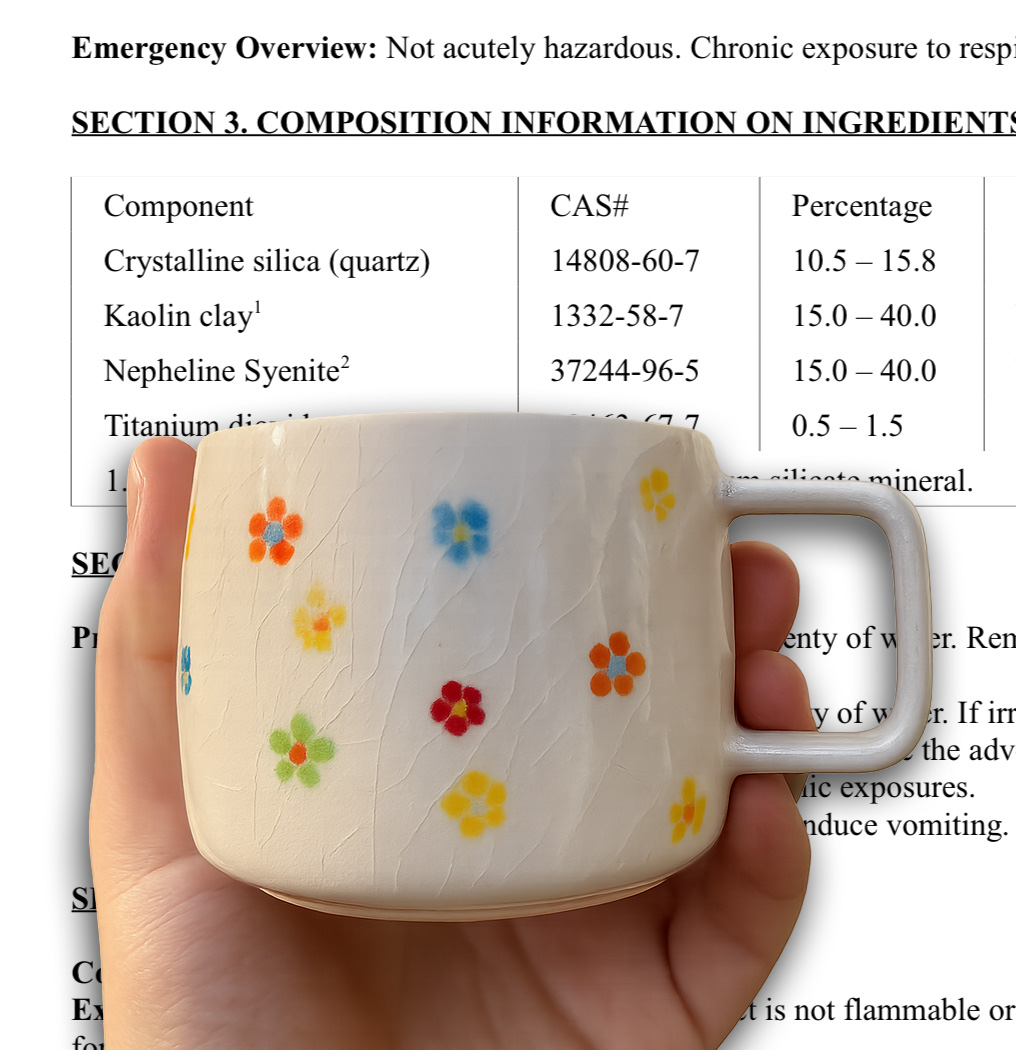
Generated with a prompt for a crazed glaze on a slip cast mug AI Policy
Related Pictures
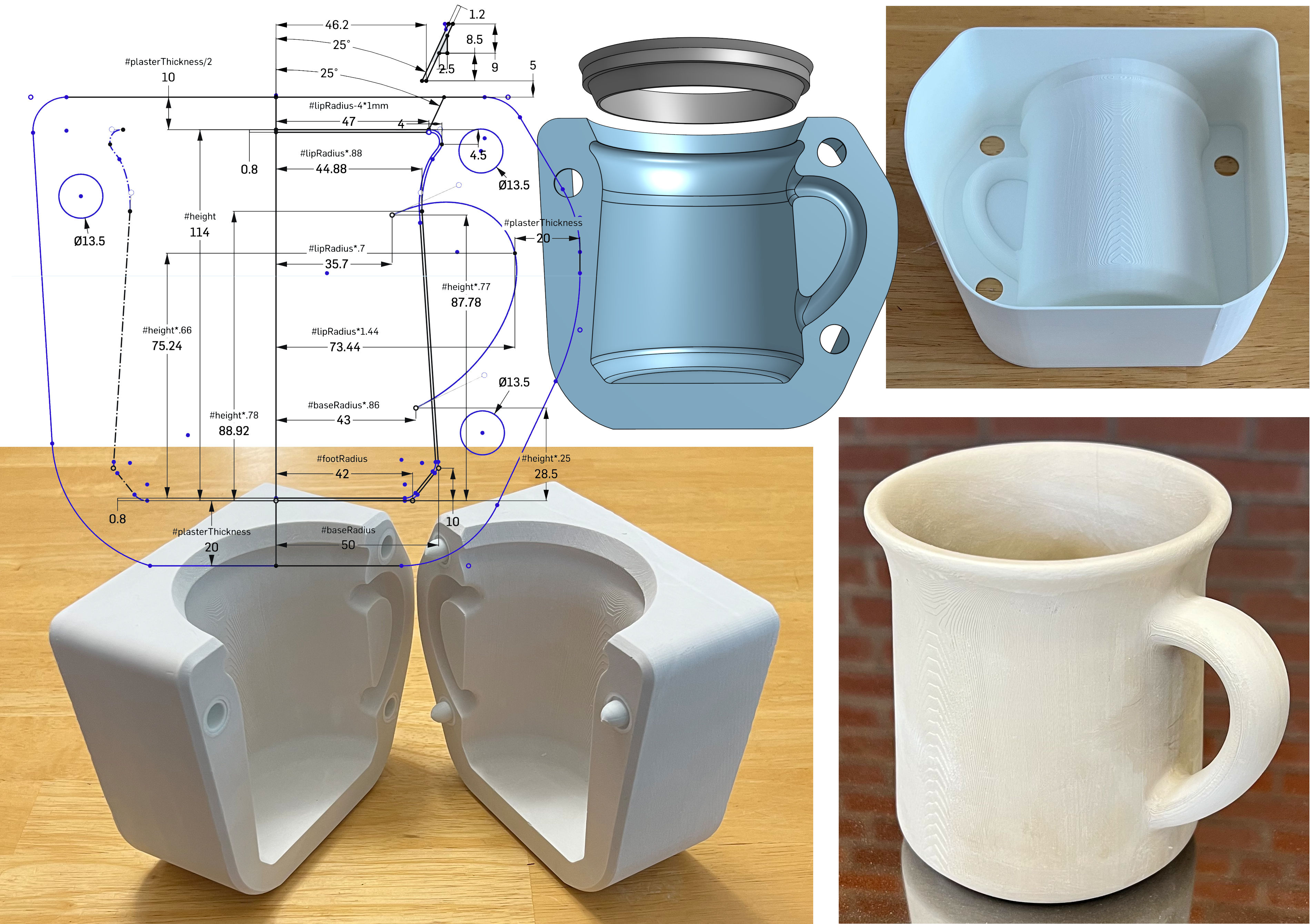
v3 Shelled AI Mug Using OnShape CAD
A great on-ramp to learning slip casting
Available on the Downloads page
This picture has its own page with more detail, click here to see it.
Follow the video, step-by-step, to create this yourself. Don’t expect perfection the first pour, we did this dozens of times to get to this point. You’ll still make a few mistakes before getting it right, that is what DIY is about.
This design differs from the v2 drawing in that the plaster pouring cavity is formed by shelling (hollowing) the back side (top right). And this is designed for removal using a heat gun. This method has several advantages:
-No sketch offset or extrusion was needed to make the outer wall.
-Because the first 3D action is to extrude everything as one solid mass, corners of the outer 3D perimeter can be chamfered (but don’t do it so much that that there is insufficient thickness for the natches).
-The mug's geometry (offset inward by 0.8mm) is revolved, swept and bevelled by cutting into the block. Shelling to the same 0.8mm wall thickness, from the backside of the block, produces the cavity needed (top right).
-The last steps, after shelling, are chamfering the outside inner corner, cutting the holes for the natches and revolving the pouring spout (as a separate body).
-Our v3 natch system continues to work well with this (lower left).
-Printing artifacts are not a problem for prototype molds (visible op right). Production is asking me to enhance these (a freshly cast mug is shown lower right).
-The plaster mold is of stunning quality (the PLA 3D print was softened using a heat gun and carefully removed using needle-nose pliers).
-Slip cast mugs most often have poor-quality and oval lips. This one stays round because of the outward flare and the quality is better because the 3D printed pouring spout also acts as a cutting guide at the pre-removal stage.
-The PLA pouring spout is deep and absorbs no water. Thus, the slip level does not need to be topped up during casting, the slip surface stays flatter (not developing a bowl shape) so pour-out time can be accurately gauged by its slip level.
There are many casting body recipes that would work with this. DIY CAD skills will enable you to follow me into another exciting world: Low-cost 3D printing of the clay itself! Coming soon.
Another reason for DIY casting bodies and glazes:
Glaze fit

This picture has its own page with more detail, click here to see it.
These are four different cone 6 commercial glazes made by popular US manufacturers. The body is a cone 6 casting porcelain made by another. All are crazing! This is common. Producer A's glazes fit Producer A's bodies. But not Producer B's. The transparency makes this common issue visible here. But many potters are selling crazed ware. Or ware that will craze over time. Assuming you are not one of them - which company is at fault? Neither. Neither can assure that its product fits those of others.
Mid-fire porcelains commonly craze glazes if they lack sufficient silica (20% is a typical minimum) or don't vitrify. Unfortunately, recipes are proprietary. Wait a minute - these recipes are well-known. You already have a propeller mixer and scale; why not make a DIY porcelain (e.g. L3778D or derivative)? And, why not mix your own transparent brushing glaze or dipping glaze (e.g. G2926B recipe; it has lots of documentation and can be adjusted to deal with fit issues on any clay body)?
 PayPal | No tracking, No ads, No paywall, No transient content! Just organized, concise information constantly updated and improved. Was this helpful? Consider supporting me. |
Got a Question?
Buy me a coffee and we can talk 

https://digitalfire.com, All Rights Reserved
Privacy Policy