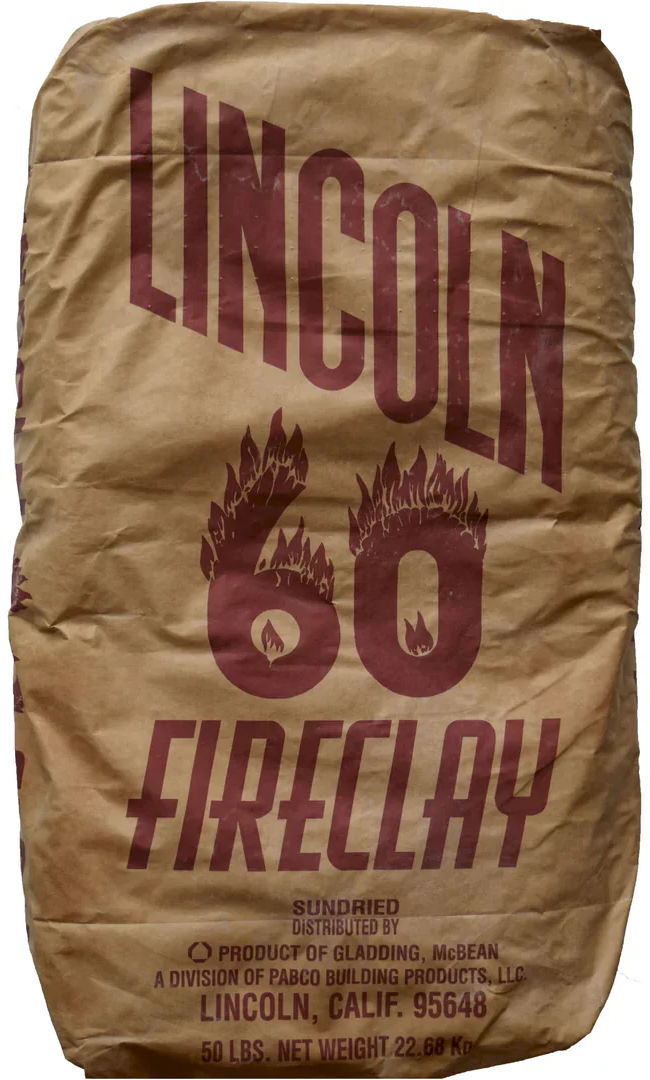
Lincoln 60 Fireclay bag
I stole this off a website so don't publish it
Related Pictures
Is Lincoln 60 really a fireclay? Simple physical testing says...

This picture has its own page with more detail, click here to see it.
Materials are not always what their name suggests. These are Lincoln #60 Fireclay test bars fired at cone 10 reduction (top) and from cone 11 down to 6 oxidation (top to bottom). This clay already has stoneware density at cone 7 (3% porosity as indicated by our SHAB test). It vitrifies progressively from there upward (less than 3% porosity at cone 7 to near zero% by cone 9 oxidation. Maximum firing shrinkage happens at cone 8 and by cone 10 it is expanding (indicating decomposition has started) and it is bloating by cone 11 (melting is sealing the escape of gases of decomposition). Is Lincoln #60 a really fireclay? Absolutely not! But at cone 6 it is a credible plastic stoneware, all by itself!
Links
| Materials |
Lincoln 60 Fireclay
It was first used in the late 1800s by Gladding McBean to make sewer pipe, subsequently for a wide range of architectural purposes. Since then, for pottery. |
 PayPal | No tracking, No ads, No paywall, No transient content! Just organized, concise information constantly updated and improved. Was this helpful? Consider supporting me. |
Got a Question?
Buy me a coffee and we can talk 

https://digitalfire.com, All Rights Reserved
Privacy Policy