Clay is dirt. Glaze is powdered rock and glass.
Why do they cost so much? DIY is the answer.
Historically, pottery has been a shining star of resilience and independence because the materials were in the ground nearby. So why are they coming thousands of miles in shipping containers? Because you can't just head out to the nearest hill with your wheelbarrow. But you are not helpless either.
Rather than viewing these containers as full of specific brand-name clays, minerals and man-made powders, it is better to view them as full of materials that supply the physical properties and chemistries needed to make bodies, glazes, engobes, slips, etc. By characterizing your glazes and bodies, using an effective record-keeping system, you can not only adjust recipes to adapt to changing supplies, but even improve them in the process (adjusting glaze thermal expansion, temperature, surface, color, etc). Or, use materials native to your area. It is not rocket science; it is just work and gradual learning accompanied by organized record-keeping, good labelling and interpretation skills.

Related Pictures
Supply chain crises hit commercial glazes first.
Cope better by knowing DIY glaze mixing.
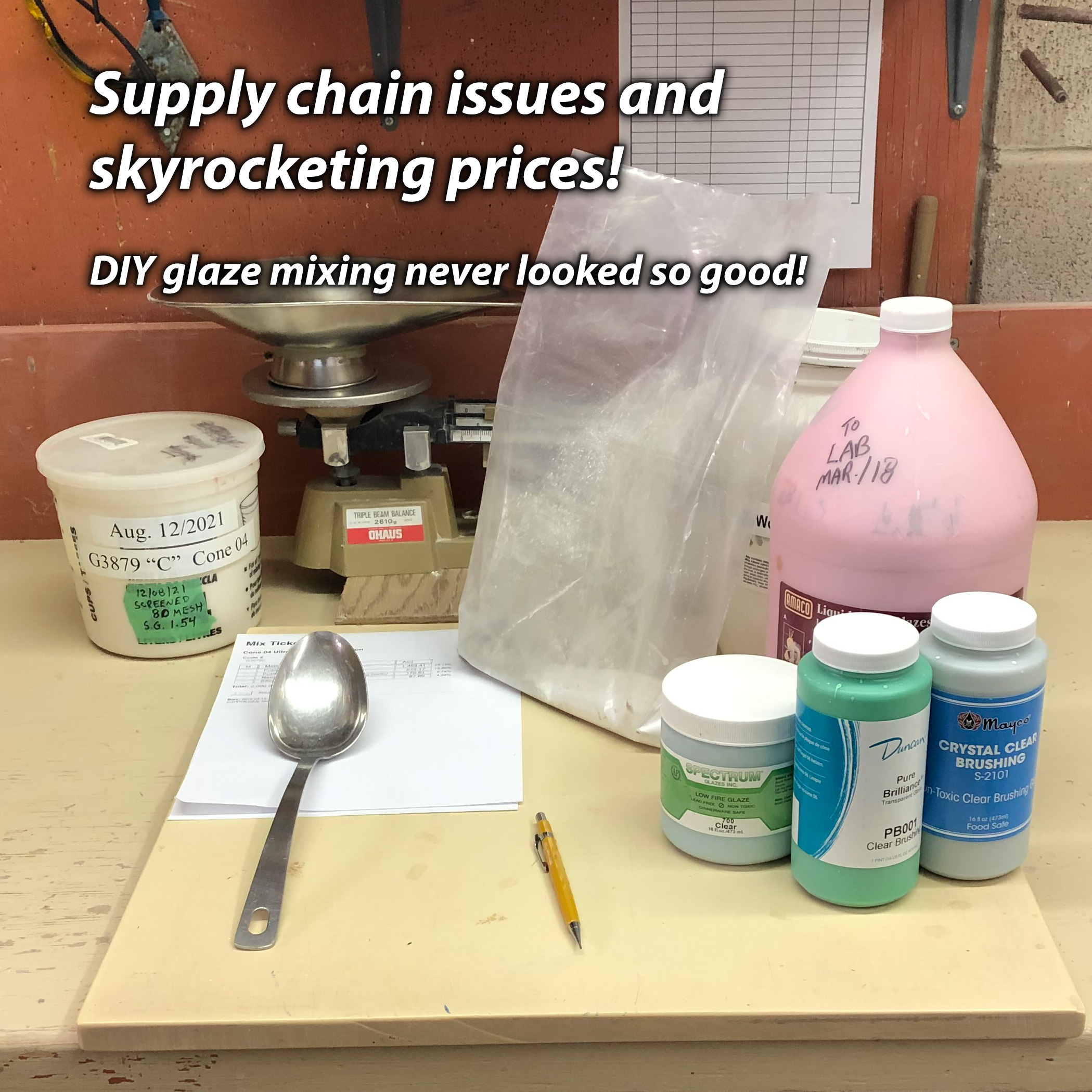
This picture has its own page with more detail, click here to see it.
As potters, we learned that no one is affected by supply chain problems more than prepared glaze manufacturers; they have complex recipes that require complex supply chains. It wasn't just availability; product consistency was also affected. It is again time to think about DIY, to start learning how to weigh out the ingredients to make at least some of your own. Arm yourself with good base recipes that fit your clay bodies (without crazing or shivering). Add stains, opacifiers and variegators to the bases to make anything you want. Admittedly, ingredients in your recipes can also become unavailable! But DIY is about options. When you "understand" glaze ingredients and what each contributes to the recipe and oxide chemistry, you are equipped to go well beyond weathering material supply issues. You will improve recipes, not just adjust them, to accommodate alternative materials. It is not rocket science; it is just work accompanied by organized record-keeping and good labelling.
Rising prices are putting potters at a crossroads:
DIY and documented testing are your insurance
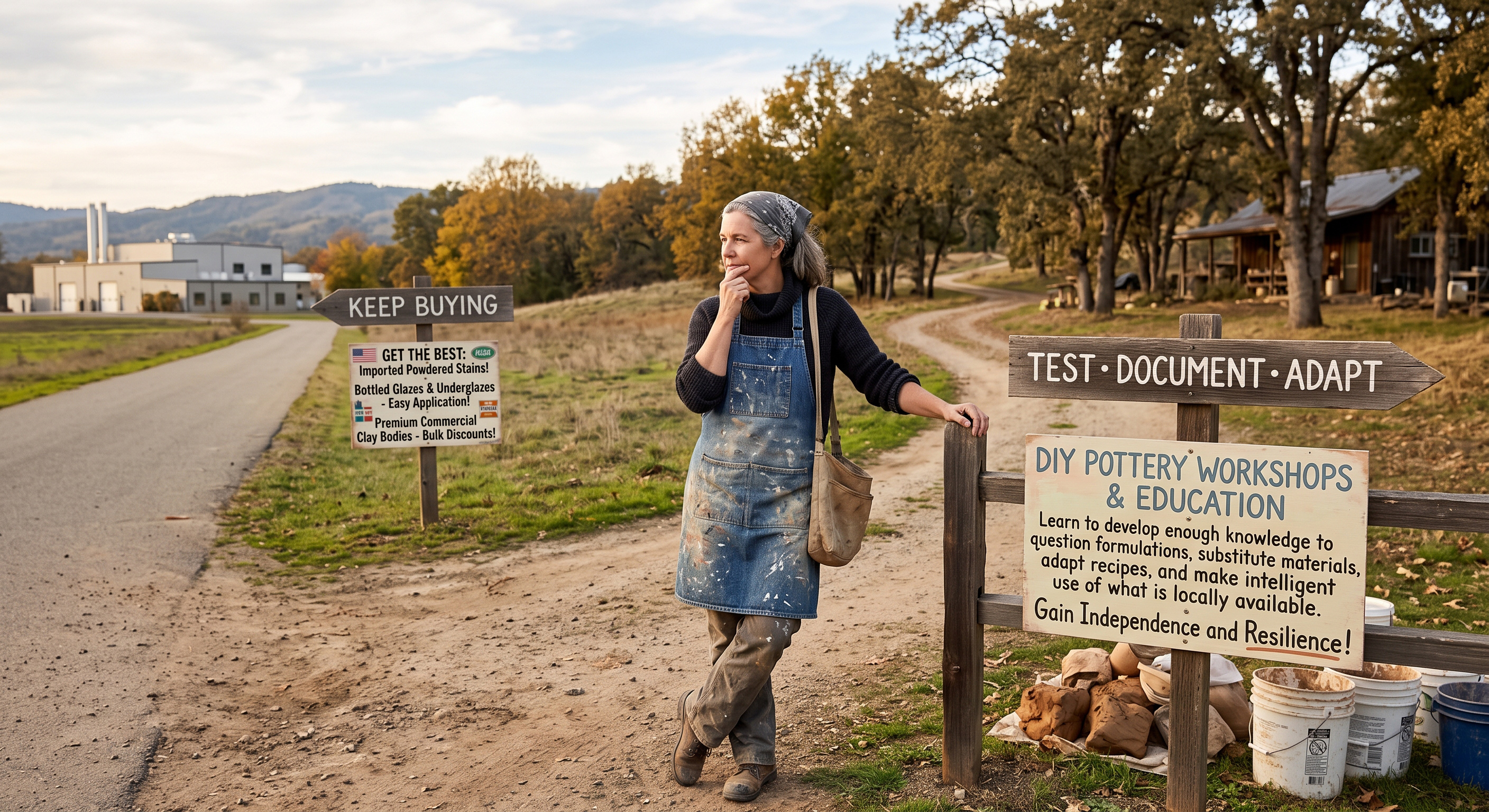 Generated at Gemini by submitting the text of this post AI Policy
This picture has its own page with more detail, click here to see it.
The ceramic materials we depend on are no longer commodities we can assume will always be cheap and available. Lithium materials can suddenly multiply in price. Cobalt colorants can double. A familiar plaster can disappear. Zircon and stains can jump with global mineral markets. Products made from these (e.g. glazes, underglazes) follow suit. And freight can make even inexpensive clay expensive.
The answer is not to stockpile everything—it is to learn how to adapt. A potter who tests, documents and understands materials can reduce cobalt, replace lithium, qualify a new plaster, reformulate around a discontinued feldspar, make better use of a local clay, and even make his/her own glaze and underglaze. Accumulated knowledge from ongoing testing becomes insulation against both inflation and disruption. Think of your test records as a savings account. Every melt test, firing schedule, recipe adjustment, clay test and photograph is a small deposit. When supply problems or price increases arrive, years of organized observations suddenly become very valuable, giving your choices and options others don't have.
Make your own vibrating sieve
And process your own super-fine clays

This picture has its own page with more detail, click here to see it.
Being more independent is now cool again. Actually, it is being forced upon us by necessity because of supply chain issues and skyrocketing prices of convenience glazes, bodies, engobes, etc. Independence involves using sieves. True, it is no problem for a potter or lab tech to manually coax a glaze slurry through a small 80# sieve. But real independence is about sieving in volume - clay bodies made from your own native clays. And doing it at up to 325 mesh. That requires a vibrating sieve. This one cost us less than $100 to make. Of course, a Tyler sieve (or similar) is needed, these can be purchased on Ebay or Amazon. And a vibration motor, some metal and hardware and a friend with metal fabrication tools. This demonstrates the utility of a vibrating sieve, the idea can be scaled to any size you need. As an example, oil well drilling sites here have to remove particulates from huge volumes of drilling mud and they do it on giant multi-level units.
The glaze cost on this mug is three times the cost of the clay!

This picture has its own page with more detail, click here to see it.
This jar of low-temperature clear glaze will do seven of these Plainsman Snow mugs, which works out to almost $3/mug! Four coats are required; it is watery, so they go on thin. This is a thin-walled piece, so the whole thing waterlogs with each coat. And it takes me an entire morning of repeatedly applying coats and heating to dry each of them out.
There are two obvious choices for a more economical and faster method: Make my own high SG brushing glaze and do it in two coats. Or heat the piece once to ~250F and quickly immerse it in a dipping glaze and be done in 5 seconds! My G3879 or G1916Q recipe families are a good starting point for both options.
Videos
| Media |
Substitute Ferro Frit 3134 For Another Frit
I use my Insight-live account to do the glaze chemistry to replace Ferro frit 3134 with combinations of three other common Ferro frits. We will see the challenges of doing this in three different types of recipes. |
Links
| Articles |
Where do I start in understanding glazes?
Break your addiction to online recipes that don't work or bottled expensive glazes that you could DIY. Learn why glazes fire as they do. Why each material is used. How to create perfect dipping and brushing properties. Even some chemistry. |
| Articles |
Glaze Recipes: Formulate and Make Your Own Instead
The only way you will ever get the glaze you really need is to formulate your own. The longer you stay on the glaze recipe treadmill the more time you waste. |
| Articles |
Formulating a Porcelain
The principles behind formulating a porcelain are quite simple. You just need to know the purpose of each material, a starting recipe and a testing regimen. |
| Articles |
Ceramic Tile Clay Body Formulation
An overview of the technical challenges a technician in the tile industry faces in making good tiles from the least expensive materials and process possible. |
| URLs |
https://digitalfire.com/4sight/material/index.html
Digitalfire Reference Database This is the traditional ceramics reference website that couples with your account at insight-live.com. |
 PayPal | No tracking, No ads, No paywall, No transient content! Just organized, concise information constantly updated and improved. Was this helpful? Consider supporting me. |
Got a Question?
Buy me a coffee and we can talk 

https://digitalfire.com, All Rights Reserved
Privacy Policy