Body is firing with less maturity. How did we fix it?
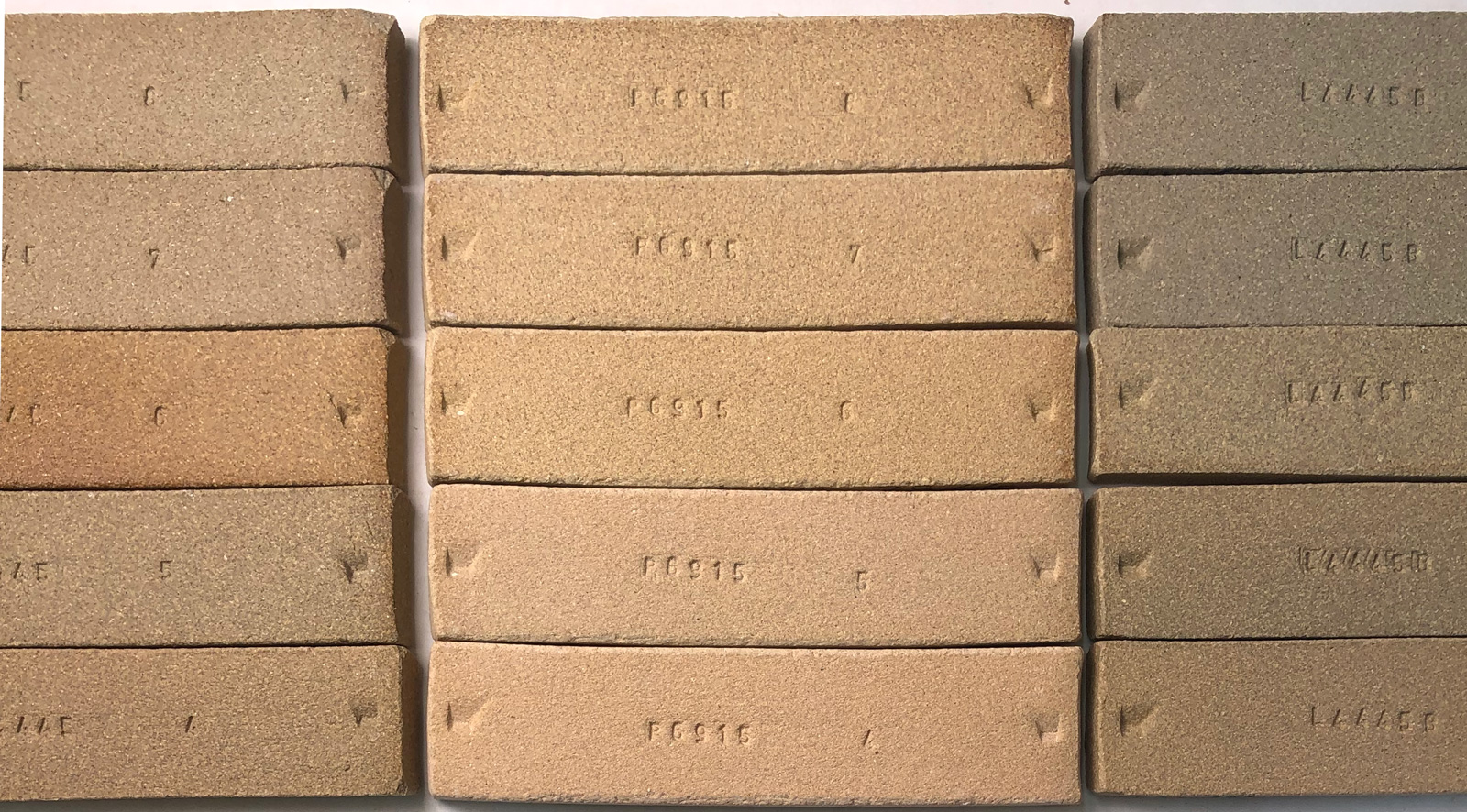
The centre set of test bars shows Plainsman F-95, a cone 6 sandy coloured stoneware, fired from cone 8 down to cone 4. Because of a change in a low-fire red clay in the recipe, it has become much more refractory (10%+ porosity at cone 6 instead of the normal 4-5%). We had made hundreds of boxes for a custom order (for these we are unable to exercise the same diligence in testing). Two approaches were tried to make it fire more dense. For the left set of bars, we prepared some plastic Gerstley Borate (it exhibits workability like a clay) and wedged that with the F-95 in a ratio of 5:95 (by weight). This greatly improved maturity and color, bringing cone 6 porosity down to 6.5% (this is still too high; likely 7% would be needed). For the right set of bars, we wedged in Plainsman L210 in a ratio of 15:85. That lowered the cone 6 porosity (water absorption) to 2.7%, too far (also darkening the color). So it appears that a 10:90 mix should be about right.
Links
| Glossary |
Vitrification
A process that happens in a kiln, the heat and atmosphere mature and develop the clay body until it reaches a density sufficient to impart the level of strength and durability required for the intended purpose. Most often this state is reached near zero p |
 PayPal | No tracking, No ads, No paywall, No transient content! Just organized, concise information constantly updated and improved. Was this helpful? Consider supporting me. |
Got a Question?
Buy me a coffee and we can talk 

https://digitalfire.com, All Rights Reserved
Privacy Policy