Joining rules are different
When clay is soft and plastic
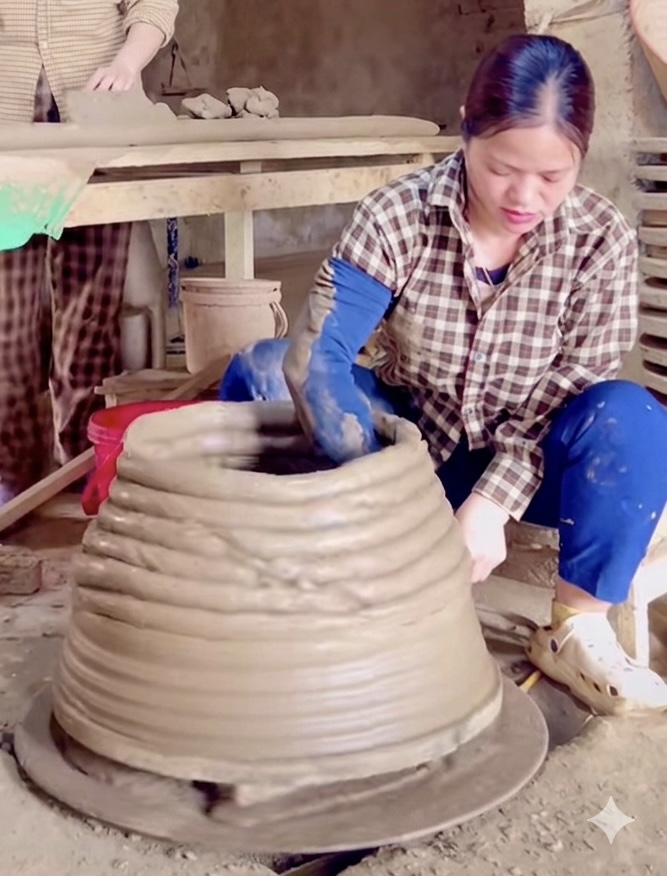
This woman has quickly laid coils of smooth plastic clay on top of each other, in a conical shape. Then she simply begins throwing, centering, compressing and even verticaling the walls on the first pull. Since joining stiffer grogged clay elements, as done in typical hand-building, can be a time-consuming, elaborate process, how can this potter just ignore that?
-The clay is very soft, but very plastic (evident in how the coils are rolled, how the potter dangles the coils like a rope, yet they don’t break, and that she can make such large pieces).
-The coils are rolled on a wet table by a helper, then laid in place while still slip-covered and sticky (it glues them together on contact).
-The piece being made is large and the walls are thick. Asian potters are not averse to doing alot of trimming to thin them later.
-The mere act of applying pressure and thinning the wall also joins the coils.
Watch her do this on the Instagram video link on the home page for this post.
Related Pictures
Tandoor Oven making:
How is this possible without drying cracks?

This picture has its own page with more detail, click here to see it.
A potter would press clay into a plaster mold to do this. But the hand building techniques these workers use appear to be impossible. Consider:
-Clay shrinks when it dries. When it dries unevenly, it shrinks unevenly. The rim on these should dry and become rigid long before the base. Drying cracks should occur partway down the wall as the base tries to shrink against the already-dry rim. Why does this not happen?
-Dried clay turns back into mud if it gets wet. Why don't these disintegrate in the rain?
-Wouldn't the clay need to be plastic to do what the craftsmen do? Clays having typical pottery plasticity shrink 6%. The friction and drag on the ground, as they dry, should cause cracks. Or at least pull them to an oval shape. Why does this not happen?
-Wet clay cannot be joined to dry clay. How are they doing this?
-How much does the straw addition reduce shrinkage? Even if the straw could cut shrinkage to 3%, that is still 1 inch on a 30 in diameter base.
It appears the answer is that they likely do pull oval. And they don't use a plastic clay, they use a low-plasticity clay-containing grogged paste held together with fiber, achieving minimal shrinkage and sufficient strength.
The incredible plasticity of bentonite.
It is the secret to win the ThrowDown!

This picture has its own page with more detail, click here to see it.
The 20cm vase on the left is thrown from what I thought was a very plastic body, M370. I achieved close to the same thickness top-to-bottom (5mm). The one on the right was the same original height, 20cm. But it has dried down to only 18cm high, it shrinks 14% (vs. 6% for the other). The thinnest part of the wall is near the bottom, only 2mm thick! How is it possible to throw that thin? The body is 50% ball clay and 50% bentonite. Bentonite, by itself, cannot be mixed with water, but dry-blended with fine-particled ball clay it can. That bentonite is what produces this magic plasticity. But it comes at a cost. It took about four days to dewater the slurry on our plaster table. And one month under cloth and plastic to dry it without cracks.
Links
| URLs |
https://www.instagram.com/reel/DXk0OgxipU6
Video: Throwing a large coil-formed vessel The potter has not joined the coils, they are simply laid one atop the other and the throwing stage is begun immediately. |
| Glossary |
Clay Stiffness
In ceramics, clays exhibit plasticity in accordance with their recipe but also the water content. Each types of forming method has an ideal combination of stiffness and plasticity. |
| Glossary | Hand Building Techniques |
| Glossary |
Plasticity
Plasticity (in ceramics) is a property exhibited by soft clay. Force exerted effects a change in shape and the clay exhibits no tendency to return to the old shape. Elasticity is the opposite. |
 PayPal | No tracking, No ads, No paywall, No transient content! Just organized, concise information constantly updated and improved. Was this helpful? Consider supporting me. |
Got a Question?
Buy me a coffee and we can talk 

https://digitalfire.com, All Rights Reserved
Privacy Policy