Measure specific gravity using a scale and measuring cup
The specific gravity of a suspension is simply its weight compared to water (water weighs 1g per cc). For example, different glazes optimize to different specific gravities (e.g. 1.45 is typical for stoneware glazes). Casting slips typically have specific gravities of 1.75-1.8. This plastic measuring cup accommodates 500g. I have already counter-weighed it on our 0.1g scale and filled it with 500 grams of water to verify the accuracy of the 500g marking (mark the correct level with a felt pen or sticker if needed). Now, I am filling the cup with the slurry to the same level. The specific gravity will be that weight divided by 500.

Related Pictures
Are cheap plastic graduated cylinders useful?
Yes, you can calibrate them yourself.
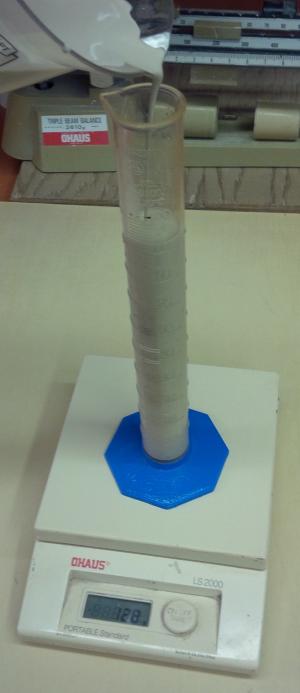
This picture has its own page with more detail, click here to see it.
Graduated cylinders like this are inexpensive (e.g. Amazon.com). Of course, these cheap plastic ones are not accurate. But, there is one factor that makes them useful: They are light and can thus be used to measure specific gravity on a 200g scale. There is a way to make these accurate enough for a potter: Calibrate them by checking with 100g and 50g of water, just mark the levels using a Sharpie.
Specific gravity using a scale and graduated cylinder:
It doesn't matter how high you fill it

This picture has its own page with more detail, click here to see it.
In this case, I just need an approximate measure. So I counterbalance a graduated cylinder on a 0.01g scale and pour in some slurry. Fill it to any level that does not exceed the weight the scale can handle. Divide the weight by the volume. In this case, it weighs 60.6g and the volume is 41. That calculates to about 1.47 specific gravity. The higher it is filled, the higher the quality of the graduated cylinder and the better you are at reading the level, the more accurate the measurement will be. After adding more water to this glaze, I will measure again, filling it to near the 100cc level. I have to use a plastic cylinder because our glass one is too heavy for this scale to handle (its max is 200g).
Links
| Tests |
Glaze Observations
|
| Articles |
Understanding the Deflocculation Process in Slip Casting
Understanding the magic of deflocculation and how to measure specific gravity and viscosity, and how to interpret the results of these tests to adjust the slip, these are the key to controlling a casting process. |
| Glossary |
Specific gravity
In ceramics, the specific gravity of slurries tells us their water-to-solids ratio. That ratio is a key indicator of performance and enabler of consistency. |
| Glossary |
Deflocculation
Deflocculation is the magic behind the ceramic casting process, it enables slurries having impossibly low water contents and ware having amazingly low drying shrinkage |
| Glossary |
Thixotropy
Thixotropy is a property of ceramic slurries of high water content. Thixotropic suspensions flow when moving but gel after sitting (for a few moments more depending on application). This phenomenon is helpful in getting even, drip-free glaze coverage. |
 PayPal | No tracking, No ads, No paywall, No transient content! Just organized, concise information constantly updated and improved. Was this helpful? Consider supporting me. |
Got a Question?
Buy me a coffee and we can talk 

https://digitalfire.com, All Rights Reserved
Privacy Policy