Kaolin and ball clay:
Why the uncracked disk is not the whole story
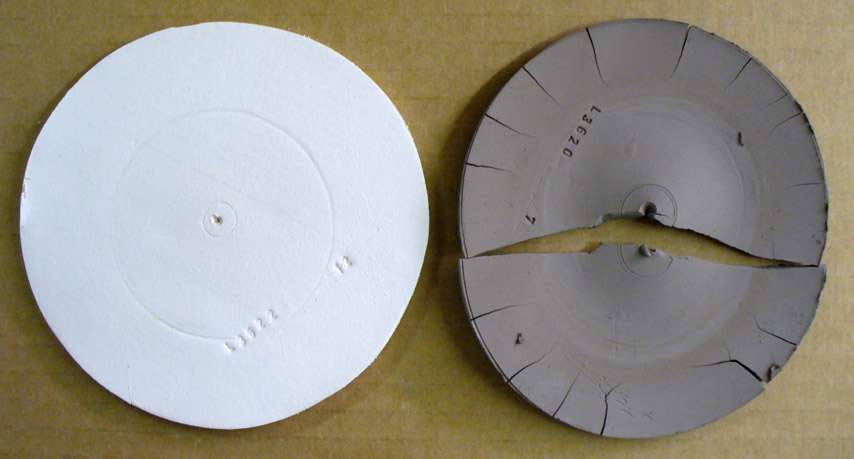
Left: OptiKast, a coarse-particle kaolin intended for slip-casting. Right: Plainsman A2 ball clay. These DFAC drying performance disks were dried with their centers covered, deliberately creating uneven drying. The exposed perimeter dries and stiffens first; the covered center dries and shrinks later. The resulting cracks reveal how each clay responds to that stress. OptiKast feels smoother, yet its individual clay particles are much coarser than those typical of ball clay. This kaolin has low drying shrinkage, so its disk remained intact. The ball clay shrinks more. As its center dried and tried to contract against the already stiff perimeter, stresses developed, splitting the disk and opening numerous cracks around the edge.
So why use ball clay? This particular kaolin has so little plasticity that even making this disk was difficult. And the dried disk is fragile. Yet it is very useful in casting bodies, where plasticity impedes permeability. Ball clays are highly plastic; high drying shrinkage comes with that. Adding some of this to poor-plasticity casting or forming bodies that can tolerate a darker fired color can transform them into ones that both form well and dry harder and stronger.
Related Pictures
It dry shrinks much more yet cracks less. How is that possible?

This picture has its own page with more detail, click here to see it.
Two mugs have dried. The local terra cotta native clay on the left shrinks 7.5% on drying, the porcelain one on the right only 6% (it is made using Kentucky ball clay). Yet few pieces of the terra cotta are ever lost due to drying cracks, even if it is uneven! For example, in a batch of a dozen mugs none of these will be lost whereas one or two of the white ones will always crack. Why? Dry strength. The clay on the left is very strong in the dry state, likely double or triple the white clay (the strength is a by product of its high plasticity and particle size distribution profile). That strength is enough to more than counter the extra shrinkage.
Links
| Materials |
Kaolin
The purest of all clays in nature. Kaolins are used in porcelains and stonewares to impart whiteness, in glazes to supply Al2O3 and to suspend slurries. |
| Materials |
OptiKast Kaolin
|
| Materials |
Ball Clay
A fine particled highly plastic secondary clay used mainly to impart plasticity to clay and porcelain bodies and to suspend glaze, slips and engobe slurries. |
| Glossary |
Primary Clay
A clay deposit that is near the site of erosion and alteration. They have more mechanical impurities and fewer chemical and mineralogical impurities. Primary clays have larger particles and less plasticity. |
| Glossary |
Ultimate Particles
Utlimate particles of ceramic materials are finer than can be measured even on a 325 mesh screen. These particles are the key players in the physical presence of the material. |
| Glossary |
Casting Rate
Casting rate describes how quickly a layer of clay builds against the mold surface during slip casting and how quickly items release from molds and can be handled. |
| Minerals |
Ball Clay
Ball clay is the most common type of secondary clay. They are much more plastic than kaolin because |
| Tests |
Drying Factor
The DFAC Drying Factor test visually displays a plastic clay's response to very uneven drying. It is beneficial to show the relative drying performance of different clays. |
 PayPal | No tracking, No ads, No paywall, No transient content! Just organized, concise information constantly updated and improved. Was this helpful? Consider supporting me. |
Got a Question?
Buy me a coffee and we can talk 

https://digitalfire.com, All Rights Reserved
Privacy Policy