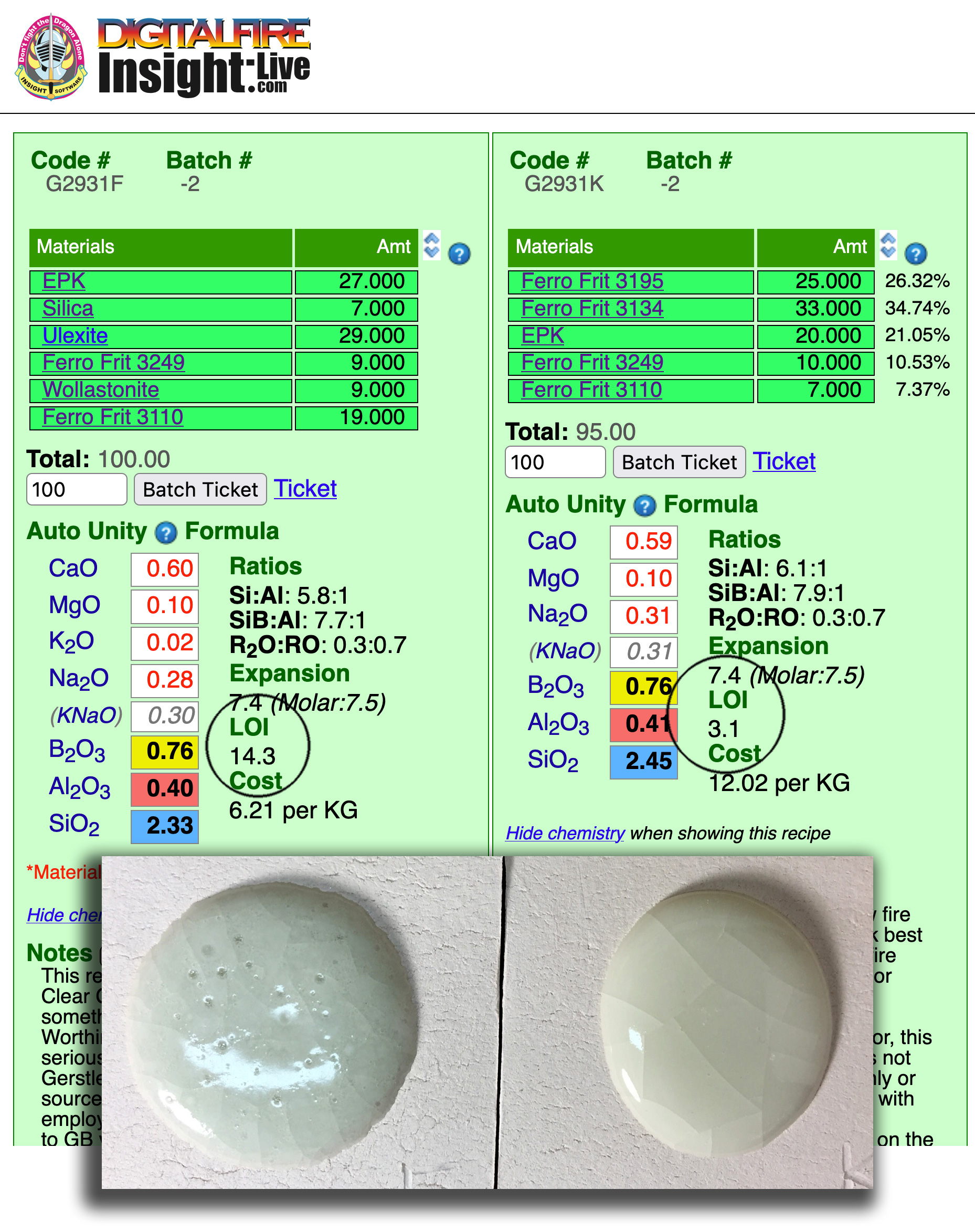
Same glaze chemistry, very different LOIs.
Look at the bubbles!
These two GBMF test balls were melted on refractory tiles to compare their melting behaviour. Their calculated oxide chemistries are almost identical, but their recipes are very different. G2931F (left) contains 29% Ulexite, driving its calculated LOI to 14.3%. G2931K (right) sources its boron from frits, reducing the LOI to just 3.1%. The difference is striking! The high-LOI glaze is full of large bubbles that were unable to escape or clear before the melt stiffened during cooling. Although ulexite releases most of its chemically bound water before significant glaze melting, that early gas evolution can contribute to foaming and trapped bubbles as melting progresses. The fritted glaze is much clearer, although it still contains fine bubbles. These may be associated with the kaolin or other sources of entrained gas.
The GBMF test exaggerates gas-retention behaviour, which is precisely why it is useful for comparing recipes, but it does not necessarily predict the appearance of a thin glaze layer on ware.
Links
| Typecodes |
Glaze Chemistry
Case studies where glaze chemistry was used to solve a problem. |
| Glossary |
LOI
Loss on Ignition is a number that appears on data sheets test results of ceramic materials and bodies. It refers to the amount of weight lost as it decomposes to release water vapor and various gases during firing. |
| Glossary |
Glaze Bubbles
Suspended micro-bubbles in ceramic glazes affect their transparency and depth. Sometimes they add to to aesthetics. Often not. What causes them and what to do to remove them. |
| Glossary |
Frit
Frits are used in ceramic glazes for a wide range of reasons. They are man-made glass powders of controlled chemistry with many advantages over raw materials. |
 PayPal | No tracking, No ads, No paywall, No transient content! Just organized, concise information constantly updated and improved. Was this helpful? Consider supporting me. |
Got a Question?
Buy me a coffee and we can talk 

https://digitalfire.com, All Rights Reserved
Privacy Policy