Tile having angular shape is cracking at vertexes
Cracks are happening during heatup (we know this because these have widened, cooling cracks are hairlines). Assuming the cracks were not there after drying, the piece likely could have been fired successfully by employing a slower heat-up. How to solve: Smooth, compress and round those sharp concave angles. This denies cracks a place to start. Even if the concave corners could have been rounded and compressed to a tiny radius (e.g. 2mm), it would likely have helped. And rounding and compressing the sharp edges would help (there are a couple of cracks on the straight sides).

Related Pictures
Tile stacking in an electric kiln - Fingers crossed!
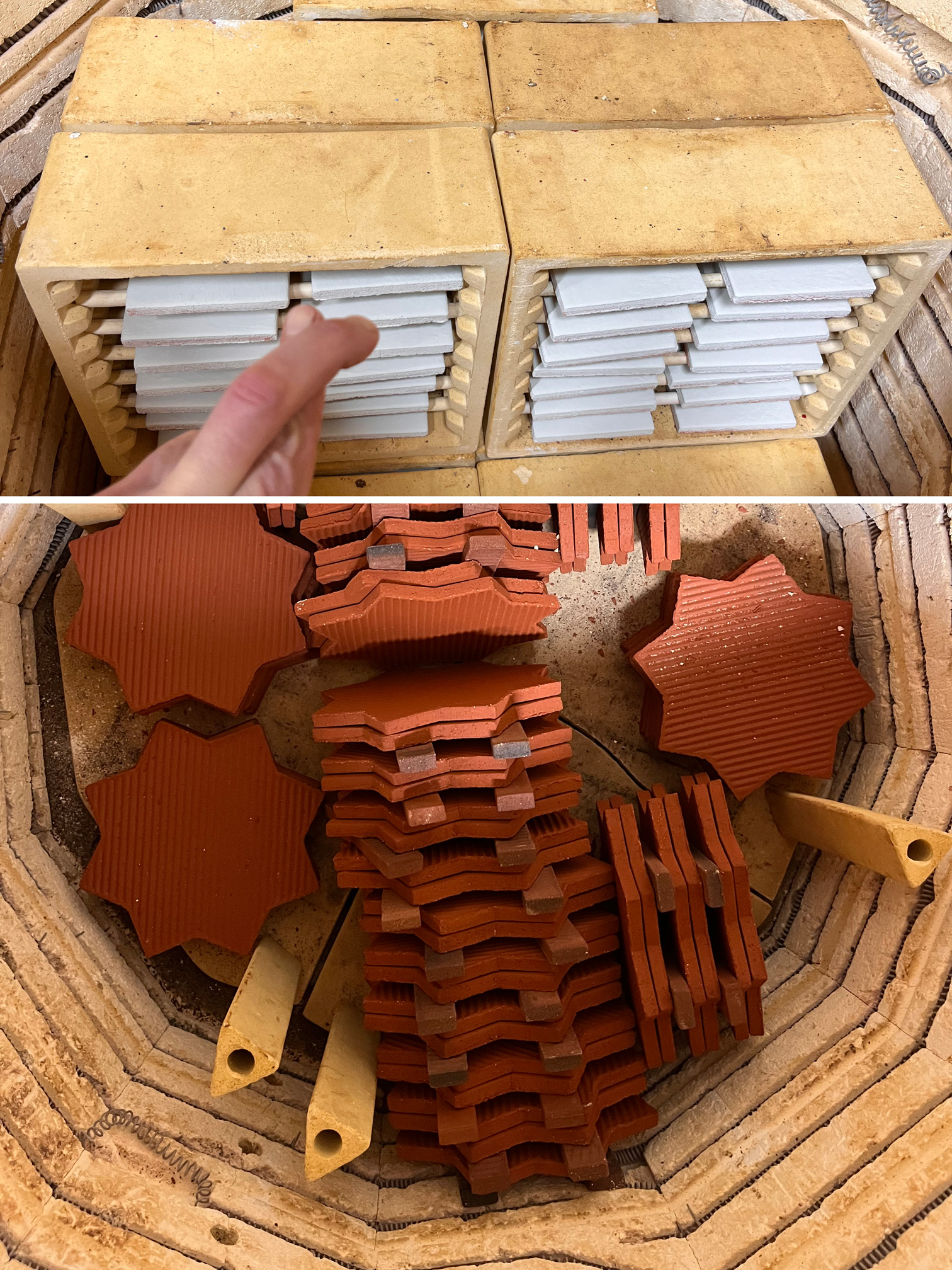
This picture has its own page with more detail, click here to see it.
Small-scale operations everywhere are making tile like this. Most use plastic clay intended for pottery, which introduces more drying shrinkage, complicating drying them flat. Stacking them in the kiln can be a game of chance. Stacked too tightly and they crack (mostly because of quartz inversion). Stacked to loosely and most of the energy goes into heating the shelves and stackers. Using a clay with minimal large quartz particles is the best way to avoid dunting, however that is also a balance since such clays are more difficult to fit glazes to (without crazing).
Links
| Troubles |
Dunting and Cracking of Clay Bodies During Firing
Ceramic industry can fire much faster and deal with much heavier objects than potters can, how do they do it. The answer is they pay more attention to the basics, it is all common sense and good equipment. |
 PayPal | No tracking, No ads, No paywall, No transient content! Just organized, concise information constantly updated and improved. Was this helpful? Consider supporting me. |
Got a Question?
Buy me a coffee and we can talk 

https://digitalfire.com, All Rights Reserved
Privacy Policy