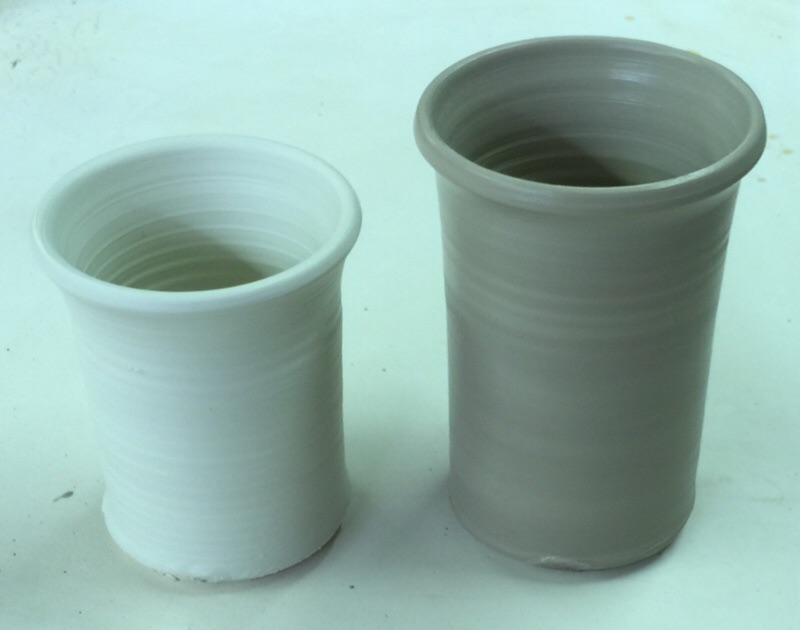
Thrown pieces of pure Grolleg and EPK:
This is how you compare kaolin plasticities
These have just been thrown on the wheel. I find it to be a foolproof method of comparing the plasticity of two clays. They were slurried up and dewatered to about the same moisture content and the same amount was thrown to compare the size achievable. While the Grolleg is stickier and dewaters a little slower, it is not as plastic as dark EPK (which itself is not that plastic compared to others). Curiously, New Zealand kaolin (halloysite) is quite a bit less plastic than the Grolleg but it responds to plasticity augmentation (in porcelain recipes) just as well as Grolleg (similar amounts of bentonite producing similar plasticities). And, bodies containing EPK also need about the same amount of bentonite to produce plasticity suitable for throwing large forms. So, the plasticity that a kaolin appears to have by itself is not completely indicative of what it will contribute to a body (if augmented with bentonite). The EPK used here is the darker and more plastic of the two varieties Plainsman receives.
Related Pictures
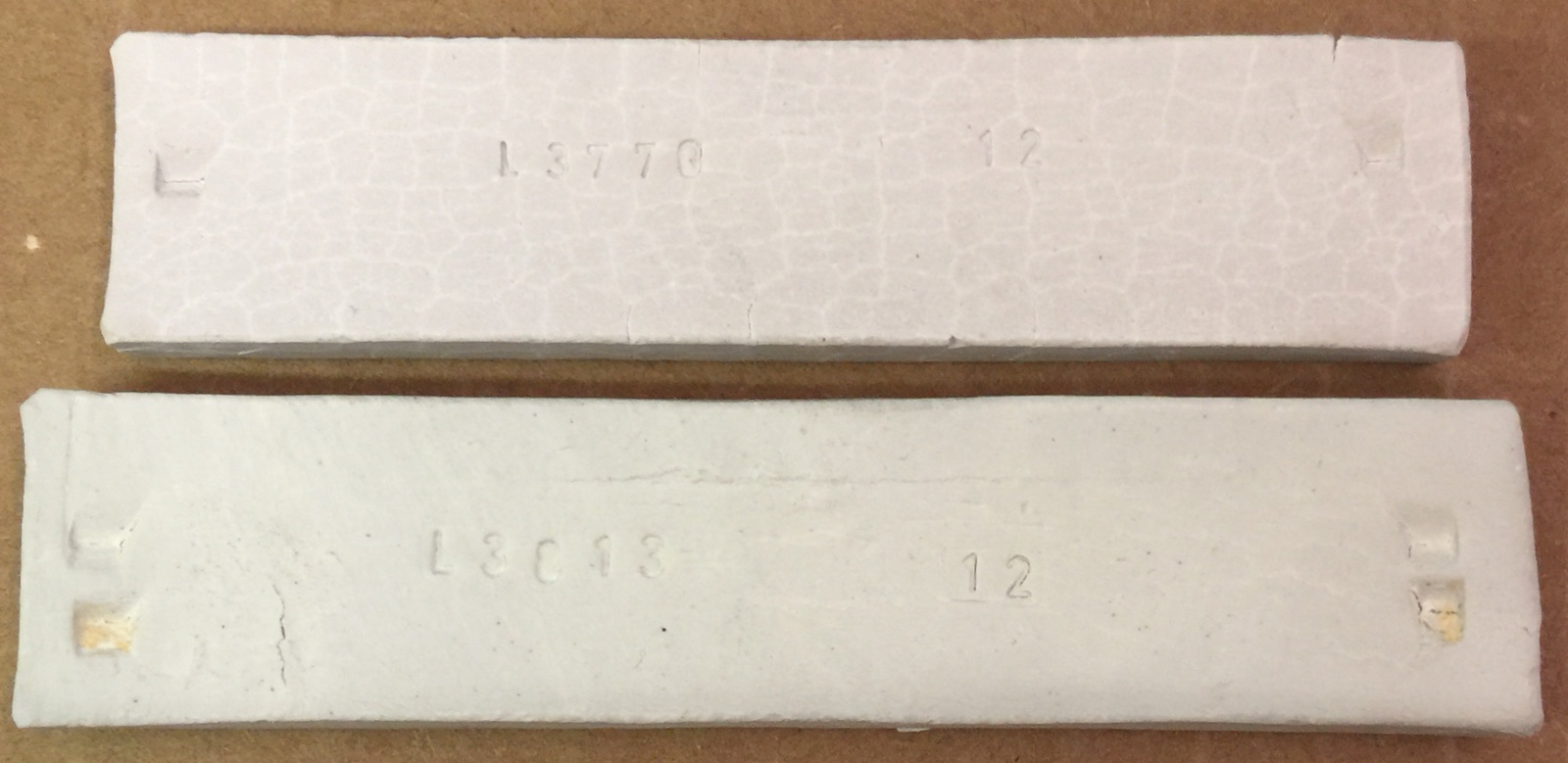
EPK fired bar (top) vs Grolleg kaolin at cone 10R. Why shrinking more?
This picture has its own page with more detail, click here to see it.
From these SHAB test bars EP kaolin appears to have a much higher fired shrinkage. But half of that happened during drying. Still, EPK shrinks 4% more during firing. Yet Grolleg produces more vitrified porcelains. The EPK bar also appears to be whiter. Yet in a porcelain body, Grolleg fires whiter. That higher drying shrinkage proves that EPK is much more plastic, right? Not really. Throwing porcelains containing either require plasticity augmentation using similar percentages of bentonite. What do we learn? To compare materials like this we need to see them "playing on the team", in a recipe working with other materials. Don't rely on material data sheets, do the testing in your recipes.
Links
| Materials |
Grolleg Kaolin
A white burning kaolin from the UK, commonly used in porcelain bodies and as a glaze suspender. Sticky when wet, low plasticity. |
| Materials |
New Zealand Halloysite
The whitest burning kaolin available to potters. Low plasticity. Very sticky when wet, suspends glazes well. |
| Materials |
EP Kaolin
A kaolin that gels slurries (good for suspending glazes). It has two variations: a low and medium plasticity. It fires white for use in porcelain bodies. |
 PayPal | No tracking, No ads, No paywall, No transient content! Just organized, concise information constantly updated and improved. Was this helpful? Consider supporting me. |
Got a Question?
Buy me a coffee and we can talk 

https://digitalfire.com, All Rights Reserved
Privacy Policy