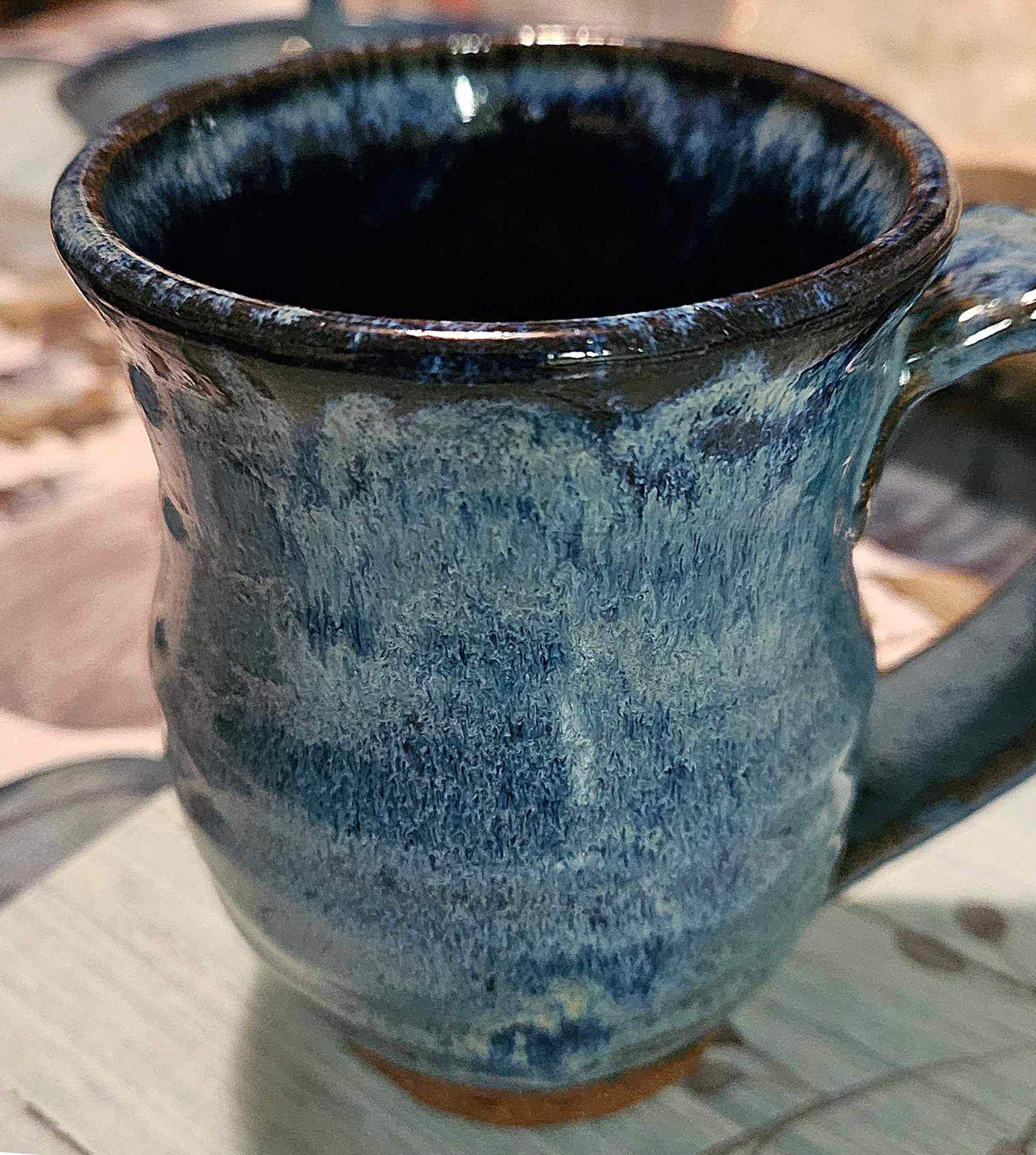
We made a floating blue
G4561
This is a 50:30:20 recipe.
Base recipe with additions. But that base comes with baggage.
Could the 4:2:1 addition work in other glazes?
Related Pictures
The popular Gerstley Borate 50:30:20 glaze:
Is the Gillespie Borate version any better?

This picture has its own page with more detail, click here to see it.
This recipe, G2826A, a base transparent recipe having 50% Gerstley Borate plus 20% kaolin, was used by generations of potters; it melted so well, yet without any frit. But, it was "jelly city". Although a low temperature base, this was much more commonly used at cone 5-6. This recipe, G2826A, was at the limit of the slurry properties that could be tolerated with this material. In this test, even with 2.5g of Darvan deflocculant in this jar, it was still thick enough to require pushing this tile down into it! It still needed 5 seconds to build up enough thickness. And did not cover the recesses properly. Yet people used this popular fluid-melt to get the surface variegation its high melt fluidity produced (because it was so high in boron). They added all manner of colorants and opacifiers and it generally performed without blistering. This was a "Dr. Jekyll and Mr. Hyde" of ceramic materials!
Potters are using Gillespie Borate in this recipe (with issues), see the G2826A2 recipe. Other approaches are to source the boron (B2O3) from a frit (or mix of frits). An example is G2826A1, it does not variegate as much, but adding titanium or rutile can emulate that. Another hybrid option is the G2826A3 that employs both Gillespie Borate, nepheline and talc.
Links
| Glossary |
Base Glaze
Understand your a glaze and learn how to adjust and improve it. Build others from that. We have bases for low, medium and high fire. |
| Glossary |
Rutile Blue Glazes
A type of ceramic glaze in which the surface variegates and crystallizes on cooling in the presence of titanium and iron (usually sourced by rutile) |
 PayPal | No tracking, No ads, No paywall, No transient content! Just organized, concise information constantly updated and improved. Was this helpful? Consider supporting me. |
Got a Question?
Buy me a coffee and we can talk 

https://digitalfire.com, All Rights Reserved
Privacy Policy