This surprised me about calcia matte glazes:
Most are highly melt fluid.
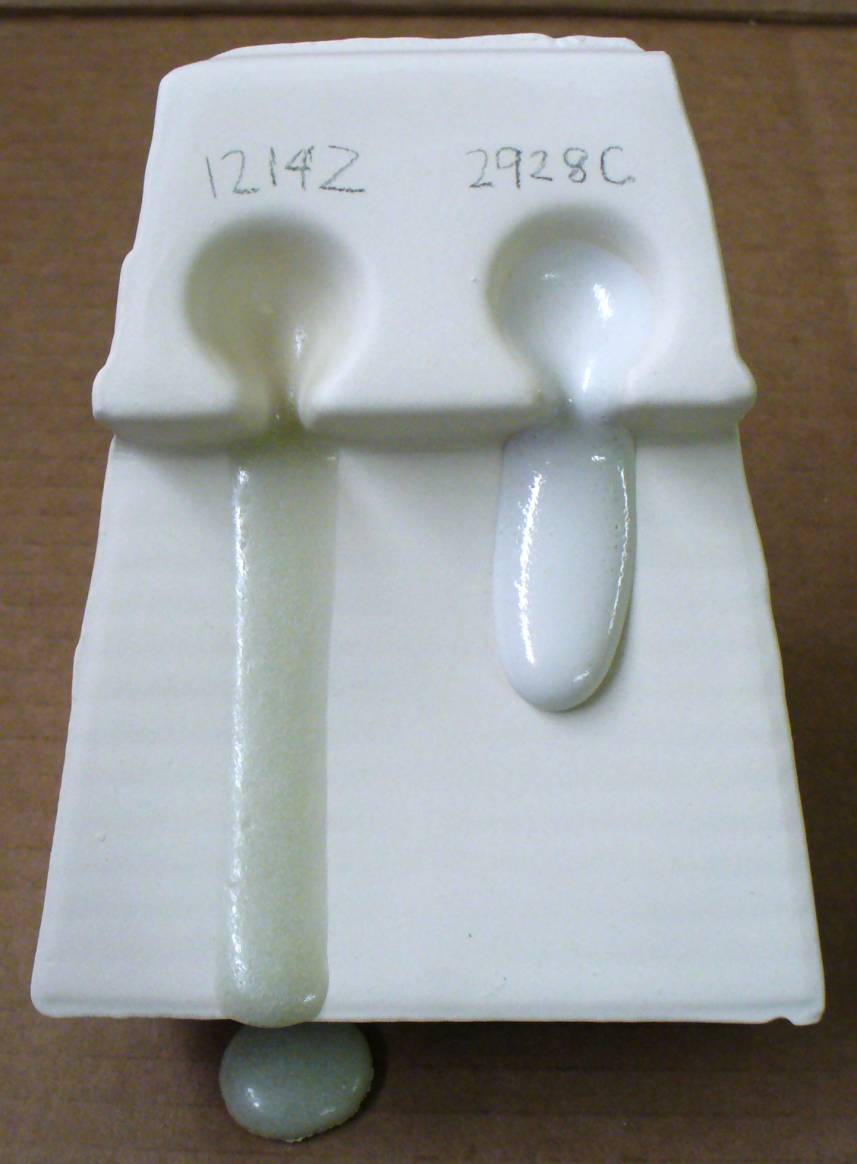
Unfortunately, many matte glazes are such simply because they are not melted enough. That is not the case with cone 6 G1214Z tested here. When applied as a thin layer on pottery, it seems normal. But this GLFL test demonstrates that it fires highly melt fluid, much more than one might expect from a matte glaze. A quick look at its oxide chemistry reveals the reason: It is a calcia matte. It has high CaO, so as the melt cools, it combines with SiO2 and even Al2O3 to form calcium silicate crystals (instead of staying in the glass).
What is the G2928C? That is Ravenscrag cone 6 Tri-Matte; it employs three matteness mechanisms: High CaO, MgO and Al2O3. It contains significant Tin Oxide (thus the white color).

Related Pictures
Calcia vs Magnesia matte - Different mechanisms
This picture has its own page with more detail, click here to see it.
This melt flow test was done at cone 6+ (without slow cooling) to demonstrate the difference in melt viscosity between a calcia matte (left G1214Z1) and a magnesia matte (right G2928C). In simplest terms, the former depends on a fluid melt to provide the needed mobility for tiny crystals to form during cooling, those crystals scatter the light and soften the surface to produce the matte effect. The latter requires a stiffer melt to help prevent levelling during cooling and host phase separation to produce a rippled surface that scatters light.
Links
| Recipes |
G1214Z1 - Cone 6 Silky CaO matte base glaze
This glaze was born as a demonstration of how to use chemistry to convert a glossy cone 6 glaze into a matte. |
| Recipes |
G2928C - Ravenscrag Silky Matte for Cone 6
Plainsman Cone 6 Ravenscrag Slip based glaze. It can be found among others at http://ravenscrag.com. |
 PayPal | No tracking, No ads, No paywall, No transient content! Just organized, concise information constantly updated and improved. Was this helpful? Consider supporting me. |
Got a Question?
Buy me a coffee and we can talk 

https://digitalfire.com, All Rights Reserved
Privacy Policy