Online Glaze Recipe Rescue:
Seeks good home for a magnesia matte blue
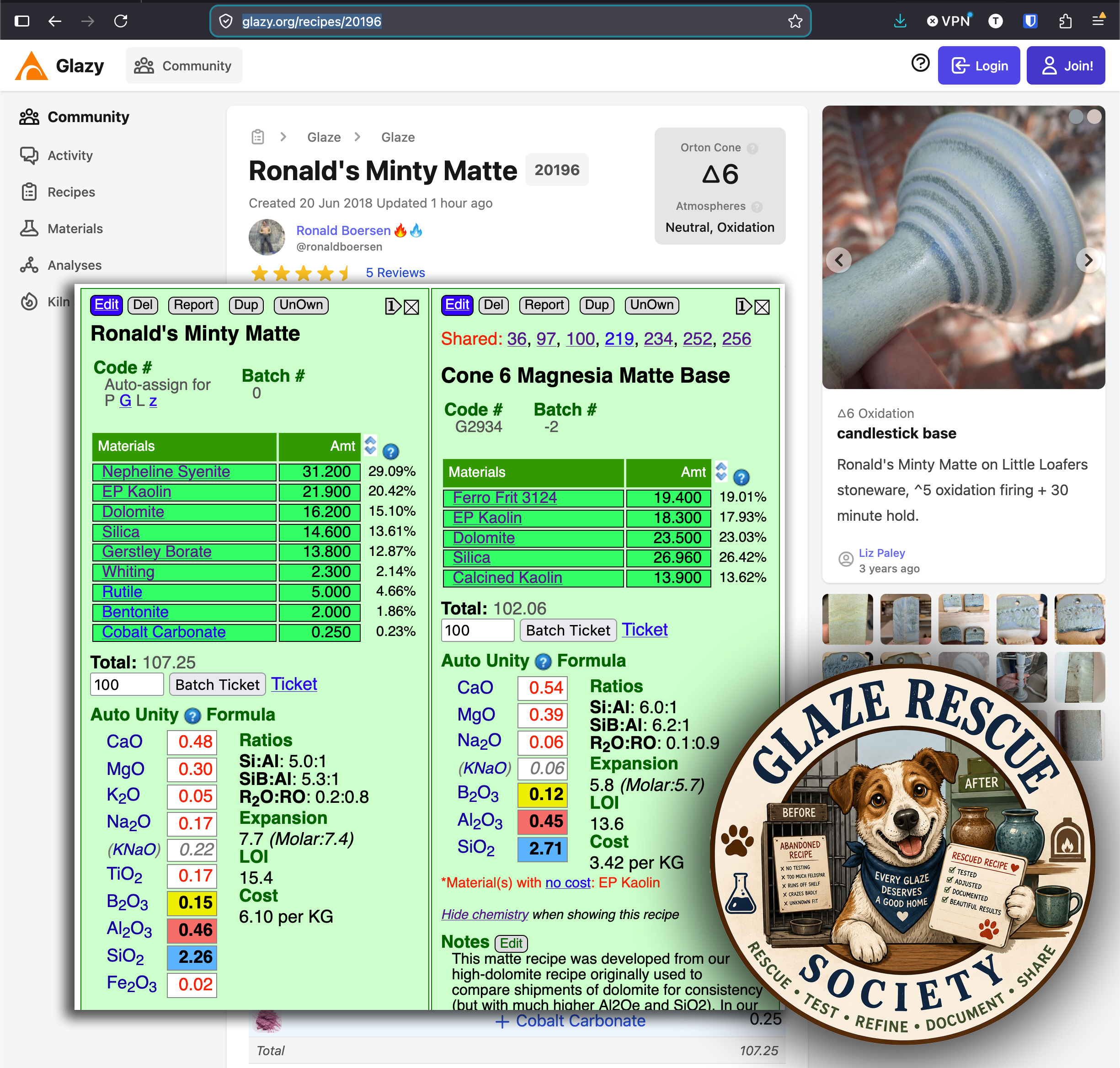
This "Minty Matte" glaze was found wandering in a Facebook group. The current "home" is a base recipe having high nepheline syenite coupled with very low SiO2 (thus high COE). It crazes on most clay bodies used by the potter who contacted me. Its tag traced it to Glazy 20196. I sometimes think of these as "shelter recipes", needing a "glaze rescue". The beautiful appearance of this one provides the motivation to give it a little love and rehome it into a new base recipe! The love it needs is a simple understanding of the mechanism to move: It is rutile saturation in a magnesia matte with a little cobalt to kick the blue. Base recipes aren't carved in stone; the chemistry of this one can be altered to drop the COE a lot (by switching Na2O for MgO). G2934 magnesia matte also works with this mechanism (and has a much lower COE). Transplanting the rutile and cobalt into it would surely reduce crazing.
However, this recipe needs another rescue. From a misunderstanding. Although the potter contacting me was happy with the G2934 as a base for the rutile and cobalt, she had learned that durable glazes should have an R2O vs RO Ratio of around 0.3:0.7 (G2934 is 0.1:0.9). However, the R2O:RO ratio thing is misunderstood. Durability is much more about producing a well-melted homogeneous glass (but not over-fluid) with minimal phase separation and surface crystallization, good body fit and absence of large amounts of easily dissolved colorants.
Related Pictures
Titanium Dioxide in a cone 6 calcia matte glaze

This picture has its own page with more detail, click here to see it.
The glaze is G1214Z1 cone 6 base calcia matte on Plainsman M390 fired at cone 6 using the PLC6DS schedule. 5% titanium dioxide has been added (a high percentage). Titanium can create reactive glazes, like rutile, with no other colorants added. This effect also works well on matte surfaces, but the glaze needs good melt fluidity (that is good because functional mattes melt well). Calcia mattes host crystallization and work particularly well. Because titanium dioxide does not contain iron oxide, lighter colors and better blues are possible compared to rutile (iron is still needed, but it is coming from the body here). Like rutile, the effects are dependent on the cooling rate of the firing, slower cools produce more reactivity. Even application without drips is important (mixing as a thixotropic dipping glaze is best). This appearance also depends on using a dark-burning body or engobe.
5% titanium dioxide in G2934Y matte, G1214Z1 matte, G2926B glossy

This picture has its own page with more detail, click here to see it.
The body is Plainsman M390. The firing schedule is Plainsman PLC6DS. Of course, rutile could be used in place of titanium; it contains iron oxide that would enhance the development of blue. A small amount of cobalt can also be added to enhance the blue (the G2934 magnesia matte on the left, especially, will respond to that).
Links
| Typecodes |
Glaze Chemistry
Case studies where glaze chemistry was used to solve a problem. |
| Typecodes |
Glaze Rescue
Taking an alluring recipe found on-line and using recipe logic and materials sense to determine if it is worth spending time on. Quite often, reactive glazes (the most popular) can be recognized on sight as having many strings attached. Rather than just mixing them as given, it is worthwhile to investigate improving them on the way into your studio or plant. At one extreme, this may just involve transplanting the mechanism into another base. At the other, glaze chemistry can enable a whole range of improvements and fixes. |
 PayPal | No tracking, No ads, No paywall, No transient content! Just organized, concise information constantly updated and improved. Was this helpful? Consider supporting me. |
Got a Question?
Buy me a coffee and we can talk 

https://digitalfire.com, All Rights Reserved
Privacy Policy