One company has recognized Redart changes
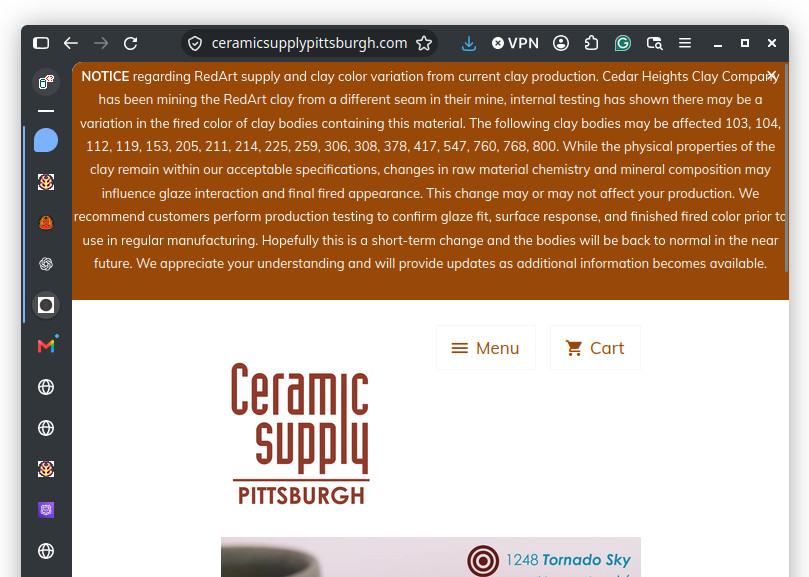
This company deserves credit for the internal testing they do and for openly acknowledging consistency issues with the RedArt shipment(s) they have received, doing so at the top of their homepage! It enables brown and red color in so many of their bodies (with little or no need for messy iron oxide or even feldspar). RedArt works really well with ball clays also. They reveal that "Cedar Heights Clay Company is mining the RedArt clay from a different seam." They recommend that customers perform production testing prior to use.
An old-versus-current oxide and mineralogy analysis from Cedar Heights (along with shrinkage, absorption and color comparisons) seems needed. Plus the lot numbers affected. If you are a tech at Resco, contact me and let's get this done.
Related Pictures
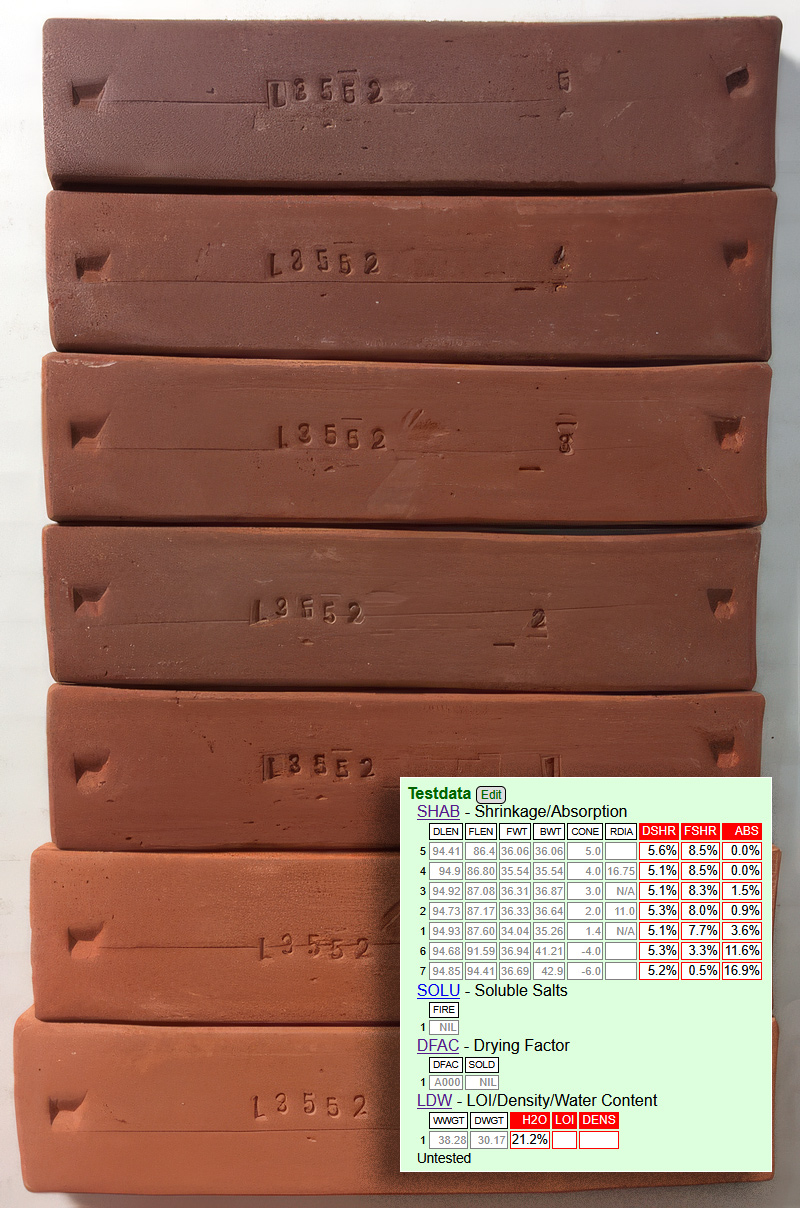
Redart 2010 test bars:
As a physical properties reference
This picture has its own page with more detail, click here to see it.
Here is what Redart fired like in 2010 when evaluated for physical properties using the SHAB test and LDW test. These bars are fired from cone 5 down to 06 (top to bottom). The clay reached zero porosity between cone 1 and 2. Beyond that, it was stable to cone 4. Its drying shrinkage was only 5%, indicating low plasticity (compared to a typical pottery clay). It is thus an ideal candidate for a ball clay addition to create a plastic body for handbuilding or throwing.
However, its plasticity is just right for slip casting; it can be used as is. It has no soluble salts and a perfect score on the drying performance DFAC test. Cone 04 and 06 porosity and fired color are very typical of terracotta clays. The fired color of this material really is stunning. And the stability of that color across such a wide temperature range.
Ready-Freddie and the Redart shipment:
Clays change; he adjusts recipes to compensate
This picture has its own page with more detail, click here to see it.
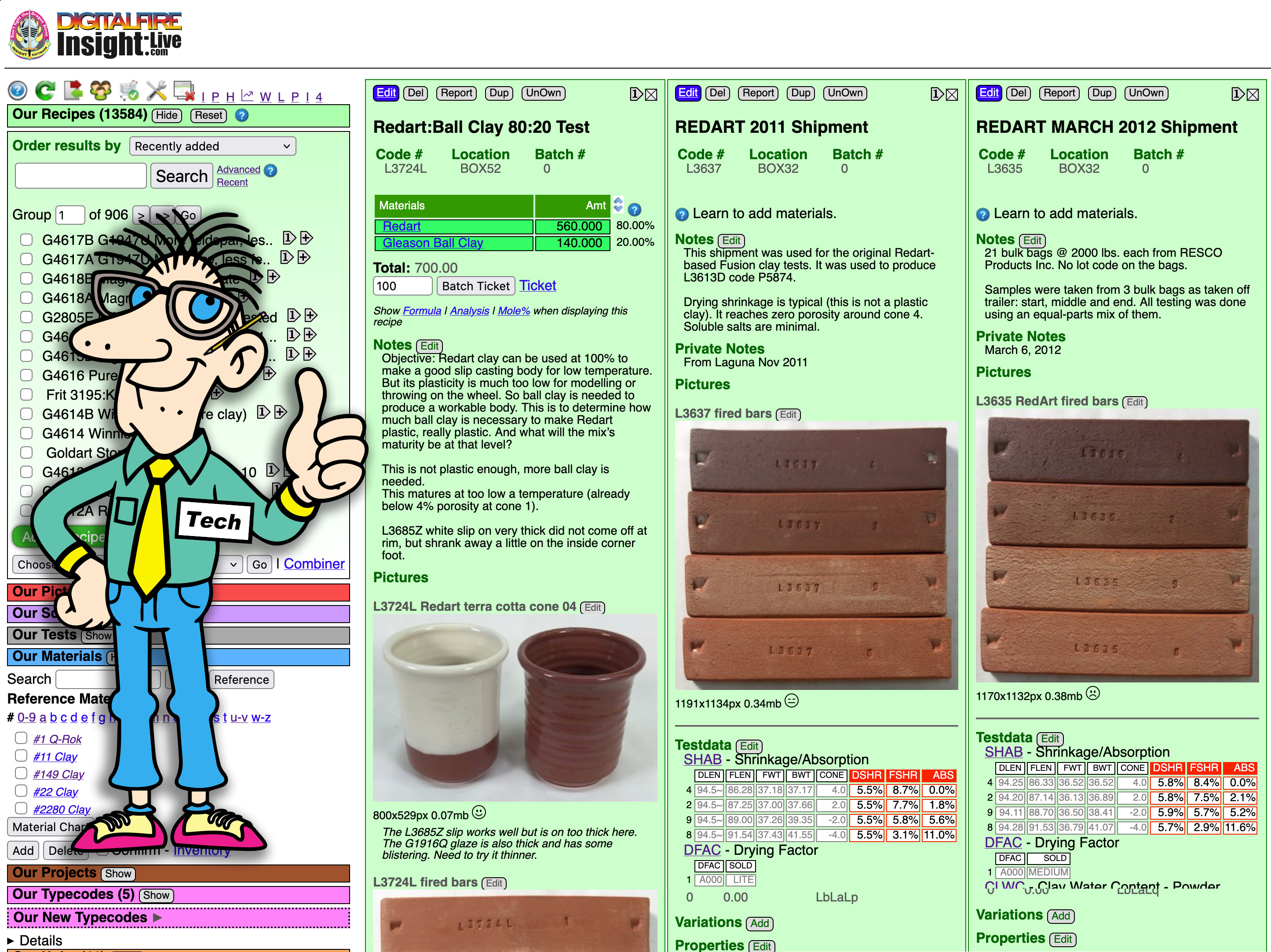
Redart has been so reliable over the years that many have just trusted it. But it is a high-iron terracotta clay. This is ceramics; we've just been lucky. Such materials are variable by nature.
While many clay body makers put Redart into their products as soon as it arrives, Freddie doesn't do that. He notes the batch code(s), takes multiple samples, and makes SHAB test bars. He even mixes up a test body and makes ware and test bars from it too. He has a well-developed testing program and knows Redart well. Freddie also understands the recipes it is used in. The low-temperature bodies depend on its iron content for their red color (he is ready to adjust the iron oxide percentage in recipes). But Freddie has to be really diligent with stoneware bodies that also depend on Redart for fired maturity, being ready to adjust their recipes (to increase or reduce the degree of vitrification).
A modest change to a Redart stoneware recipe:
The reason for the lighter color is telling
This picture has its own page with more detail, click here to see it.
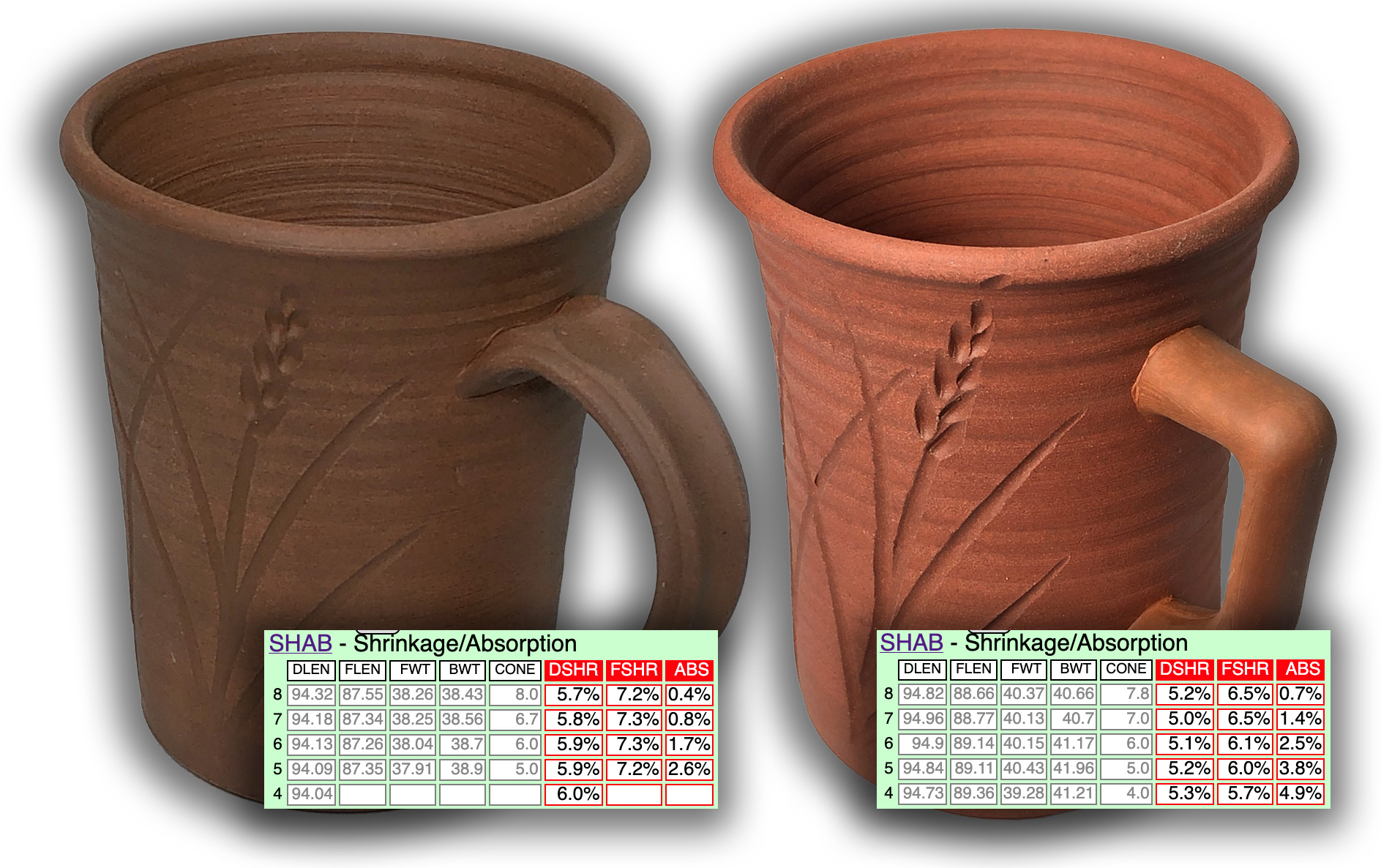
These are L4005C and L4005D unglazed mugs fired to cone 6 oxidation (same schedule). Shrinkage and absorption data are shown. They contain 35% Redart and a 2% red iron oxide addition. The redder body is not merely a different color because of less iron; it is less vitrified (if it were fired a cone higher, it would also be brown).
D simply adds 5% silica and uses a different ball clay (click the above code numbers for details)! This demonstrates that Redart can be a tipping point material when used at significant percentages for fluxing stonewares. The above linked page shows the sudden color transition just below cone 6 for L4005C). So if the recipe or firing schedules change a little, the appearance of the body can change a lot. But what if the alkali content in the Redart changes? That would do the same. Is the Redart the problem or failure to test incoming shipments and adjust recipes (assuming they are adjustable)?
A change in Redart’s chemistry or mineralogy could shift this balance too. That makes incoming-shipment testing especially important for bodies formulated close to a maturity threshold. The challenge is not just restoring the red: it is preserving absorption, workability and glaze fit at the same time.
Links
| Materials |
Redart
The most common commercially 200 mesh available raw terra cotta clay in North America. It fires red, has low plasticity and matures a low kiln temperatures. |
 PayPal | No tracking, No ads, No paywall, No transient content! Just organized, concise information constantly updated and improved. Was this helpful? Consider supporting me. |
Got a Question?
Buy me a coffee and we can talk 

https://digitalfire.com, All Rights Reserved
Privacy Policy