Glaze melt fluidity comparison:
Same chemistries, different recipes
At low temperatures, potters want transparents with good clarity to support brilliant colors. Especially on terra cotta bodies. A melt flow test like this enables a comparison one cannot do on using glazed test tiles.
These are two low temperature glazes I use at cone 03, G2931F and G2931K. They have the same chemistry. But F gets its boron from Ulexite, a material with a high LOI (notice how the escaping gases have disrupted the downward flow). The frit-sourced boron version on the right flows cleanly and contains almost no obvious bubbles.
So obviously, one would use the K, right? Not exactly. I used the K version successfully on many pieces. In a thin layer, the ulexite seems to act as its own fining agent, like Gerstley Borate, and the bubbles do merge clear well enough.

Related Pictures
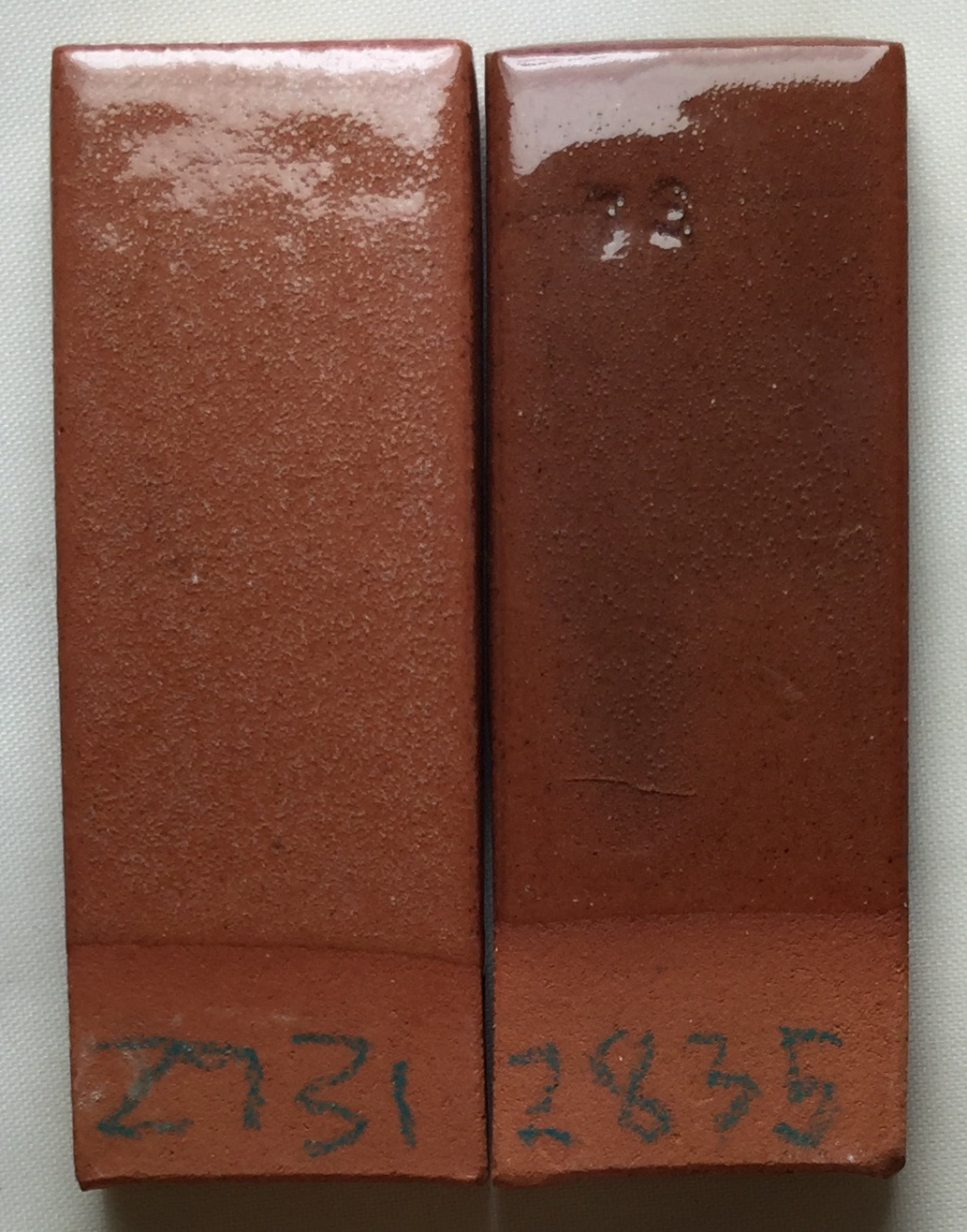
Two glazes of the same chemistry:
But supplied by different sets of materials
This picture has its own page with more detail, click here to see it.
These two specimens are the same terracotta clay fired at cone 03 in the same kiln. The glaze on the left combines 30% frit with five other materials. The one on the right mixes 90% frit with one other material (kaolin). Ulexite is the main source of boron in #1, it decomposes during firing, expelling 30% of its weight as gases, mostly CO2, forming micro-bubbles. Each of the six materials in that recipe has its own melting characteristics; their interaction creates a non-homogeneous glass containing phase separations (discontinuities) that affect the fired surface. In the fritted glaze, by contrast, all the particles soften and melt in unison and produce no gas. Notice that it has also interacted with the body, fluxing and darkening it (thus forming a better interface). And it has passed (and healed) more of the bubbles from the body.
Links
| Glossary |
LOI
Loss on Ignition is a number that appears on the data sheets of ceramic materials. It refers to the amount of weight the material loses as it decomposes to release water vapor and various gases during firing. |
| Glossary |
Frit
Frits are used in ceramic glazes for a wide range of reasons. They are man-made glass powders of controlled chemistry with many advantages over raw materials. |
| Glossary |
Glaze Bubbles
Suspended micro-bubbles in ceramic glazes affect their transparency and depth. Sometimes they add to to aesthetics. Often not. What causes them and what to do to remove them. |
| Tests |
Glaze Melt Flow - Runway Test
A method of comparing the melt fluidity of two ceramic materials or glazes by racing them down an inclined runway. |
 PayPal | No tracking, No ads, No paywall, No transient content! Just organized, concise information constantly updated and improved. Was this helpful? Consider supporting me. |
Got a Question?
Buy me a coffee and we can talk 

https://digitalfire.com, All Rights Reserved
Privacy Policy