Does ChatGPT know the recipe of this commecial glaze?
Yes, it thinks it does. And its reasoning is sound.
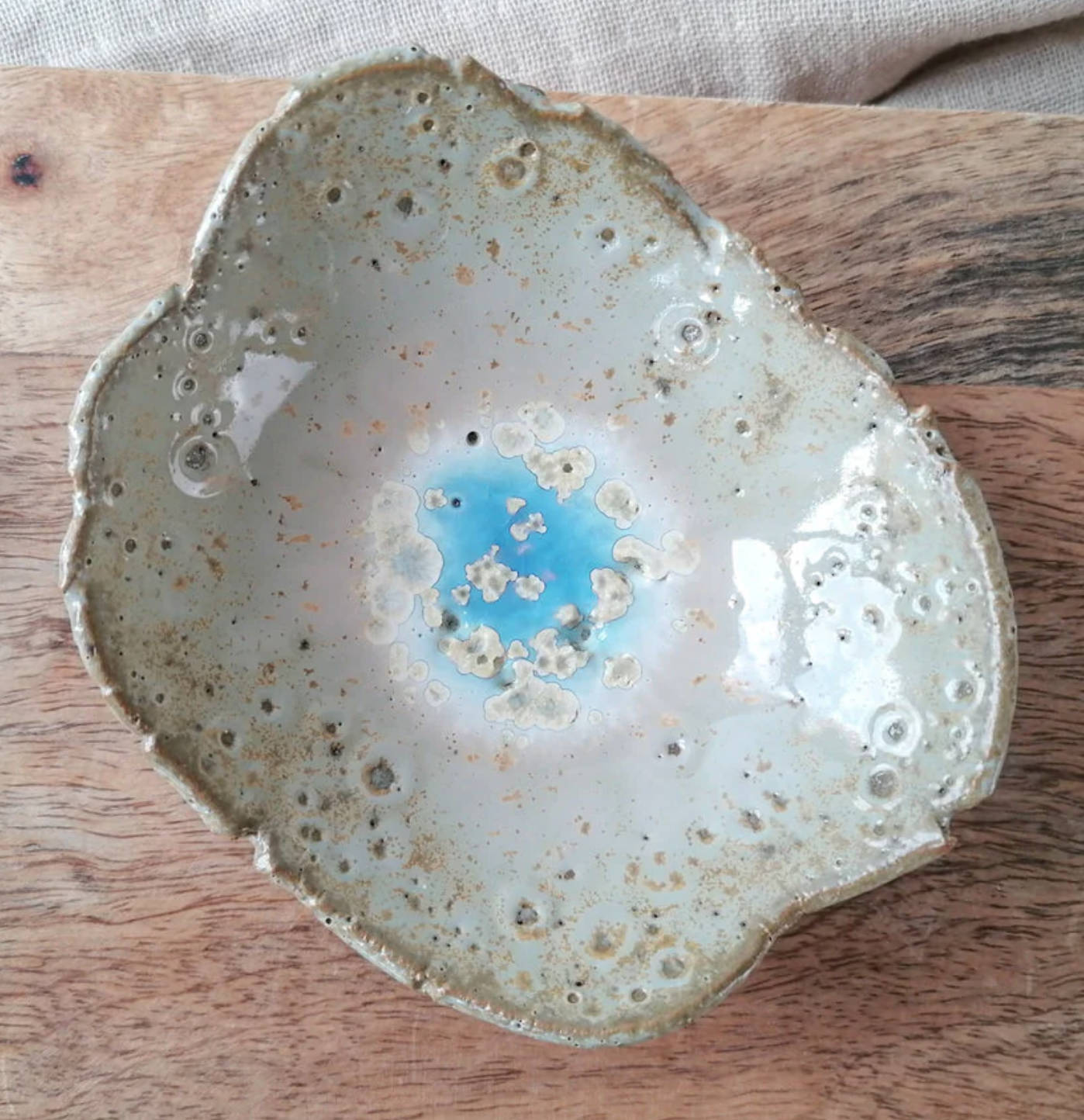
This is "Botz Plus Effect Enhancer". To ask ChatGPT, I boiled the wordy Botz sales-language description down to: "Application of this as a thin layer over existing glazes acts as a flux to add movement, enhance color intensity and gloss. When applied alone, it is runny and fires a satin, crackle surface. Useful from cone 05-10. Use at 1250°C for crystalline effects. Effects depend on application thickness."
On seeing this description and the picture, ChatGPT readily described it as "controlled melt-enhancing overglaze" and gave a wordy "glaze-nerd" description that I also had to boil down: A very fluid, low-alumina, boron-rich chemistry designed to melt early, flow strongly, dissolve and mobilize underlying colorants and glazes, crystallize and craze easily. It even noted the blue pooling and strong crystal development on the picture! It concluded that these properties almost always come from a wide-temperature-range borosilicate frit, minimal Al2O3 (for strong running) and moderate SiO2. It recommended:
80 Sodium borosilicate Ferro Frit 3134 (for more crazing, substitute some for Frit 3110)
10 Silica
5 Kaolin
5 Zinc Oxide (to promote the blue and crystallization)
Titanium Dioxide 1 (to promote crystallization)
We can speculate that the blisters are a product of the layered-over enhancer melting first and dissolving into the surface of the glaze below (early enough that healing does not occur). 1250C is where zinc crystalline glazes do their magic; the Botz guidance to fire there is a strong indicator of zinc crystals. If you plan to try this, consider mixing it as a brushing glaze for suspension and thickness/placement control. Of course, if the crystals are desired, controlling cooling (as is done with crystalline glazes) would be needed. And remember that such a cooling curve will likely matte the outside glaze on the piece.
Of course, you can just buy it from them (Germany). But a DIY version will enable tuning the degree of melt, the amount of titanium, the type of kaolin (e.g. a super plastic one like #6 Tile), the amount or even presence of crazing. You'll need to keep records on all the tests (including pictures, firing schedules), an account at insight-live.com is the right place for that.
Related Pictures
2026: ChatGPT is doing credible troubleshooting
This picture has its own page with more detail, click here to see it.
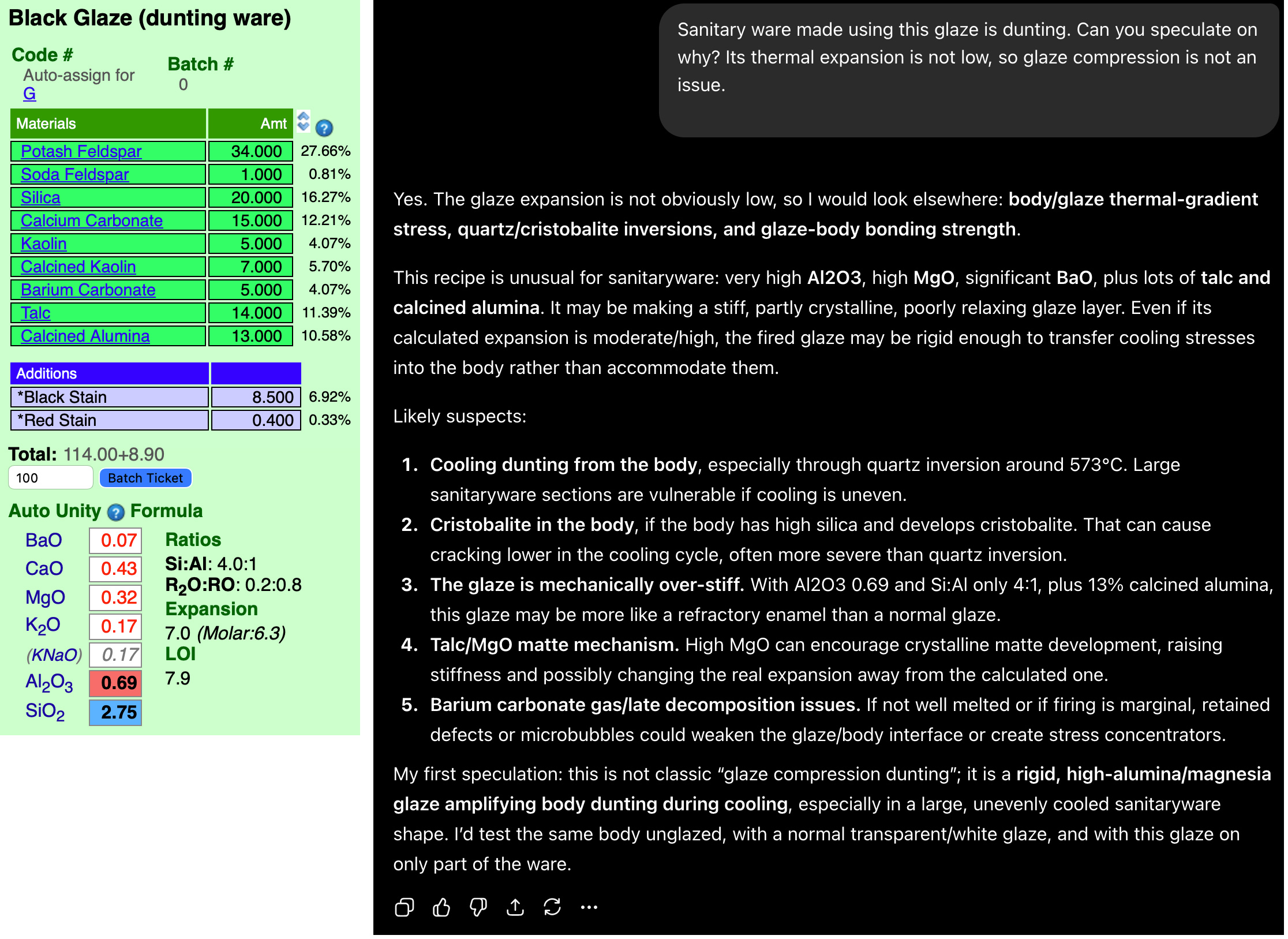
I uploaded a screenshot of this recipe panel from Insight-live and asked ChatGPT why sanitaryware using this glaze is dunting. Its response is impressive, good enough to provide remediation ideas.
-It notes things about the recipe that are unusual. For example, that the Al2O3 of 0.69 and Si:Al only 4:1, plus 13% calcined alumina, make this glaze more like a refractory enamel than a normal glaze.
-Its observation that crystallization could mean the real thermal expansion may be different from the calculated one, maybe much lower.
-Barium carbonate decomposition does not seem like something that would contribute to dunting, but its presence is strange for such a glaze.
Based on its answer, I think the 13% calcined alumina is the wild card, which is way too much for any glaze to dissolve, something to deal with first.
Links
| URLs |
https://www.botz-glasuren.de/en/
Botz Glazes - Germany producer Their "joy of ceramics" is displayed on their About page; it highlights their products as developed health-consciously and in an environmentally and dealer-friendly manner. |
| Glossary |
Reactive Glazes
In ceramics, reactive glazes have variegated surfaces that are a product of more melt fluidity and the presence of opacifiers, crystallizers and phase changers. |
 PayPal | No tracking, No ads, No paywall, No transient content! Just organized, concise information constantly updated and improved. Was this helpful? Consider supporting me. |
Got a Question?
Buy me a coffee and we can talk 

https://digitalfire.com, All Rights Reserved
Privacy Policy