No glaze chemistry needed
At least not right away
You have 147 glaze recipes. How can you get your head around all of them? Is glaze chemistry needed? No, that's a "maybe" way in the future. Right now, you need to start organized documentation. The recipe for each. A few pictures of each fired on different clay bodies, different thicknesses. Perhaps slow and fast-cooled firing. This is what an account at Insight-live does well. What it does even better is tracking your testing. The first step is to assign each recipe a proper code number (replacing these) and write that on all test specimens and buckets. From this point on, learn. Record every observation you make about each in its notes.
Through all of this, constant use in the studio (or factory) will never stop surfacing problems (e.g. settling in the bucket, crazing, running, blistering, material issues, etc.). The seriousness of each will determine the level of attack. First, identify the mechanism of the desired fired result. If it is a base recipe plus additions of colorants, opacifiers or variegators, then check if the base of one of the other glazes has a similar surface texture and character. If so, then could the additives in the troublesome one be used with the better base? If not, then it's time to sanity-check the recipe and bring out the heavy guns of at least looking at the chemistry. But in Insight-live, you only need to turn on the display of the unity formula (there is nothing else to do). Next, make sure each material in the recipe links to one in the material database (so the calculated formula is accurate). Then compare the calculated unity formula with a limit formula (often a simple sanity check, like with the recipe, quickly spots oxides that are in excess or are short.
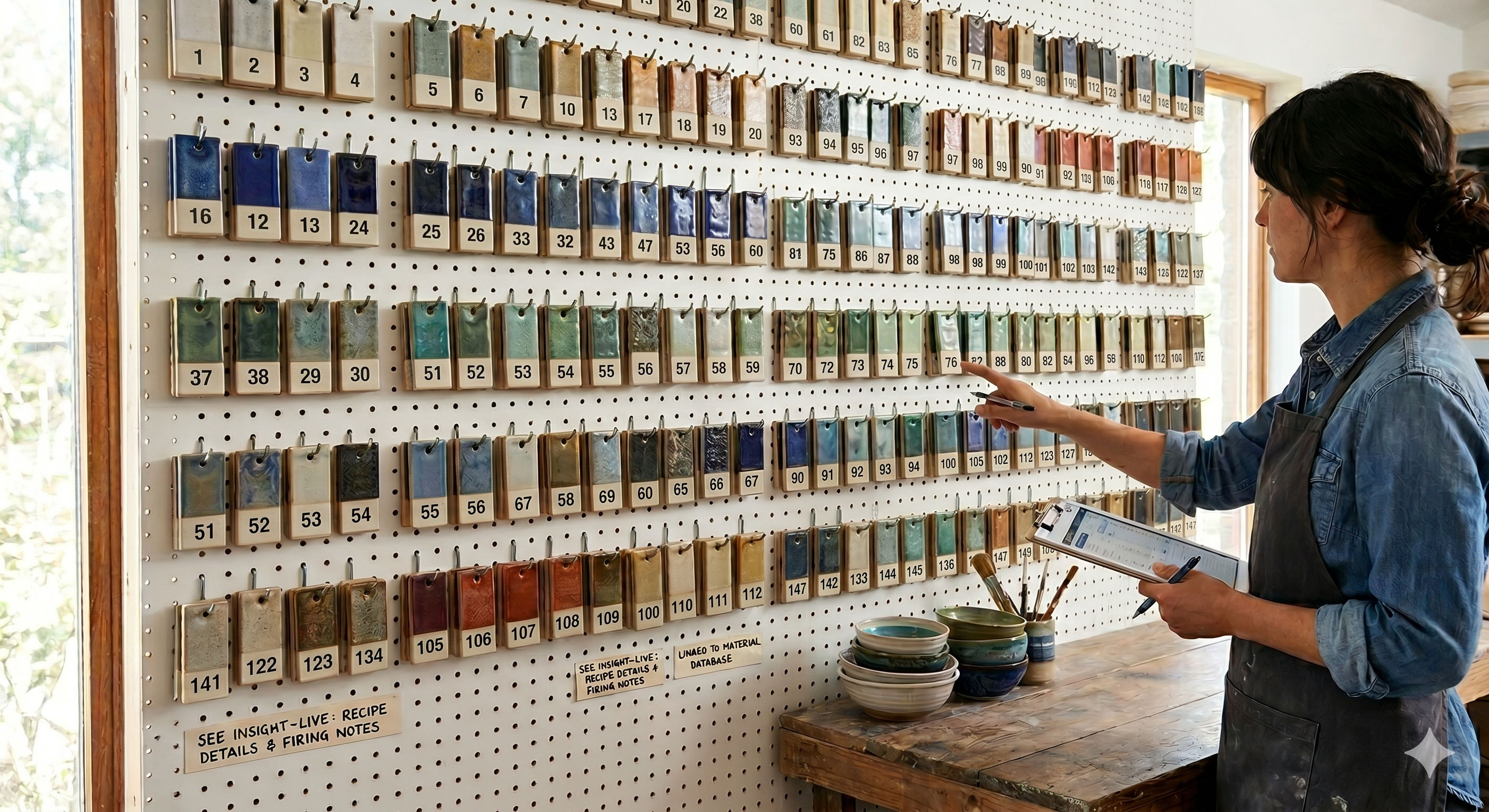
Created with Gemini to show a technician puzzling over 147 glaze tiles, sequentially numbered. AI Policy
Related Pictures
Start glaze chemistry by learning when you don't need it!
A high feldspar glaze is a good example
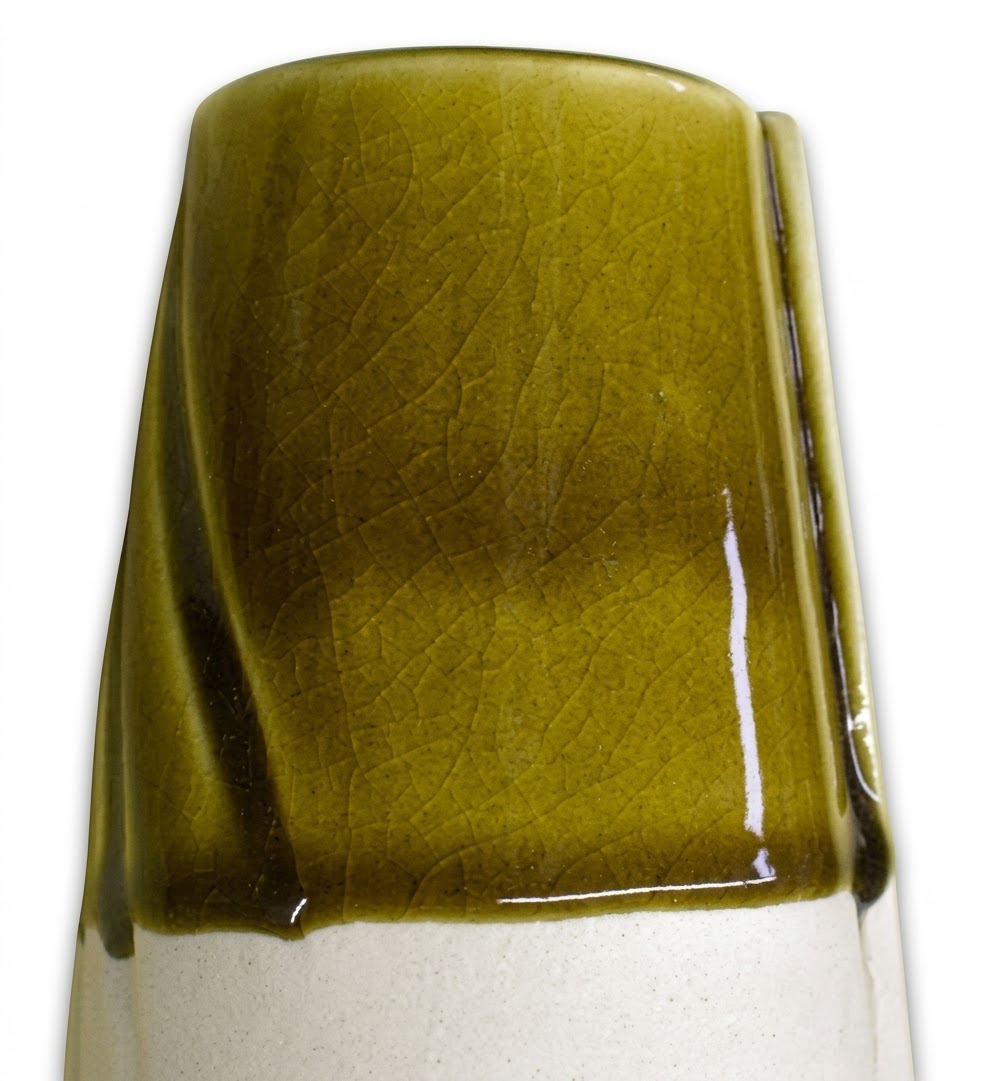
This picture has its own page with more detail, click here to see it.
This reduction celadon is crazing badly. Why? Its chemistry is dominated by feldspar, which supplies lots of K2O and Na2O fluxes. Scores of recipes being traded online contain 50% or more feldspar; they benefit from these powerful fluxes but inherit their high thermal expansion (COE). Many work only because the body happens to have sufficiently high expansion - often aided by significant residual quartz.
Crazing is more than a cosmetic problem in functional pieces. It reduces ware strength and durability, can compromise food safety and turn into a customer complaint. Let's fix it, starting without chemistry:
- Use recipe logic: Transplant the color mechanism into a transparent base glaze that already fits the body. In this case, the celadon color is largely produced by an iron addition under reduction, so there is no need to preserve the high-feldspar base itself.
- Use material sense: A 2:1 silica:kaolin mix supplies an Si:Al ratio similar to typical glossy glaze chemistries. A 10% addition thus shouldn't change the degree of gloss but will likely lower the COE, reduce melt fluidity and improve durability.
- Use glaze chemistry. Substitute some of the high-expansion KNaO with much lower-expansion MgO. Both are fluxes, and even a 0.1-mole shift can make a significant difference. Couple that with an increase in SiO2 where the melt can tolerate it, and glaze fit can improve dramatically.
 PayPal | No tracking, No ads, No paywall, No transient content! Just organized, concise information constantly updated and improved. Was this helpful? Consider supporting me. |
Got a Question?
Buy me a coffee and we can talk 

https://digitalfire.com, All Rights Reserved
Privacy Policy