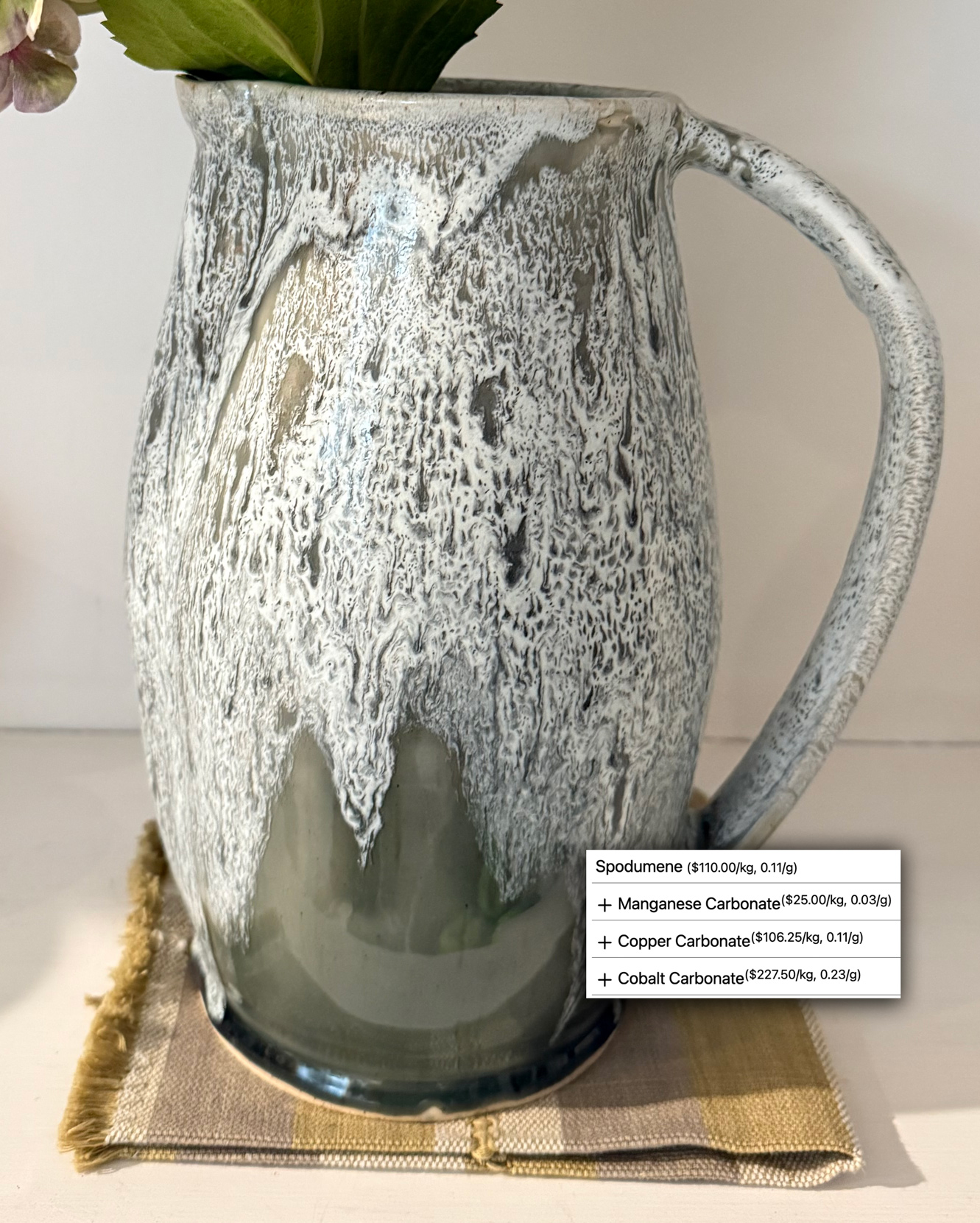
LOI-gassing and Spodumene produce this:
Melt fluidity with blisters that variegate, then heal
This pitcher was made by Elora Pottery. Like everyone using glazes that require lithium (from Spodumene or Lithium Carbonate), they are facing the unbelievable price increases these materials are seeing. Staci actually calculated the weight applied to each piece, determining the $$ dip cost! Notice her material costs on the photo. During efforts to reduce the spodumene content, I noticed the expensive carbonate colorants and asked if these were causing blisters in the glaze (because of gassing associated with their LOI). When I saw this picture, it became clear that they are. But in a good way. Part of the variegation we are seeing is doubtless the mechanical disturbance they cause in the fluid-melt phase-separated glass. But the melt fluidity of the glaze appears to be sufficient to heal them and smooth out the glass during cooling.
What did we do about the spodumene? We calculated to use lithium carbonate to supply the Li2O instead - it took one fifth as much material. Still super expensive, but easier to use and more consistent.
Related Pictures
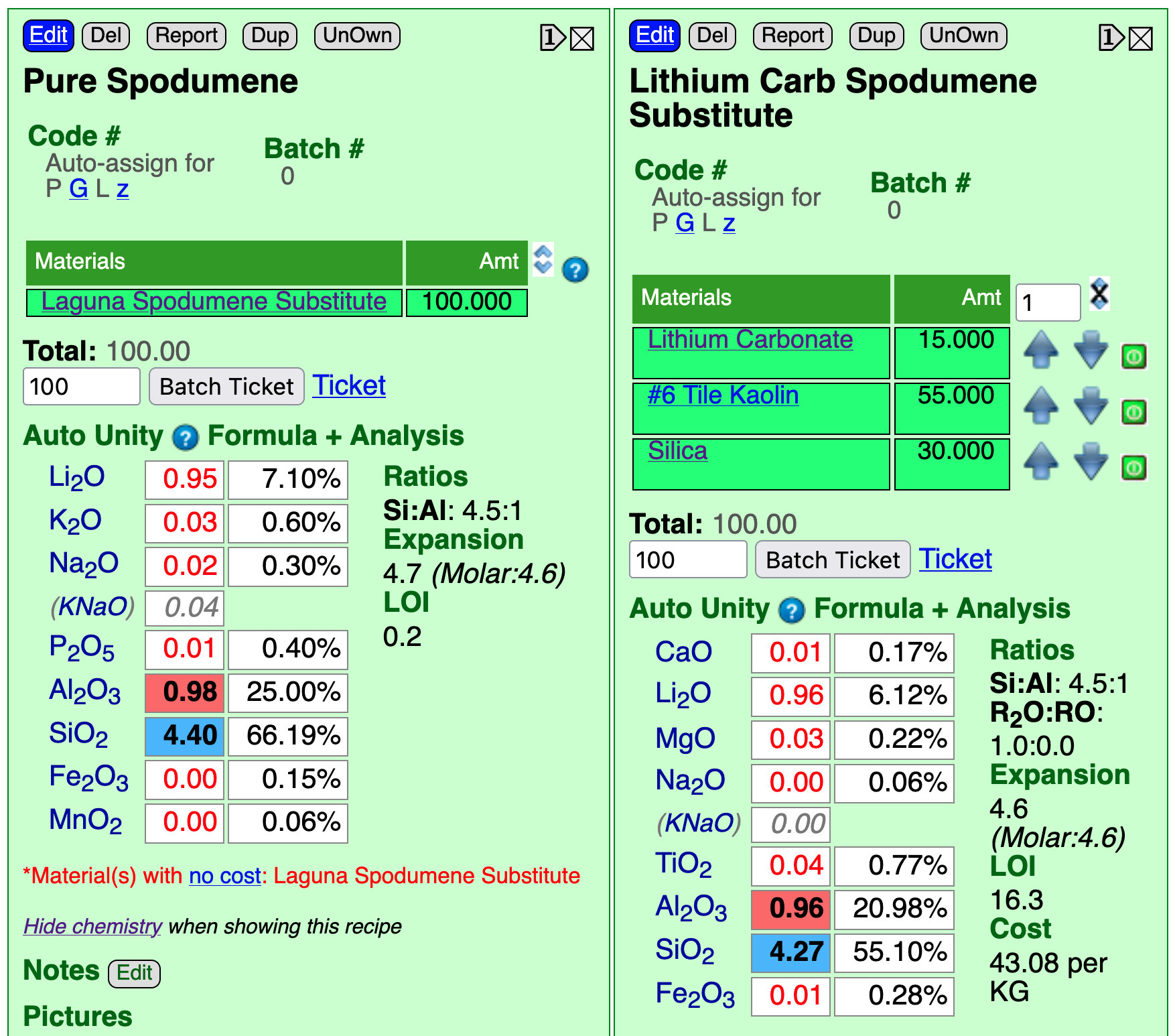
How to make Spodumene using Lithium Carbonate
This picture has its own page with more detail, click here to see it.
Spodumene is super expensive; one dunk in a dipping glaze can now cost dollars. But lithium carbonate is even more so. However, both are used as a source of Li2O. The latter is 6+ times more concentrated. And spodumene is more troublesome in glazes (issues with settling, dusting, slurry properties, consistency). And it can be hard to get. So using lithium carbonate might be a better choice for you.
This side-by-side calculation seems to indicate that 15 Lithium Carbonate, 55 Kaolin and 30 Silica can substitute for 100 parts by weight of Laguna Spodumene Substitute. However, that is not quite correct. Note that my substitute recipe calculates to an LOI of 16.3. If I assume the Laguna material has no LOI (for convenience, it actually has 0.2%), that means each of the amounts need to be divided by (100-16.3)/100=0.84. Thus, to substitute for 100 parts of spodumene, you need ~120 of this mix (18 lithium carbonate, 66 kaolin and 36 silica).
Why Petalite and Spodumene will seldom substitute for Lithium Carbonate

This picture has its own page with more detail, click here to see it.
Of course, if a recipe only calls for 1-2% lithium carbonate, either of these might be candidates to supply the Li2O. But Petalite is 8x less concentrated and Spodumene 5x less. Not surprisingly, prices reflect this (unless availability is the issue). But when a recipe calls for 5% lithium carbonate, there is another problem: Petalite is extremely high in SiO2 and spodumene is very high in Al2O3. Introducing enough of either of them to supply the same amount of Li2O as 5% lithium carbonate can easily oversupply either. While extra SiO2 can often be accommodated because most glazes contain significant silica, bringing in a lot of Al2O3 necesitates cutting the most important normal source: Clay. The result is a slurry that does not harden and does not stay suspended.
Lithium is no longer affordable for ceramics.
Yet in many cases it seems indispensable
This picture has its own page with more detail, click here to see it.
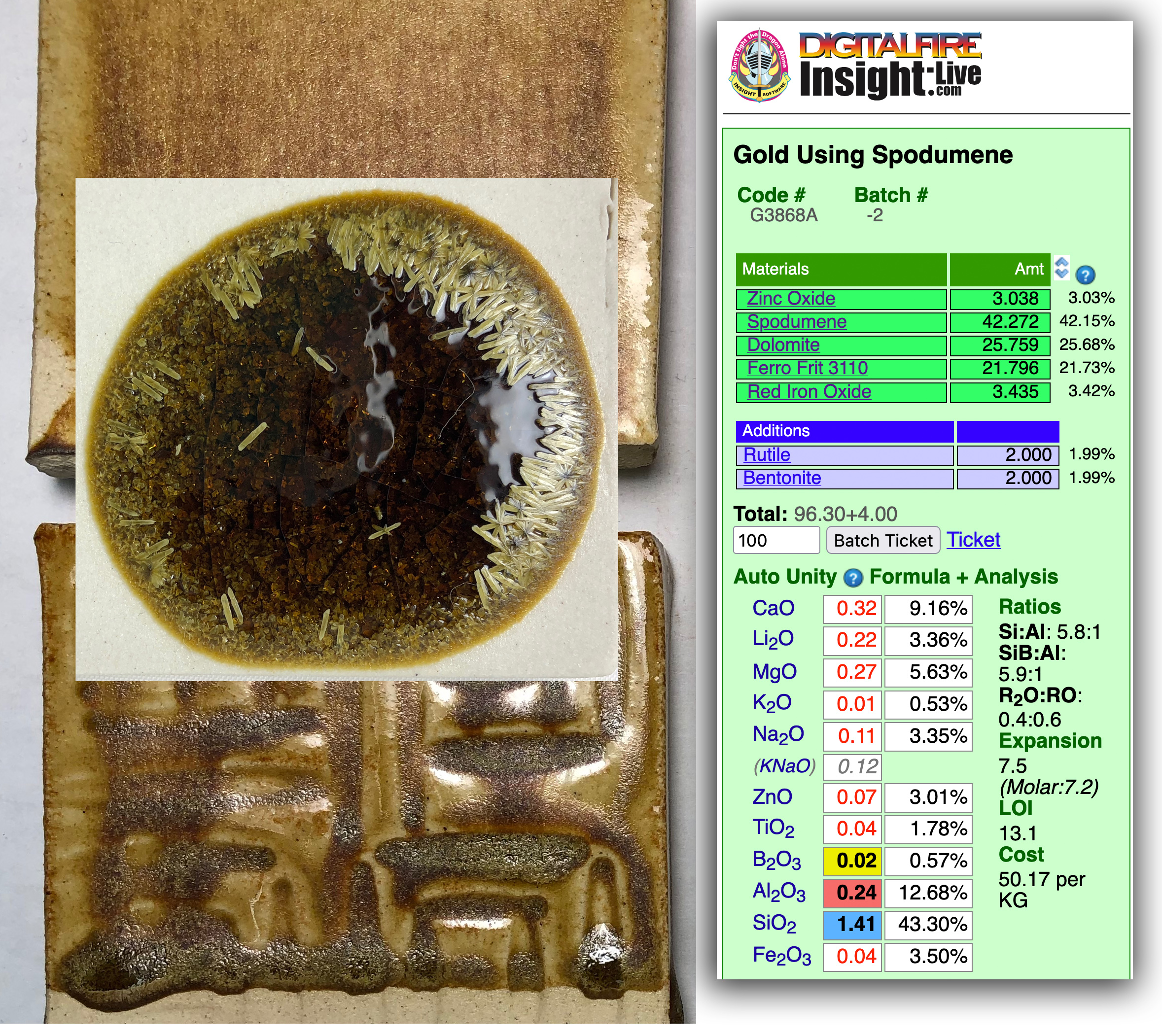
The crystals that form as this cone 6 fluid-melt glaze solidifies are one of the minerals in the recipe: Spodumene. Actually β-spodumene. But it is so expensive, and there is 42% here! What would it take to reduce the cost of making this glaze ($52/kg in 2026)? Another flux could certainly make it just as melt-fluid, but it would not grow spodumene crystals.
β-spodumene is Li2O - Al2O3 - 4SiO2 So the 0.22 Li2O in this glaze would require 0.22 Al2O3 and 0.88 SiO2 to crystallize as a β-spodumene-type lithium aluminosilicate. The glaze contains 0.24 Al2O3 and 1.41 SiO2. There is almost exactly enough lithium to combine with nearly all of the alumina as β-spodumene. The 2% rutile supplies TiO2; it acts as a nucleating agent. Replacing Li2O with another flux could maintain the melt fluidity, but Na2O, K2O or B2O3 cannot simply take the place of Li2O in β-spodumene.
It is possible that less spodumene could still do this. That could be tested by reducing Li2O to 0.1 and increasing Na2O to 0.23 (while maintaining the other oxides as-is). B2O3 could also be tried (it has a far lower thermal expansion). Of course, effecting changes in specific oxides requires some glaze chemistry.
Links
| Materials |
Lithium Carbonate
A powerful melter very valuable in ceramic glazes. It is 40% Li2O and has an LOI of 60% (lost as CO2 on firing). This material in now incredibly expensive. |
| Materials |
Spodumene
Spodumene is a lithium sourcing feldspar, an alternative to lithium carbonate to supply Li2O to ceramic glazes. Contains up to about 8% Li2O. |
| Glossary |
Variegation
Ceramic glaze variegation refers to its visual character. This is an overview of the various mechanisms to make glazes dance with color, crystals, highlights, speckles, rivulets, etc. |
 PayPal | No tracking, No ads, No paywall, No transient content! Just organized, concise information constantly updated and improved. Was this helpful? Consider supporting me. |
Got a Question?
Buy me a coffee and we can talk 

https://digitalfire.com, All Rights Reserved
Privacy Policy