This glaze suspends, but it doesn’t harden on drying
That’s why glazes need a binder or a clay
This is a slurry of pure feldspar. A tiny addition of powdered Epsom salts flocculates it enough that it can remain suspended for days; without that, the watery slurry settles very quickly. Remarkably, it can even be applied to absorbent bisque despite containing no clay. But suspension is only one requirement of a usable glaze slurry. The deposited feldspar layer is extremely permeable, so the bisque sucks water through it almost unhindered. The coating therefore builds at remarkable speed—the piece must essentially be dipped in and out with no dwell time. Then a second problem appears. It can only be handled while the coating is damp, the dry layer is just powder. The Epsom salts have solved suspension, but not binding.
Some industrial dipping glazes likewise contain little or no clay. They compensate using organic binders such as CMC gum. These retain water, control application behavior and, especially important here, glue the particles together after drying so the glazed ware can survive handling before firing.

Related Pictures
Pure feldspar applied as a glaze:
Because of the magic of thixotropy.

This picture has its own page with more detail, click here to see it.
These are pure Custer feldspar and Nepheline Syenite. The coverage is perfectly even on both. No drips. Yet no clay is present in the mix. The secret? Epsom salts. I slurried the two powders in water until the flow was like heavy cream. I added more water to thin and then started adding the Epsom salts (powdered) as it mixed. After only a pinch or two, they both gelled. Then I added more water and more Epsom salts until they thickened again and gelled even better. The result is a thixotropic slurry. They both applied beautifully to these porcelains. The gelled consistency prevents them from settling to a hard layer (which they would otherwise do in seconds).
Could you do this with pure silica? Yes. Of course, this is just a demonstration of the power of Epsom salts (that's why no attempt was made to measure amounts). No potter or manufacturer would attempt to put a clayless slurry method into production as a dipping glaze without any additives.
Pure Nepheline Syenite as a crackle glaze:
Its chemistry explains exactly why crackle glazes crack
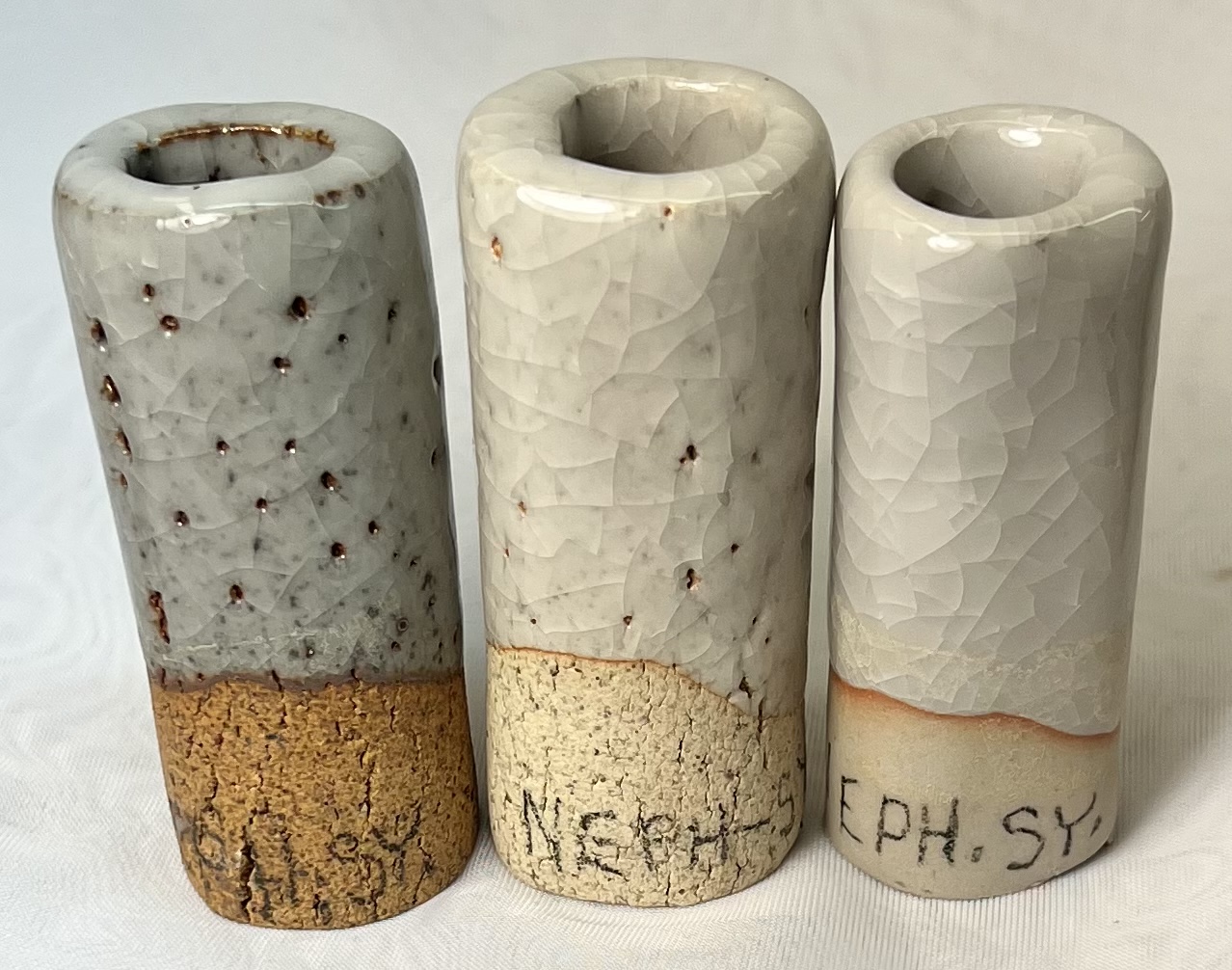
This picture has its own page with more detail, click here to see it.
Crackle glazes are often thought of simply as recipes that somehow produce a crack pattern. However, crackle is a glaze/body fit phenomenon, not simply an intrinsic visual property of the glaze. They have very high levels of Na2O and/or K2O (collectively, KNaO). These two have the highest coefficients of thermal expansion, by far, of oxides commonly found in pottery glazes. Feldspars, and particularly nepheline syenite, can supply them in abundance.
Shown here is the 77E10A recipe, originally from Luke Lindoe. It is simply Nepheline Syenite and water (shown on three types of clay bodies). Of course, this won't suspend in water so special measures are needed to make it suitable as a dipping glaze or brushing glaze. Think of it as an on-ramp to understanding more about this type of glaze. 77E10A1 and 77E10A2 are improvements on this; both provide a path to develop and adapt it for your needs.
A crackle glaze is crawling
An excellent case for a DIY brushing glaze
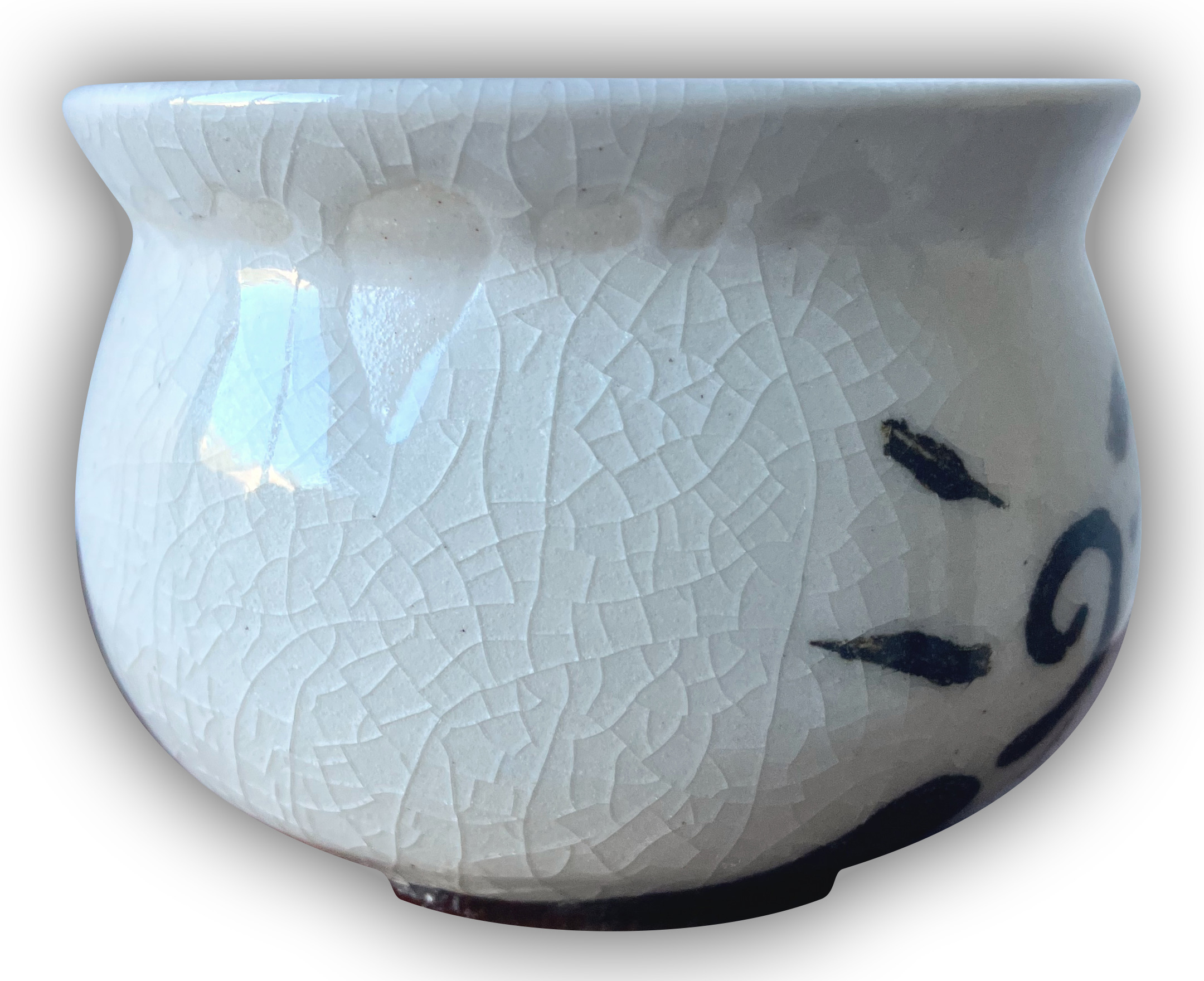
This picture has its own page with more detail, click here to see it.
A potter uses a 70% potash feldspar, 20% whiting, 10% kaolin glaze for a crackle cover over iron oxide brush strokes. While it fires crystal clear, it has a problem: it crawls. While it can be flocculated with Epsom salts, and the application and dry adherence are fairly good; this crawling problem is occurring. By mixing it as a DIY brushing glaze we can fix three of its problems without changing the recipe: Its tendency to go on too thick, the entrained bubbles in the clear glass and the crawling. Don’t dismiss this idea immediately. This is a special-purpose surface and brushing can be done more quickly than you might think. Careful control of thickness is possible and the CMC gum in the glaze will make it adhere much better (eliminating the crawling). The consistently thinner coverage will also make it possible to produce crystal clarity with fewer micro-bubbles in the glass. A hybrid approach is also possible: Pour glazing the inside and brushing the outside.
Links
| Glossary |
Suspension
In ceramics, glazes are slurries. They consist of water and undissolved powders kept in suspension by clay particles. You have much more control over the properties than you might think. |
 PayPal | No tracking, No ads, No paywall, No transient content! Just organized, concise information constantly updated and improved. Was this helpful? Consider supporting me. |
Got a Question?
Buy me a coffee and we can talk 

https://digitalfire.com, All Rights Reserved
Privacy Policy