Unoxidized carbon in unexpected glazes
And melting earlier than expected
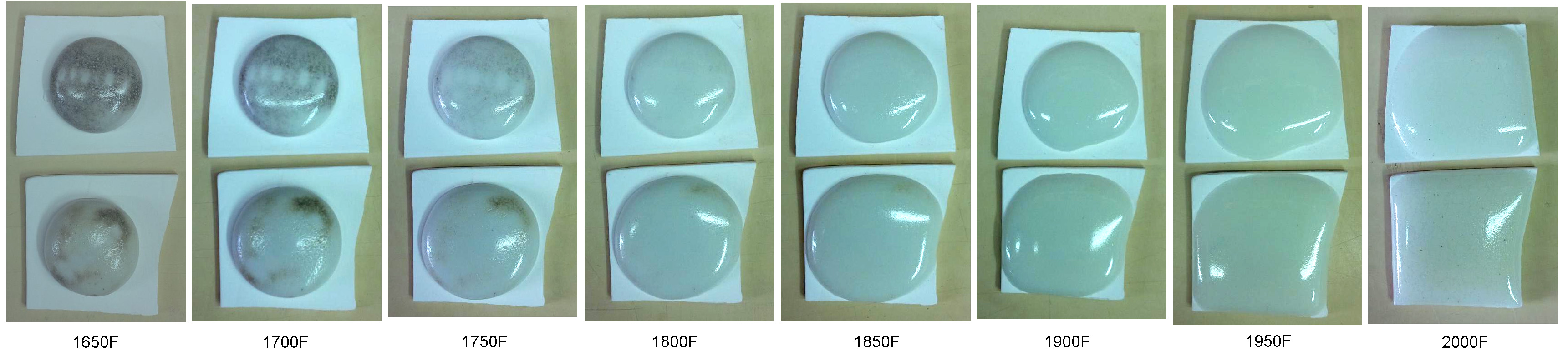
Hard to believe, but this black discoloration (consistent with residual carbon) is in ten-gram GBMF test balls of low-fire glazes with 85% frit. The upper row is G1916Q, the lower is G1916J (12% added zircon). These balls were fired to successively higher temperatures to try to determine:
- The point at which the glazes finish oxidizing carbon? Answer: Beyond 1500F.
- The point at which they densify enough to resist passing any decomposition gases? Answer: They begin melting at about 1450F.
This is not on the level of raising alarm bells and does not establish a universal burnout temperature. But it does demonstrate a potential overlap between burnout and melting in glazes where such is not expected. We can gain some comfort in that surface gloss near 1450°F indicates melt development; but it does not establish precisely when interconnected pores close. In addition, glazes are applied in thin layers, while these are about 1cm thick.

Related Pictures
Frits melting before carbon expulsion
This picture has its own page with more detail, click here to see it.
These G1916Q and G1916J low fire clear glazes contain 85% frit and 15% kaolin, so they begin to soften as low as 1450F. I made these 10 gram GBMF test balls to compare the degree of melting across a broad range. I did not expect to see carbon or the degree to which these balls could trap it. Notice that unoxidized carbon is still obvious at 1650F, still visible at 1750F and leaves the residual effect of micro-bubbles that opacify the matrix even at 1950F (cone 04). While a thin layer of these glazes on ware will most often tolerate this anyway, when bubble clouds do appear an option is to hold the firing at 1400F to fire away as much of the carbon as possible (before melting begins).
Links
| Glossary |
Carbon trap glazes
A type of ceramc glaze. |
| Glossary |
LOI
Loss on Ignition is a number that appears on data sheets test results of ceramic materials and bodies. It refers to the amount of weight lost as it decomposes to release water vapor and various gases during firing. |
| Glossary |
Soaking
The process of holding a kiln at the final temperature (or at other temperatures) to enable the heat to penetrate the ware or to effect or complete a glaze or body reaction |
| Glossary |
Carbon Burnout
Ceramic materials, especially clays, often contain carbon and organic compounds. When they are fired in a kiln, these must burn out, often producing complications. |
| Glossary |
Firing Schedule
Designing a good kiln firing schedule for your ware is a very important, and often overlooked factor for obtained successful firings. |
| Tests |
Glaze Melt Fluidity - Ball Test
A test where a 10-gram ball of dried glaze is fired on a porcelain tile to study its melt flow, surface character, bubble retention and surface tension. |
 PayPal | No tracking, No ads, No paywall, No transient content! Just organized, concise information constantly updated and improved. Was this helpful? Consider supporting me. |
Got a Question?
Buy me a coffee and we can talk 

https://digitalfire.com, All Rights Reserved
Privacy Policy