Why did whiting make this Ravenscrag glaze craze?
The unexpected reason can be seen in the chemistry
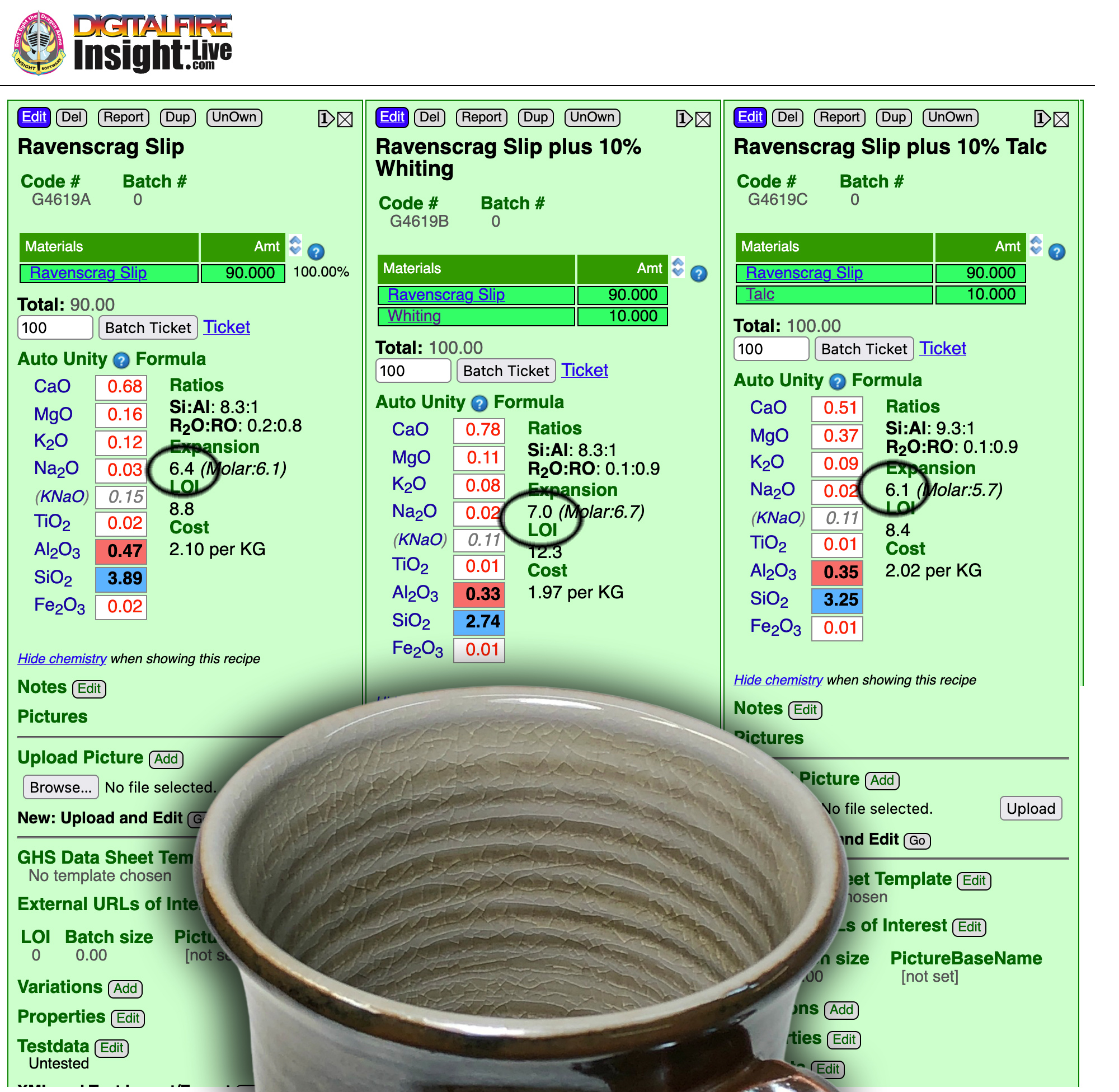
Ravenscrag Slip used by itself as a glaze shows no crazing on this body at cone 10R. The mug in the photo was fired with a blend of 90 parts Ravenscrag Slip and 10 parts whiting (calcium carbonate). It crazed. Why would that happen when CaO has a relatively low expansion compared with Na2O and K2O?
The unity formulas show what changed. Whiting supplies CaO without supplying silica or alumina. With the fluxes normalized to one mole, SiO2 drops from 3.89 to 2.74 and Al2O3 from 0.47 to 0.33. That’s about 30% less of each relative to the total flux, even though their ratio stays at 8.3:1. The calculated expansion rises from 6.4 to 7.0, consistent with the crazing on this mug.
The 90:10 talc blend goes the other way in the calculation. Talc supplies silica along with MgO, so SiO2 drops only to 3.25. MgO also has a lower expansion contribution than CaO. The result is a calculated expansion of 6.1, below that of Ravenscrag Slip alone.
Related Pictures
GR10-B Ravenscrag transparent glaze (with 10 talc)

This picture has its own page with more detail, click here to see it.
Because this glaze employs 10% dolomite instead of 10% calcium carbonate it has a lower thermal expansion and is less likely to craze. While the dolomite is contributing MgO, which normally mattes glazes, there is not enough to do it here.
You cannot fix this crazing with a process or firing change
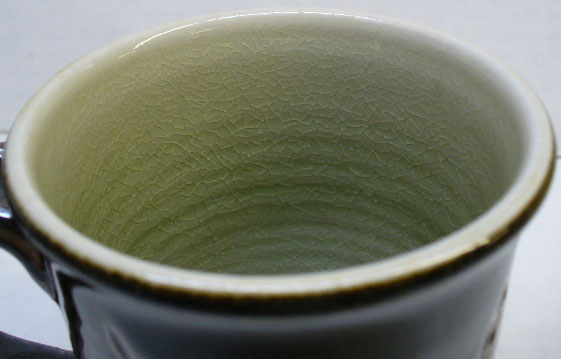
This picture has its own page with more detail, click here to see it.
This is severe crazing (at cone 10R). It is happening because of the chemistry of the glaze, not the firing. The first option to check when fixing crazing is: Can the glaze accept an addition of SiO2? This glaze is an excellent candidate for that because the melt is highly fluid, it will surely be able to dissolve extra SiO2. But it could also accept Al2O3 because it is highly glossy (a little extra Al2O3 will not matte it and would also reduce expansion and increase fired hardness and durability). What to do then? I would start with a 10% addition of a mix of two parts silica to one part kaolin (this mix has a 10:1 SiO2:Al2O3 ratio, about the same as most glossy glazes).
How can a refractory oxide be a flux?

This picture has its own page with more detail, click here to see it.
Pure calcium oxide melts at about 2570C (yet typical stoneware kilns fire around 1300C!) Yet CaO is an important flux in many stoneware glazes. How is this possible? Interactions. The contribution of CaO depends on its interaction with silica, alumina and other oxides in the melt. Thus, the melting point of the pure oxide does not predict the melting temperature of a mixture containing it.
The test tiles show 2%, 5%, 10% and 15% calcium carbonate additions to Ravenscrag Slip on a buff stoneware fired at cone 10R (prepared by Kat Valenzuela). Notice the glaze gets progressively glossier toward 15% (crazing also starts at 10%).
Links
| Materials |
Talc
A source of MgO for ceramic glazes, a flux or thermal expansion additive in clay bodies, also used in the manufacture of cordierite. |
| Glossary |
Calculated Thermal Expansion
Calculation of the thermal expansion of glazes is a very useful comparative glaze-fit tool. But it’s not a laboratory measurement. |
| Glossary |
Glaze Chemistry
Glaze chemistry is the study of how the oxide chemistry of glazes relate to the way they fire. It accounts for color, surface, hardness, texture, melting temperature, thermal expansion, etc. |
| Troubles |
Glaze Crazing
Ask the right questions to analyse the real cause of glaze crazing. Do not just treat the symptoms, the real cause is thermal expansion mismatch with the body. |
 PayPal | No tracking, No ads, No paywall, No transient content! Just organized, concise information constantly updated and improved. Was this helpful? Consider supporting me. |
Got a Question?
Buy me a coffee and we can talk 

https://digitalfire.com, All Rights Reserved
Privacy Policy