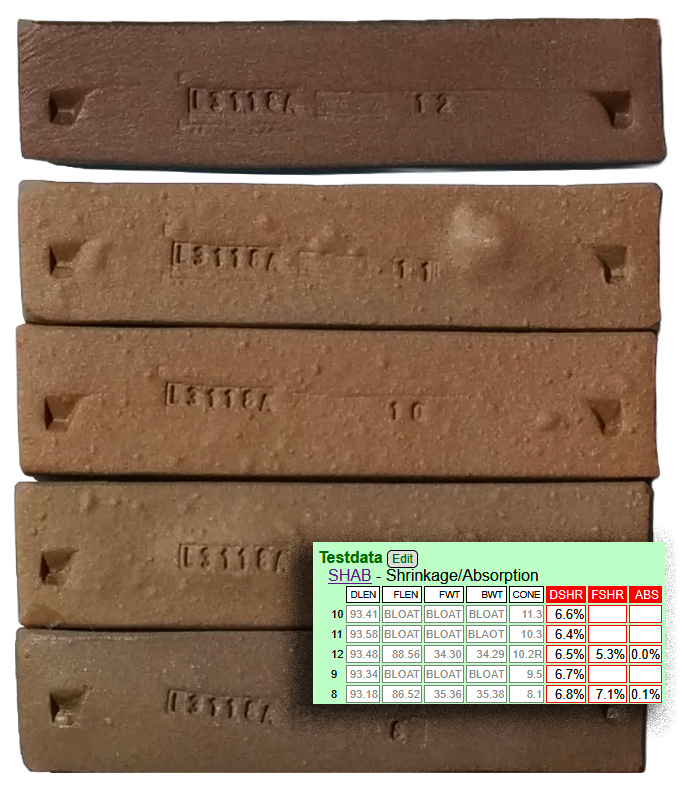
Here is how 60:40 BallClay:RedArt
fires at cone 10R, 11, 10, 9 and 8
The objective is to discover the ratio of Redart to ball clay that reaches near-zero porosity by cone 10, with minimal bloating and rich color. And with high plasticity. This is stage 1 in creating a new body; nine more tests eventually achieved L3118J.
These test bars were fired at cone 10R and 11, 10, 9 and 8 oxidation (top to bottom). It reaches zero porosity by cone 8 and blistering is already happening there (which makes measuring fired shrinkage or porosity beyond that pointless). However, the cone 10R bar is not blistering. It clearly needs less fired maturity. A real bonus: Plasticity is fantastic yet drying shrinkage is well below 7%! In the final body I ended up using 20% Redart, it still imparted good color and near-zero porosity by cone 10.
Related Pictures
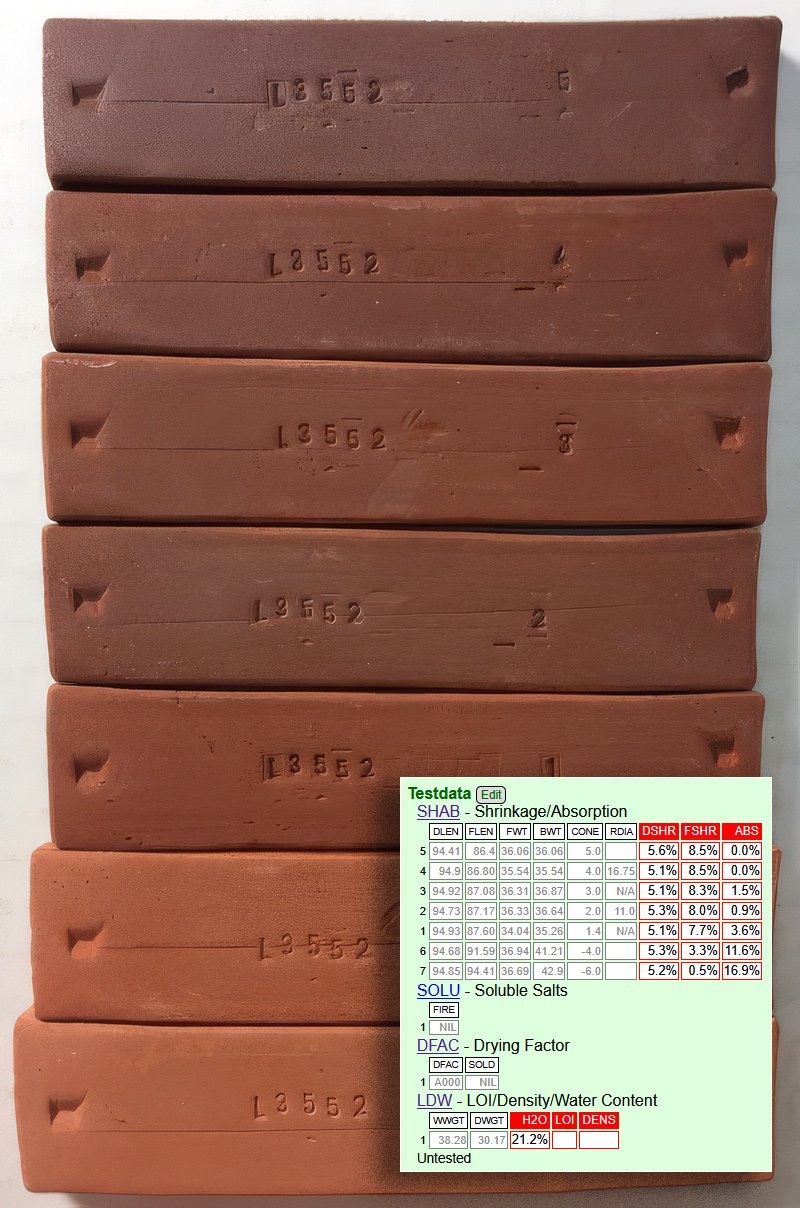
Redart 2010 test bars:
As a physical properties reference
This picture has its own page with more detail, click here to see it.
Here is what Redart fired like in 2010 when evaluated for physical properties using the SHAB test and LDW test. These bars are fired from cone 5 down to 06 (top to bottom). The clay reached zero porosity between cone 1 and 2. Beyond that, it was stable to cone 4. Its drying shrinkage was only 5%, indicating low plasticity (compared to a typical pottery clay). It is thus an ideal candidate for a ball clay addition to create a plastic body for handbuilding or throwing.
However, its plasticity is just right for slip casting; it can be used as is. It has no soluble salts and a perfect score on the drying performance DFAC test. Cone 04 and 06 porosity and fired color are very typical of terracotta clays. The fired color of this material really is stunning. And the stability of that color across such a wide temperature range.
 PayPal | No tracking, No ads, No paywall, No transient content! Just organized, concise information constantly updated and improved. Was this helpful? Consider supporting me. |
Got a Question?
Buy me a coffee and we can talk 

https://digitalfire.com, All Rights Reserved
Privacy Policy