A YOLO glaze recipe gets a reprieve
This recipe is pretty far out on the edge for a glaze rescue. But the potter loves the appearance, so it is still worth preserving for decorative or non-food-contact use. Of course, one must go in with eyes open about its application, fit and durability issues. Consider the obvious red flags:
- Almost 30% barium carbonate, combined with SiO2, this raises serious durability and barium-release concerns.
- Only 5.7% kaolin means poor slurry suspension and troublesome application.
- There is no added silica, and the calculated SiO2 is very low for a high-fire glaze.
- Custer feldspar is no longer available to many users.
- More than 43% nepheline syenite supplies a lot of KNaO, and the very high calculated thermal expansion strongly suggests crazing risk on many bodies.
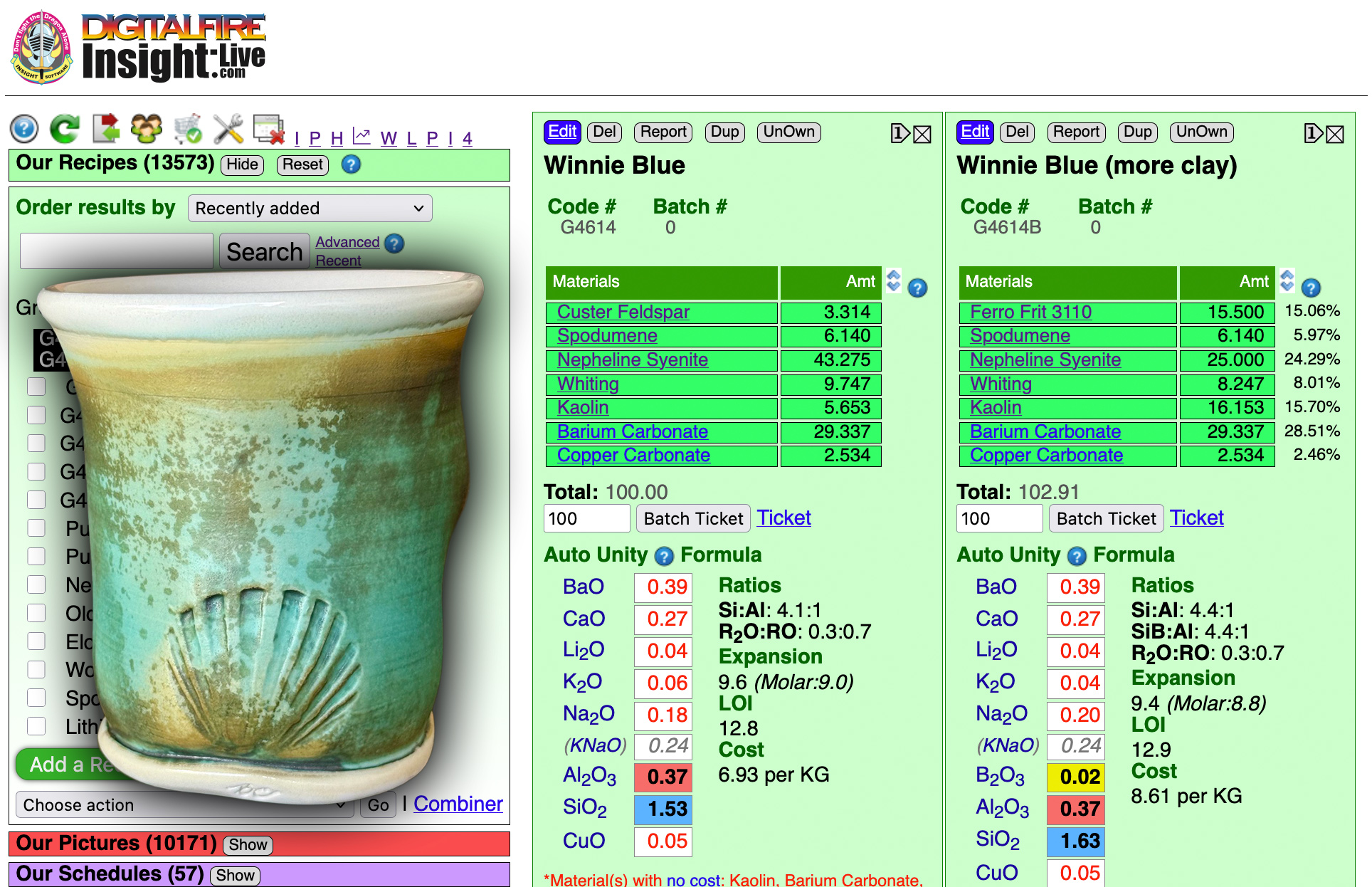
But this glaze has one thing the potter values: it appearance (see image). So rather than discard it, we reworked the material sourcing while keeping the oxide chemistry very similar. I reduced the nepheline syenite substantially and introduced Ferro Frit 3110 to supply much of the KNaO without bringing much Al2O3 with it. That enabled the kaolin percentage to almost triple, from 5.7% to 16.2%, while calculated Al2O3 stayed at 0.37. The result should be a much more practical slurry while giving the glaze a reasonable chance of retaining the character that made it worth rescuing in the first place.
However, the new recipe still has 29% barium carbonate and a calculated expansion of 9.4, so this is not a “fixed glaze.” It is a more usable version of an intentionally problematic glaze.
Links
| Materials |
Barium Carbonate
A pure source of BaO for ceramic glazes. This is 77% BaO and has an LOI of 23% (lost at CO2 on firing). |
| Typecodes |
Glaze Rescue
Taking an alluring recipe found on-line and using recipe logic and materials sense to determine if it is worth spending time on. Quite often, reactive glazes (the most popular) can be recognized on sight as having many strings attached. Rather than just mixing them as given, it is worthwhile to investigate improving them on the way into your studio or plant. At one extreme, this may just involve transplanting the mechanism into another base. At the other, glaze chemistry can enable a whole range of improvements and fixes. |
 PayPal | No tracking, No ads, No paywall, No transient content! Just organized, concise information constantly updated and improved. Was this helpful? Consider supporting me. |
Got a Question?
Buy me a coffee and we can talk 

https://digitalfire.com, All Rights Reserved
Privacy Policy