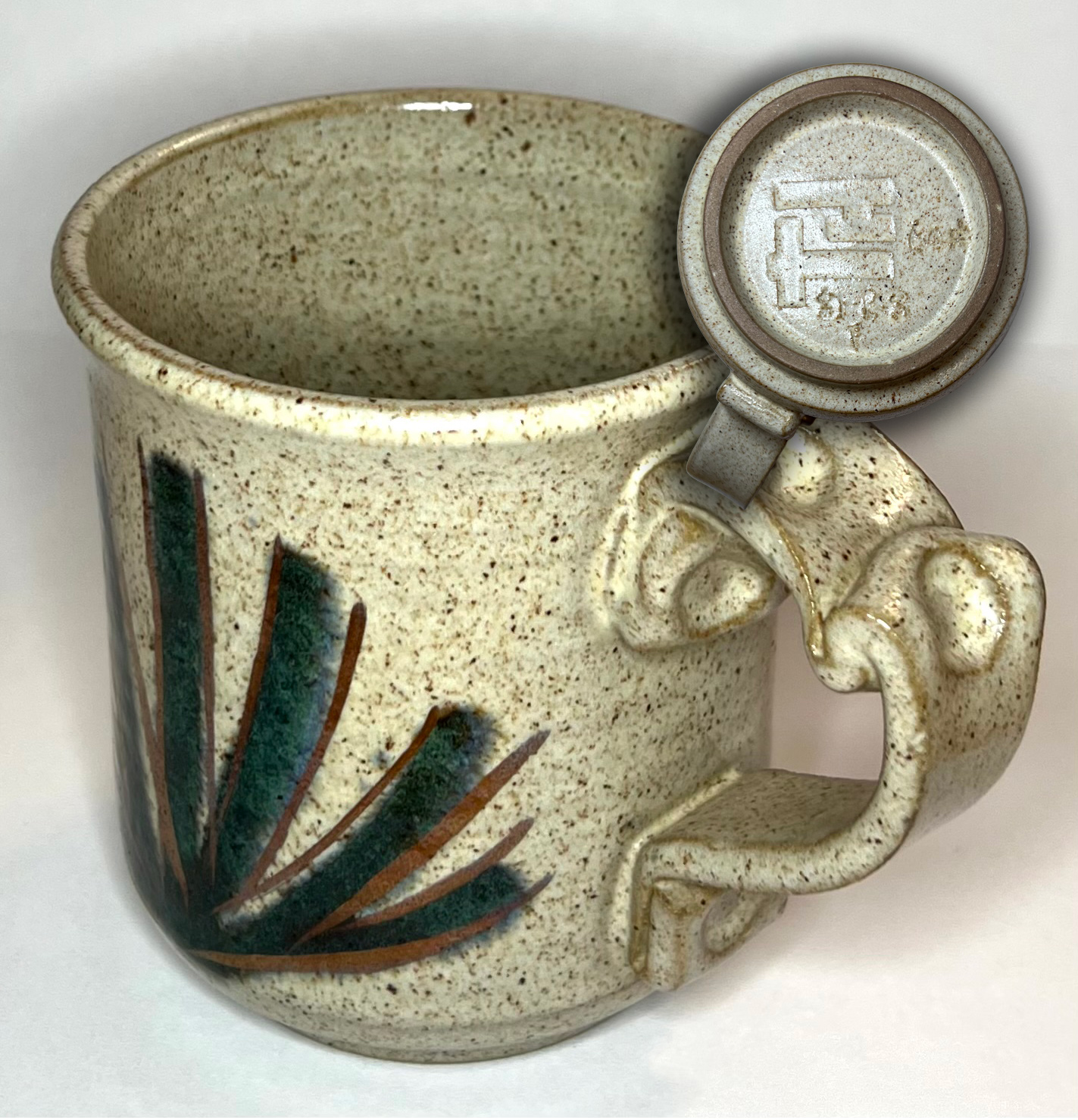
A test mug I made back in 1981
It has a story that goes back to early Digitalfire
This is a cone 6 oxidation test mug I made in 1981. The speckling in the glaze was made by adding iron stone concretion particles. But this also has a story. Most potters at the time were firing cone 10R or low-temperature, cone 6 electric stoneware was a new development. Note the incised code number: "81-R-5". Digitalfire data archival was already well underway on my TRS-80 computers. The base also has a "60#" marking. I was trying a finer 60 mesh particle size to alleviate the glaze pinholing problems that plagued Plainsman customers at the time (their products were made at 42 mesh and kilns did not have controllers that enabled drop-and-hold or even hold-at-temperature firings that are used now). Pinholing was one of the first glaze problems that I studied; many glaze chemistry projects, using my new Desktop Insight, were aimed at making glazes having melts of lower surface tension and higher melt fluidity (using frits).
Related Pictures
I once tolerated this amount of pinholing:
Then I discovered drop-and-hold firing

This picture has its own page with more detail, click here to see it.
This cone 6 vase was made from a coarse-grained stoneware body typical of those long produced by Plainsman Clays. These materials performed exceptionally well at cone 10 reduction, but when similar bodies began being fired at cone 6 oxidation, pinholing often became a challenge. Why? The coarser particle structure creates fewer but larger pathways for escaping decomposition gases, concentrating gas flow through localized vents and leaving behind pits like those visible here.
Yet today many potters fire these same clays with little or no pinholing. Electronic kiln controllers deserve much of the credit, making drop-and-hold and slow-cooling schedules practical. Equally important, I formulate glazes with enough melt fluidity to heal gas-release craters during the hold, while maintaining sufficiently low surface tension to avoid trapping gases in bubbles that later become blisters. Commercial glaze manufacturers have quietly optimized for these same properties.
Links
| URLs |
https://digitalfire.com/people/45
Tony Hansen's Pottery Gallery |
| URLs |
https://tonyhansen.com/tony.php
Tony Hansen Tony Hansen is the owner of Digitalfire Corporation, a technician at Plainsman Clays, a potter and product developer and internationally known web designer and programmer, graphic artist, author, educator and dreamer. |
| URLs |
https://tonyhansen.com/pottery
Tony Hansen pottery (what I make and why I make it) |
| Troubles |
Glaze Pinholes, Pitting
Analyze the causes of ceramic glaze pinholing and pitting so your fix is dealing with the real issues, not a symptom. |
 PayPal | No tracking, No ads, No paywall, No transient content! Just organized, concise information constantly updated and improved. Was this helpful? Consider supporting me. |
Got a Question?
Buy me a coffee and we can talk 

https://digitalfire.com, All Rights Reserved
Privacy Policy