Why this copper glaze does not micro-bubble or craze:
High cone 6 melt fluidity, low surface tension, MgO
This green is not just a typical transparent cone 6 glaze with 2% copper carbonate added (and 2.5% tin oxide). That outer glossy glaze accommodates the copper without micro-bubbling or crazing because of its lower melt surface tension. In such glazes, significant MgO (a super low expansion oxide) can often be tolerated without losing gloss. This is a light bulb moment. Fully 0.15 molar of MgO are present here. This is the "matting oxide"! Yet the glaze is still hyper-glossy!
The above factors are enough. But if this were used in industry, technicians would fix additional issues: The very low initial melting temperature (from 37% very early-melting frit in the recipe). That traps LOI bubbles unnecessarily. Raising the ZnO and sourcing as much of the B2O3 and KNaO as possible from later melting materials and/or frits.
The porcelains are Plainsman P300 and M370. The liner glaze is G2926B, it is a gloss but has a much lower melt fluidity, it is a functional transparent whose main job is to fit the body and be hard and durable. The outer glaze is G3806C.

Related Pictures
2% Copper in two cone 6 transparents:
One does not bubble and orange-peel. Why?
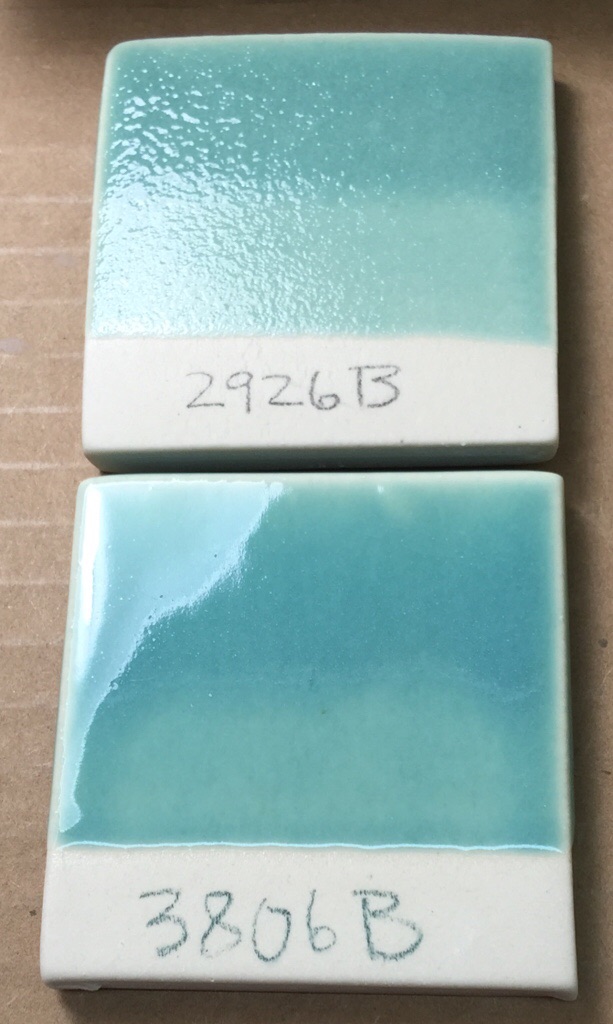
This picture has its own page with more detail, click here to see it.
The top base glaze, G2926B, has enough melt fluidity to produce a brilliant functional gloss when used as a transparent. However, for this 2% copper carbonate addition, it has too little melt fluidity and/or too much surface tension to merge, pass and heal the entrained micro-bubbles (generated by the decomposition of the carbonate).
The lower glaze, G3806B, diversifies the fluxes (half the B2O3 in exchange for more Na2O and introduction of SrO and ZnO) and increases their total compared to Al2O3 and SiO2. The result is a more fluid cone 6 melt having lower surface tension. The mixed-oxide effect is also a factor here; the diversity itself improves the melt.
The above factors are enough to solve the problem here. But more can be done. More zinc (in exchange for KNaO) could produce later melting, especially in combination with sourcing some or all of the latter from a feldspar instead of the low-melting frit. The benefit would enable more gas escape until melt-sealing (and reduce the COE).
Links
| Recipes |
G3806C - Cone 6 Clear Fluid-Melt transparent glaze
A base fluid-melt glaze recipe developed by Tony Hansen. With colorant additions it forms reactive melts that variegate and run. It is more resistant to crazing than others. |
| Glossary |
Fluid Melt Glazes
Fluid melt glazes and over-melting, over fired, to the point that they run down off ware. This feature enables the development of super-floss and cyrstallization. |
 PayPal | No tracking, No ads, No paywall, No transient content! Just organized, concise information constantly updated and improved. Was this helpful? Consider supporting me. |
Got a Question?
Buy me a coffee and we can talk 

https://digitalfire.com, All Rights Reserved
Privacy Policy