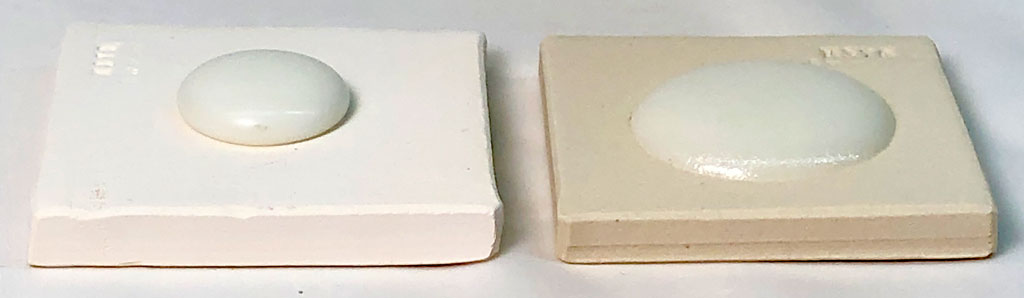
Surface tension differences between two glazes:
This simple test shows them best
Both are low-fire transparents. In a melt fluidity (GBMF test) they flow similarly. But here, where the 10 gram ball of the dry glaze is simply melted down onto a square tile (a GBMF test), differences in surface tension are more clearly evident by the angle at which the edge of the glaze meets the tile.
Related Pictures
These two transparent glazes are opposites:
In melt fluidity and surface tension

This picture has its own page with more detail, click here to see it.
This cone 04 flow tester compares two commercial low-fire transparent glazes. Their different chemistry strategies are revealed by the shape of these melt flows. While 3825B appears to have the higher melt fluidity, it also has much higher melt surface tension. This is evident in the narrow, rope-like stream and the way the flow meets the runway at a high angle before pulling into a rounded bead. A, by contrast, spreads and wets the runway, meandering downward in a broad, flat and relatively bubble-free river.
This difference is important in low-fire ware because these glazes must pass far more gases and bubbles than high-temperature glazes. The lower surface tension of A aids bubble release and healing after bubbles break. A is Amaco LG-10. B is Crysanthos SG213 (Spectrum 700 behaves similarly, although flowing less). Both approaches have advantages and disadvantages and are worth testing in your application.
Crawling on sanitary ware:
Laydown is the first suspect

This picture has its own page with more detail, click here to see it.
This is glaze crawling and it underscores the need for attention to the details of all production parameters. This one small glaze defect makes this pedestal sink either a refire, a second or unsaleable. This is most common on abrupt surface contours but that is not the case here. The cause of this is likely several factors combining. The glaze is opaque white because it contains a high percentage of zircon opacifier. Zircon glazes tend to do exactly this so their successful use is doubly dependent on minimizing the percentage added and on attention to other details to compensate. This glaze has been applied thickly to ensure good coverage (thicker laydowns bring more crawling problems). The glaze is likely low in clay and thus the physical bond of the dried glaze layer depends on the binders being used, their percentages, the integrity of the way they were mixed in, and their shelf life. The ability of the glaze laydown to dry-bond with the body depends on the condition of the surface (e.g. water content, dry or bisque fired, smoothness, dustfreeness, quality of materials used in the body and integrity of body preparation, etc), the presence of surface contaminants (e.g. soluble salts) and the way in which it was applied and its thickness. The glaze melt's ability fire-bond and form an interface with the body that produces a smooth surface is dependent on its melt fluidity and ability to form an interface with the body.
There is another way to look at this problem: The process runs along crawling multiple tipping points: A viscous glaze melt, glaze application to dry rather than bisque ware, a thick glaze application, a large surface area intolerant of any defects and a glaze application technique (spraying) prone to irregularities of thickness. Rather than trying to identify the specific problem it might be better to simply make changes to move the process back from the tipping points.
Links
| Glossary |
Surface Tension
In ceramics, surface tension is discussed in two contexts: The glaze melt and the glaze suspension. In both, the quality of the glaze surface is impacted. |
| Tests |
Glaze Melt Fluidity - Ball Test
A test where a 10-gram ball of dried glaze is fired on a porcelain tile to study its melt flow, surface character, bubble retention and surface tension. |
 PayPal | No tracking, No ads, No paywall, No transient content! Just organized, concise information constantly updated and improved. Was this helpful? Consider supporting me. |
Got a Question?
Buy me a coffee and we can talk 

https://digitalfire.com, All Rights Reserved
Privacy Policy