Why Petalite and Spodumene will seldom substitute for Lithium Carbonate
Of course, if a recipe only calls for 1-2% lithium carbonate, either of these might be candidates to supply the Li2O. But Petalite is 8x less concentrated and Spodumene 5x less. Not surprisingly, prices reflect this (unless availability is the issue). But when a recipe calls for 5% lithium carbonate, there is another problem: Petalite is extremely high in SiO2 and spodumene is very high in Al2O3. Introducing enough of either of them to supply the same amount of Li2O as 5% lithium carbonate can easily oversupply either. While extra SiO2 can often be accommodated because most glazes contain significant silica, bringing in a lot of Al2O3 necesitates cutting the most important normal source: Clay. The result is a slurry that does not harden and does not stay suspended.

Related Pictures
Why is spodumene so expensive?
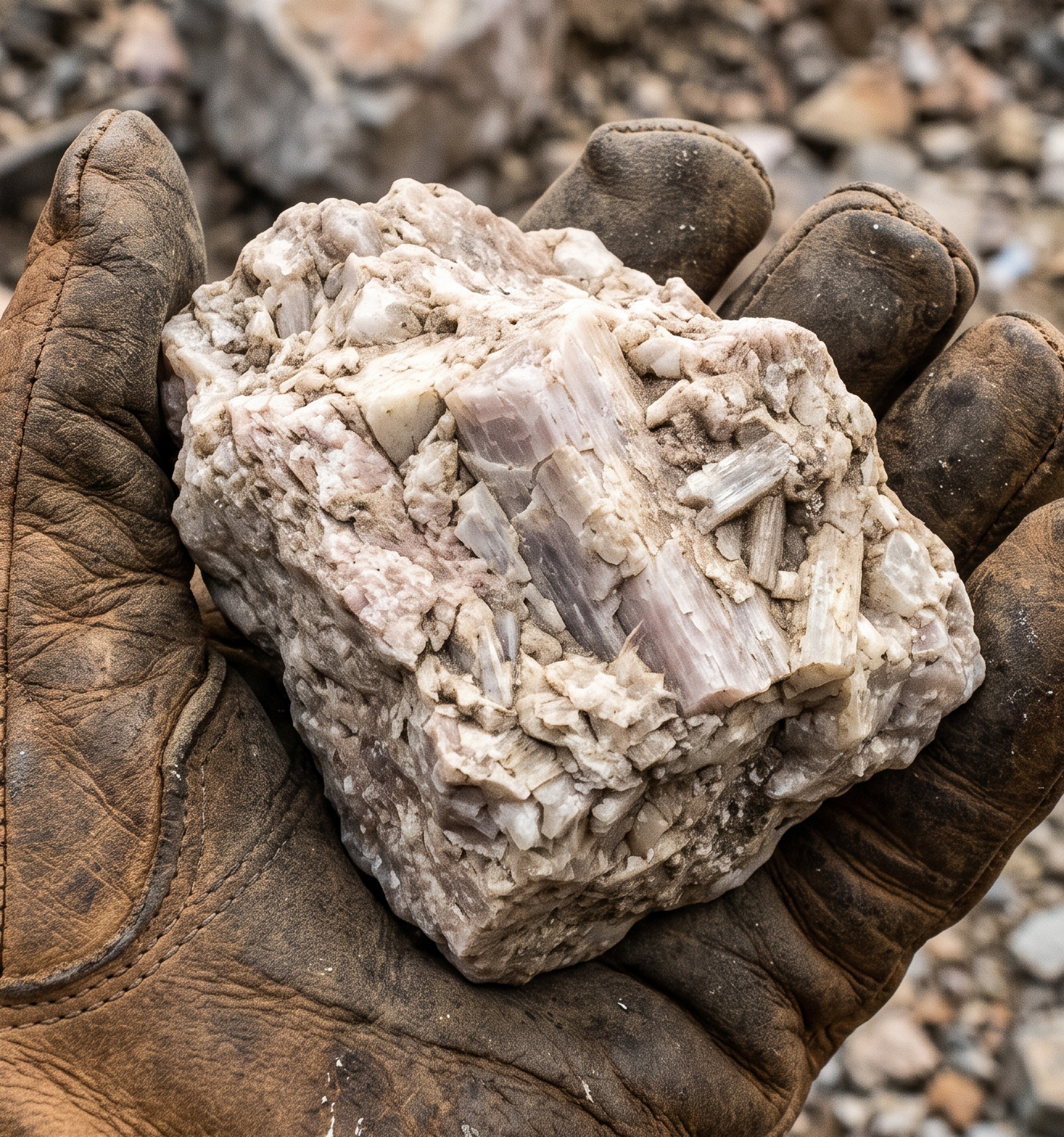 Made by Gemini in response to a query to create a fist-sized spodumene ore rock. AI Policy
This picture has its own page with more detail, click here to see it.
Industrial spodumene is found in massive quantities across major mining regions like Australia, Africa, and North America. Spodumene exists as mine concentrate, technical/ceramic grade and battery-grade material (the battery industry it has effectively repriced a ceramic feldspathic mineral as "lithium ore"). Still, if this 1.5kg rock was pure spodumene, it could be processed to ceramic grade and sold for $45 (June 2026). The actual mining commodity price at that time was US$2,100/tonne (pricing this rock at $3). That means finely ground ceramic spodumene is currently selling for 10+ times the mine/concentrate price.
Spodumene pricing is disconnected from mine-markets
The battery market continues to set the economic context for ceramic spodumene and lithium carbonate.-Zimbabwe suspended exports of raw minerals and lithium concentrates in February 2026, briefly pushing Chinese lithium-carbonate futures above 178,000 yuan/tonne.
-Earlier data showed spodumene concentrate recovering from about US$610/tonne in June 2025 to above US$2,000 in early 2026.
-Prices subsequently fell sharply in March, illustrating how disconnected ceramic-supplier pricing can be from rapidly changing mine-market values.
-October 12, 2026: The Chinese lithium benchmark fell to 115,400 yuan/tonne, down 5.68% in one day and 16.77% over the preceding month. It nevertheless remained about 58% above its year-earlier level.
What about lithium carbonate?
Albemarle reported an average industrial price of US$19.53/kg in Q2 2026. So potters currently pay only up to 8 times that! Yet, the processing is formidable: The ore must be crushed and beneficiated, then subjected to a high-temperature calcination that converts alpha spodumene to the more reactive beta form, followed by acid roasting, leaching, neutralization, impurity removal and further conversion.As evidence that lithium is still important, one potter just purchased a 50-pound bag of spodumene for $1200 so she wouldn’t have to worry about it for the rest of her career!
Glaze chemistry and willingness to do testing insulates you
Fortunately, our kilns don’t care where the Li2O comes from. Spodumene substitutions for lithium carbonate must be done oxide-for-oxide (their accompanying SiO2 and Al2O3 make weight-for-weight replacement invalid). Melt-flow, crystallization, thermal-expansion and slurry tests, not just unity-formula matching, are not only important in industrial settings but valuable to potters (insight-live.com is designed for this). Ceramic suppliers should be asked for current chemistry, mineral form and particle-size specifications; “spodumene” alone is insufficient..Li2O from Spodumene instead of Lithium Carbonate:
Good chemistry and economy, but bad physics

This picture has its own page with more detail, click here to see it.
Lithium carbonate is now ultra-expensive. Yet the reactive glaze on the left needs it. Spodumene has a high enough Li2O concentration to be a possible source here. It also has a complex chemistry, but the other oxides it contains are those common to glazes anyway. I did recipe rescue calculations and got a pretty good match in the formulas (lower section in the green boxes). Then I made 10-gram balls and did a GLFL test at 2200F.
Not surprisingly, this recipe is very runny; that's why the tiny yellow crystals grow during cooling. The new version fires very similarly, perhaps better. My calculated cost to mix these in 2022 was $17.84/kg vs. $10.40/kg. In 2026, the difference is even greater! But there is a practical cost: Poor slurry properties. The spodumene sources so much Al2O3 that 70% Alberta Slip had to be dropped to accommodate it! How does one use this type of glaze without ruining kiln shelves? Using a catcher glaze is one answer.
LOI-gassing and Spodumene produce this:
Melt fluidity with blisters that variegate, then heal
This picture has its own page with more detail, click here to see it.
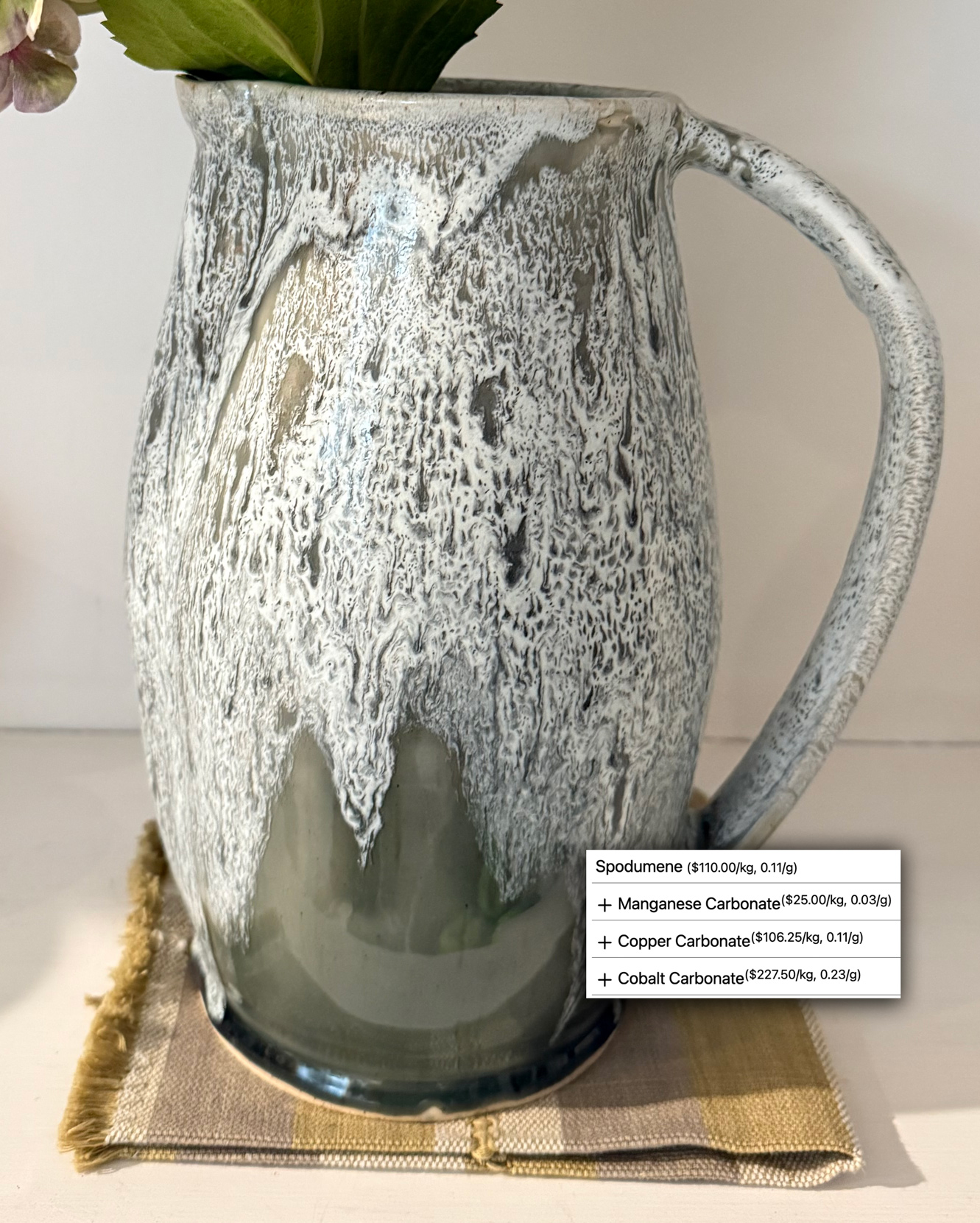
This pitcher was made by Elora Pottery. Like everyone using glazes that require lithium (from Spodumene or Lithium Carbonate), they are facing the unbelievable price increases these materials are seeing. Staci actually calculated the weight applied to each piece, determining the $$ dip cost! Notice her material costs on the photo. During efforts to reduce the spodumene content, I noticed the expensive carbonate colorants and asked if these were causing blisters in the glaze (because of gassing associated with their LOI). When I saw this picture, it became clear that they are. But in a good way. Part of the variegation we are seeing is doubtless the mechanical disturbance they cause in the fluid-melt phase-separated glass. But the melt fluidity of the glaze appears to be sufficient to heal them and smooth out the glass during cooling.
What did we do about the spodumene? We calculated to use lithium carbonate to supply the Li2O instead - it took one fifth as much material. Still super expensive, but easier to use and more consistent.
Petalite for Lithium Carbonate:
It takes eight times as much!
This picture has its own page with more detail, click here to see it.
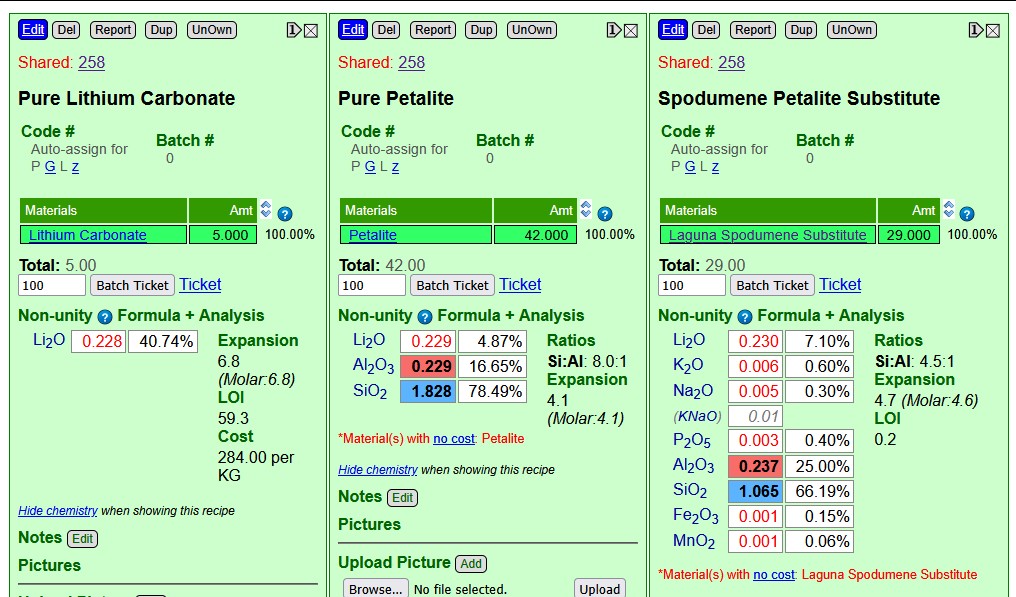
Here are the three common lithia source materials in a side-by-side calculation to compare their potencies. I have adjusted the material weights so that all are delivering the same amount of Li2O (assuming a recipe calling for 5% lithium carbonate).
By weight it takes 42 parts of petalite to deliver the same amount of Li2O as 5 parts lithium carbonate! But notice how much SiO2 and Al2O3 come along, major surgery on the host recipe is needed to compensate for this (if even possible). Spodumene is complicated too, it brings along so much Al2O3. That’s a problem because the most frequent existing Al2O3 supplier, clay, may have to be greatly reduced or even eliminated (producing a recipe that does not suspend in water). The other baggage both materials bring is lots of SiO2, especially petalite. Thus, replacing lithium carbonate with petalite or spodumene is not really a material substitution—it is a glaze reformulation.
Links
| Materials |
Petalite
|
| Materials |
Spodumene
Spodumene is a lithium sourcing feldspar, an alternative to lithium carbonate to supply Li2O to ceramic glazes. Contains up to about 8% Li2O. |
 PayPal | No tracking, No ads, No paywall, No transient content! Just organized, concise information constantly updated and improved. Was this helpful? Consider supporting me. |
Got a Question?
Buy me a coffee and we can talk 

https://digitalfire.com, All Rights Reserved
Privacy Policy