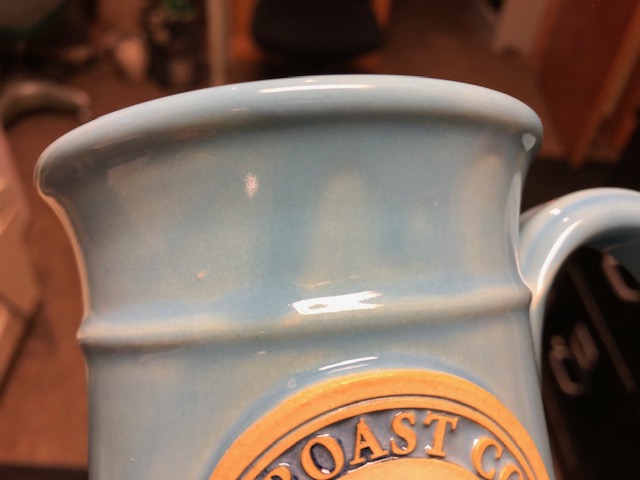
Unwanted streaking in a glaze:
Uneven laydown is the likely reason
This is a fluid melt cone 6 glaze with colorant added and partially opacified. It runs into contours during firing, thickening there (notice the darkening around the logo), this is a desired visual effect. However, notice that drips and runs coming down from the rim, they are producing darker streaks. This is a laydown issue. Dipping glazes that fasten-in-place too slowly will often drain unevenly on extraction from the bucket. This can be solved by making slurries thixotropic. Even on dense bisque, they will fix-in-place in an even layer. Glazes having sufficient clay (e.g. 15% kaolin) will gel more easily (to become thixotropic). Slurries containing significant CMC gum may apply evenly but thinly (and dry slowly, with drips).
Links
| Glossary |
Opacity
Opacity of ceramics glazes is normally achieved by adding an opacifier like tin oxide or zircon. However, there are chemical profiles that can turn transparent glazes milky and make it cheaper to opacify them. |
| Glossary |
Glaze laydown
Refers to the quality of the dried ceramic glaze layer and how this affects the fired result: e.g. density, hardness, evenness, thickness, freedom from defects, etc. |
| Glossary |
Fluid Melt Glazes
Fluid melt glazes and over-melting, over fired, to the point that they run down off ware. This feature enables the development of super-floss and cyrstallization. |
 PayPal | No tracking, No ads, No paywall, No transient content! Just organized, concise information constantly updated and improved. Was this helpful? Consider supporting me. |
Got a Question?
Buy me a coffee and we can talk 

https://digitalfire.com, All Rights Reserved
Privacy Policy