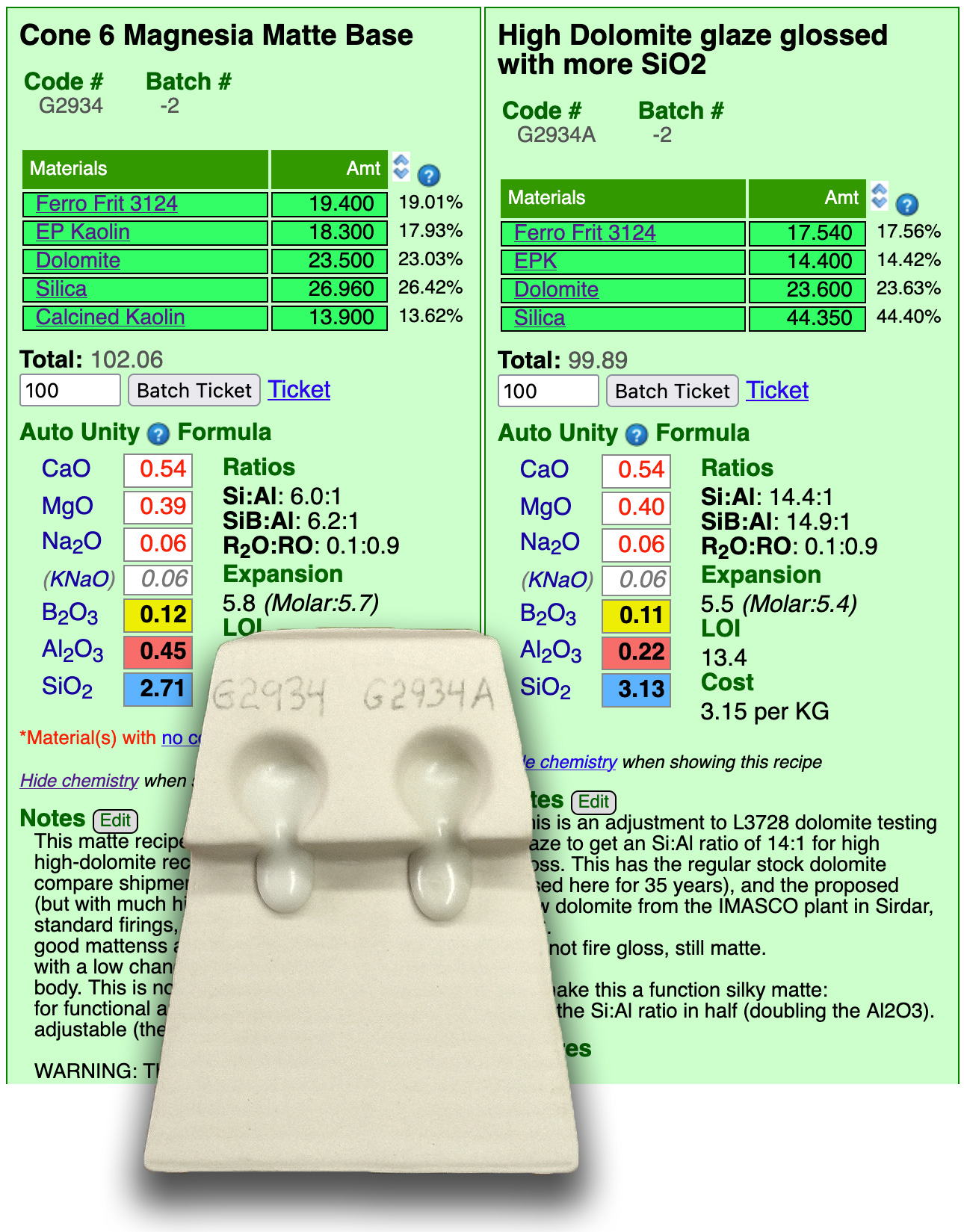
G2934 plus 10% silica actually flows more
Until now, I thought magnesia matte glazes need high Al2O3 and a low Si:Al ratio. But this melt flow test suggests otherwise. The cone 6 glaze on the left (A) is close to my usual target of 0.4 MgO, 0.1 B2O3 and a ratio of 6:1 (approaching ceramic tile proportions). It is thus a classic high-MgO / higher-Al2O3 magnesia matte. The melt's high viscosity, limited flow, and phase separation produce the very fine surface texture.
However, glaze B has a super-high Si:Al ratio of 14:1. Yet it is not running much more and is almost as matte. How? It seems I shifted the matteness mechanism. Cutting the Al2O3 in half and spiking the SiO2 has moved from a high-alumina magnesia matte toward a low-alumina, high-silica calcium/magnesium silicate matte. The massive surplus of SiO2 coupled with oversupplied MgO and plentiful CaO has weakened the "glue" that keeps the latter busy in the glass matrix, so they precipitate out (as calcium-magnesium silicates, diopside CaMgSi2O6 or enstatite MgSiO3, according to Google). This still creates a matte surface by crystallization and phase separation. The degree of matteness could likely be enhanced by slow cooling. And possibly 400 mesh silica.
Related Pictures
Calcia vs Magnesia matte - Different mechanisms
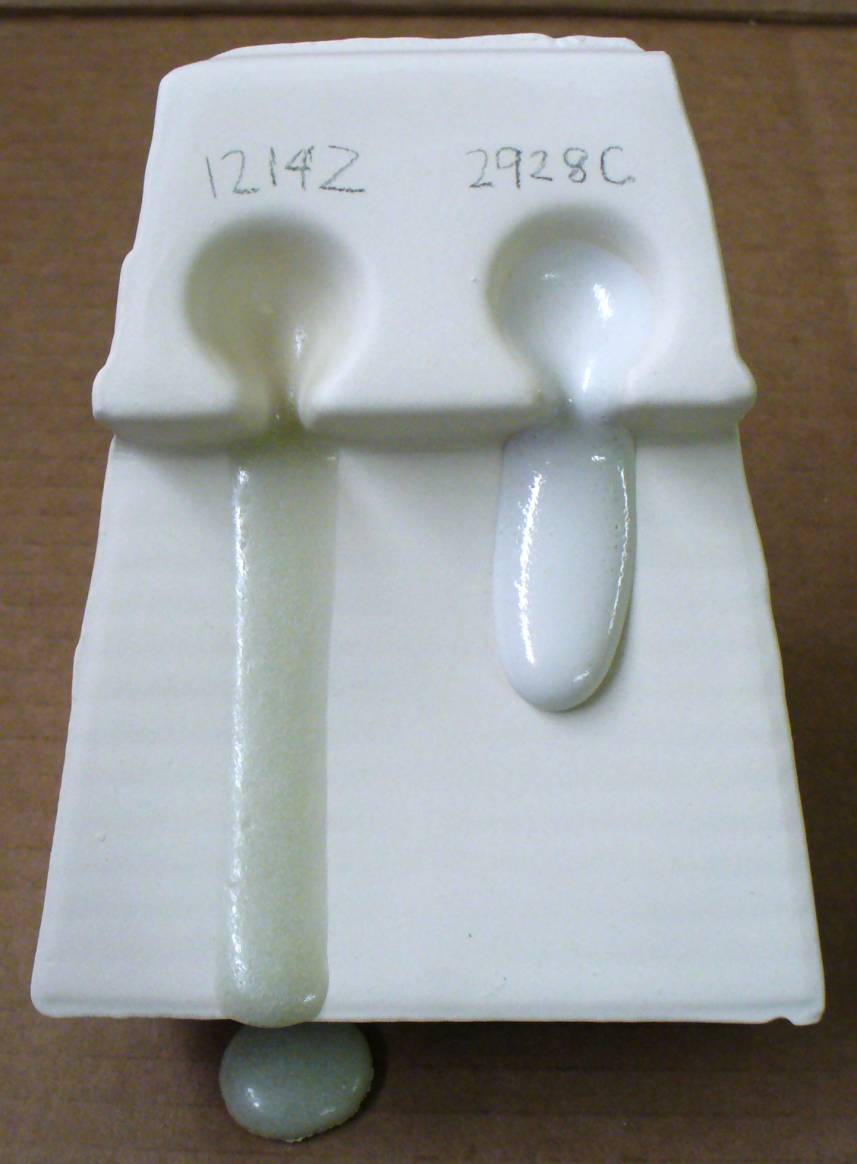
This picture has its own page with more detail, click here to see it.
This melt flow test was done at cone 6+ (without slow cooling) to demonstrate the difference in melt viscosity between a calcia matte (left G1214Z1) and a magnesia matte (right G2928C). In simplest terms, the former depends on a fluid melt to provide the needed mobility for tiny crystals to form during cooling, those crystals scatter the light and soften the surface to produce the matte effect. The latter requires a stiffer melt to help prevent levelling during cooling and host phase separation to produce a rippled surface that scatters light.
Links
| Glossary |
Calcia Matte
Calcia matte ceramic glazes are “crystal mattes” while magnesia mattes are “microstructure mattes”. They have a smoother surface but can also have finely textured, even frosty, feathery or sugary surfaces, depending cooling and crystalliztion. |
| Glossary |
Magnesia Matte
Magnesia matte ceramic glazes are “microstructure mattes” while calcia mattes are “crystal mattes”. They have a micro-wrinkle surface that forms from a high viscosity melt and microscopic phase separation, both of which prevent levelling on freezi |
| Typecodes |
Glaze Chemistry
Case studies where glaze chemistry was used to solve a problem. |
 PayPal | No tracking, No ads, No paywall, No transient content! Just organized, concise information constantly updated and improved. Was this helpful? Consider supporting me. |
Got a Question?
Buy me a coffee and we can talk 

https://digitalfire.com, All Rights Reserved
Privacy Policy