A heavily grogged body:
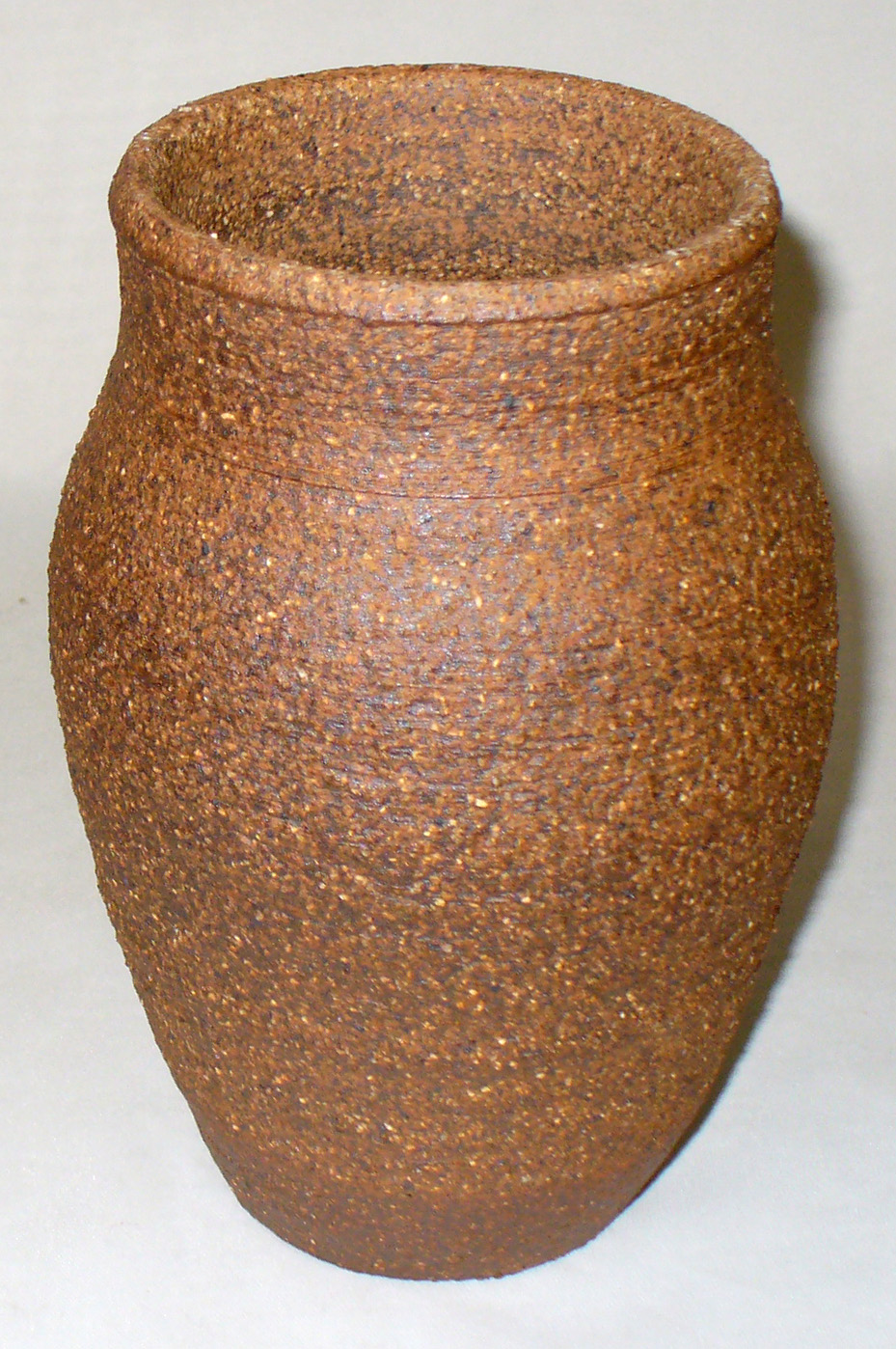
Yet throws surprisingly well
This cone 10R piece is about 8 inches tall and quite thin-walled. This is L3118J grogged clay with 25% Christy Minerals STKO22S grog. It is not a typical grog having a range of particle sizes, these particles are all close to 20 mesh. Because the base body, mainly Redart and Ball clay, is so fine and plastic, and the grog is only one size, this is not only throwable but resistant enough to splitting that large pieces can be made. The plasticity of the base and the mobility of the grog particles within enables applying pressure with surprisingly less abrasion than expected. And of course, the grog makes it highly resistant to cracking during drying.
Related Pictures
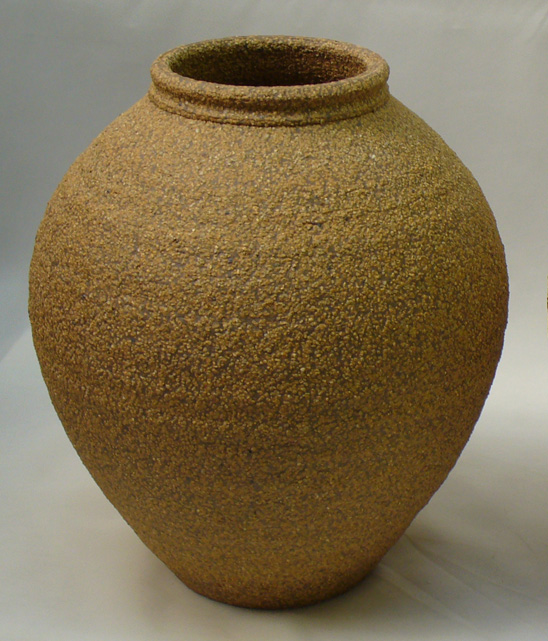
A highly grogged body that is almost porcelain-vitreous
This picture has its own page with more detail, click here to see it.
This is an unusual cone 10R vitreous sculpture clay (code number L3118J). The grogless base burns dark brown and is almost porcelain-vitreous. All of the surface variegation is a product of the contrasting colour of the dark brown body and lighter coloured grog. Almost all of the fired porosity is from the refractory grog particles.
This was inspired by Craft Crank, a UK-made highly grogged body: A super-plastic base that can host a high percentage of coarse grog particles yet still offer very good workability (and be throwable, even non-abrasive, on the wheel). My base has 40% ball clay, 10% plastic kaolin, 20% Redart, 5% quartz and 25% 20x48 grog. Redart is an illitic clay, containing K2O like a feldspar, the 20% here has enough fluxing power to vitrify the body. Given recent changes in Redart, this recipe could be modified to compensate (e.g. add iron oxide, use 45 ball clay instead of a 50 ball clay/kaolin mix, add 5% feldspar).
Sculpture Clay in functional ware? Yes!
This is Plainsman Sculpture-clay. At cone 10R it is vitreous, a deep brown low porosity body. The particles of grog create a beautiful surface. The glaze is G2571A bamboo matte. It was fired using the C10RPL schedule. By Tony Hansen.
Craft Crank sculpture clay is plastic and smooth:
Yet it has this much grog! How is that possible?

This picture has its own page with more detail, click here to see it.
The super-smooth clay on the left is "Industrial Crank" from Potclays in the UK, I have removed the grog (our test code number L3868). First I did our standard tests on that body, then I dried some, slaked it in water, screened the grog out and then dewatered the remaining clay to plastic form. The grog yielded weighed the same as the clay portion of the recipe yet this body is known for amazing workability and toughness! How is that possible with so much aggregate in the recipe? The base clay body is extremely smooth, sticky and highly plastic. Mixtures of just ball clay and feldspar (e.g. 75:25) will yield this type of material, some ball clays will produce as little as 6% drying shrinkage using this ratio. The grog they use is also special: The particles have angular shapes and a narrow range of sizes, from about 35 mesh to 70 mesh (most is of the coarsest size). This narrow range of sizes means dramatically less particle surface area. These factors produce much less disruption of the plastic properties of the base clay. How could you make a body like this? Slurry up about 75% ball clay and 25% feldspar and wedge the grog into that.
A heavily grogged vitreous clay for functional?
Redart and engobes make it possible

This picture has its own page with more detail, click here to see it.
This is L3118J, a chocolate brown burning super-plastic base clay (to which 25% coarse grog is added). The base matures at cone 6, yet the grog stabilizes the fired matrix enough that it stands up in the kiln at cone 10R, firing to a dense vitreous product (its porosity of 4%, comes from the grog). Only 20% Redart clay provides both the color and the K2O flux (no feldspar is needed). There is a second factor that makes this clay functional: An engobe to smooth the surface under the glaze. These two mugs employ L3954N (on the inside applied at the leather hard stage), they enable the smooth surface needed for the glaze. The glaze is brown and blue colored versions of G2571A.
Links
| Materials |
Grog
|
| Materials |
Redart
The most common commercially 200 mesh available raw terra cotta clay in North America. It fires red, has low plasticity and matures a low kiln temperatures. |
| Glossary |
Vitrification
A process that happens in a kiln, the heat and atmosphere mature and develop the clay body until it reaches a density sufficient to impart the level of strength and durability required for the intended purpose. Most often this state is reached near zero p |
 PayPal | No tracking, No ads, No paywall, No transient content! Just organized, concise information constantly updated and improved. Was this helpful? Consider supporting me. |
Got a Question?
Buy me a coffee and we can talk 

https://digitalfire.com, All Rights Reserved
Privacy Policy