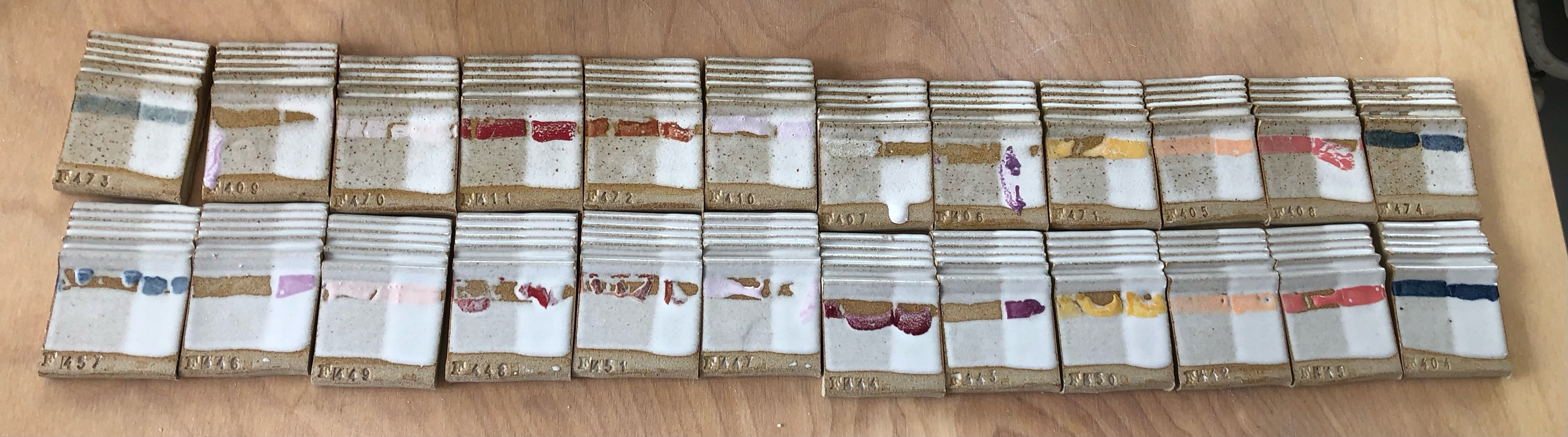
Faux majolica next level: Stoneware!
But the glaze is crawling under the colors.
The original Italian majolica ware was red earthenware with a thick layer of tin-opacified glaze vibrantly brush-decorated using single-strokes of watery metal oxides. The water-color of ceramics. But tin oxide is no longer affordable. And ceramic stains are better. And no one uses lead glazes. So all majolica-like ware made today is actually “faux (false) majolica”. These test samples take the “faux” to the next level: Stoneware with a zircon-opacified white glaze. But almost all are crawling. If this happens for you ask these questions:
Is the glaze re-wetable? Dipping glaze recipes often are not, especially if they fail sanity check (e.g. are over-clayed or under-clayed).
Base coat dipping glaze better survive the rewetting of a second layer?
Mixing them as a brushing glaze give maximum insurance.
What did they look like when the overcolor dried? Cracks are sure indicator or crawling.
Were you painting pure stain or metal oxide (mixing with water only)? Don’t do that. Water color paint uses gum Arabic, pottery colors need to be in a stain medium (which often has CMC gum).
Related Pictures
Glaze bowls by brushing instead of dipping:
Convert your dipping glazes to brushing

This picture has its own page with more detail, click here to see it.
This wheel-thrown bowl is heavy and thick-walled. Applying dipping glazes, both the outside and inside, can be cumbersome, slow and trouble prone (especially where two difference colors must meet at the rim). It turns out that the hobbyist way of brushing glazes can actually better for this. I make these 500ml jars of brushing glaze and tune the percentage of gums to get the right painting consistency and drying time. Applying multiple coats by brush takes only a few minutes, and no wax resist or any other tools are needed. And it is easy to meet two glazes in a straight line at the rim. On this piece, the inside glaze is G2936B and the outside is G2926B. Both are almost always used as thixotropic dipping glazes for other types of ware, but nothing about their recipes disqualifies them from being mixed as brushing glazes.
Links
| Troubles |
Crawling
Ask yourself the right questions to figure out the real cause of a glaze crawling issue. Deal with the problem, not the symptoms. |
| Glossary |
Stain Medium
A stain medium (or ceramic medium) is a mix of powdered ceramic materials that impart ceramic properties that stain powders lack in themselves (e.g. ability to form a hard ceramic that fits the underlying body or overlying glaze. |
 PayPal | No tracking, No ads, No paywall, No transient content! Just organized, concise information constantly updated and improved. Was this helpful? Consider supporting me. |
Got a Question?
Buy me a coffee and we can talk 

https://digitalfire.com, All Rights Reserved
Privacy Policy