Craze city: Pure Feldspar and Nepheline Syenite
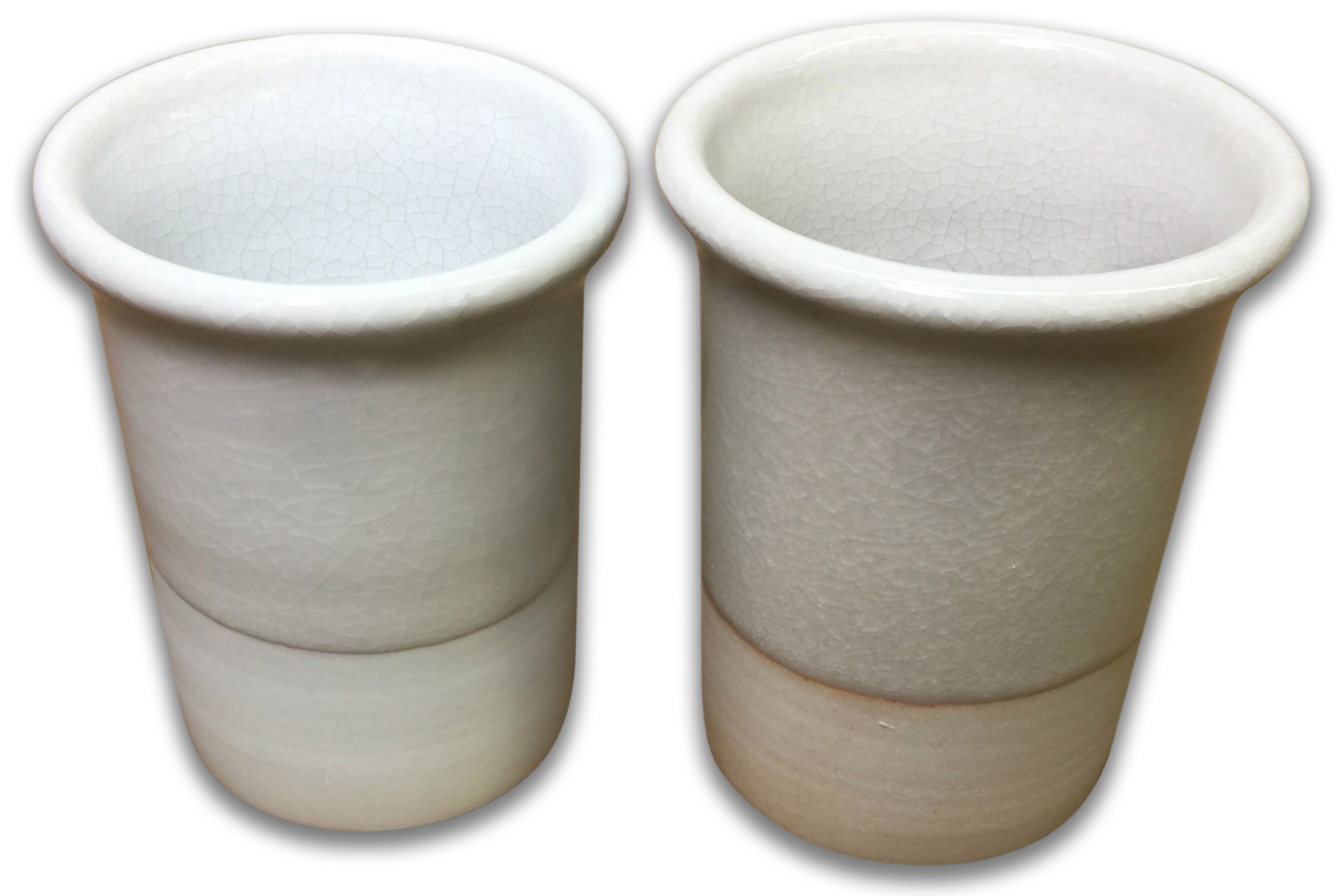
These pure material powders were applied to bisque as slurries, suspended by gelling with Epsom salts, and fired at cone 10R. On the left is Custer feldspar on a Grolleg porcelain (P700); on the right is Covia nepheline syenite on a whiteware body (P600).
Feldspars and nepheline syenite supply large amounts of K2O and Na2O, oxides having very high thermal-expansion contributions in glaze chemistry. When these materials are melted essentially by themselves, the resulting glasses have very high thermal expansion relative to typical ceramic bodies - thus the spectacular crazing seen here. Glaze recipes containing high percentages of them can likewise be prone to crazing unless enough lower-expansion oxides, especially SiO2, Al2O3 and MgO, are present.
Related Pictures
Start glaze chemistry by learning when you don't need it!
A high feldspar glaze is a good example
This picture has its own page with more detail, click here to see it.
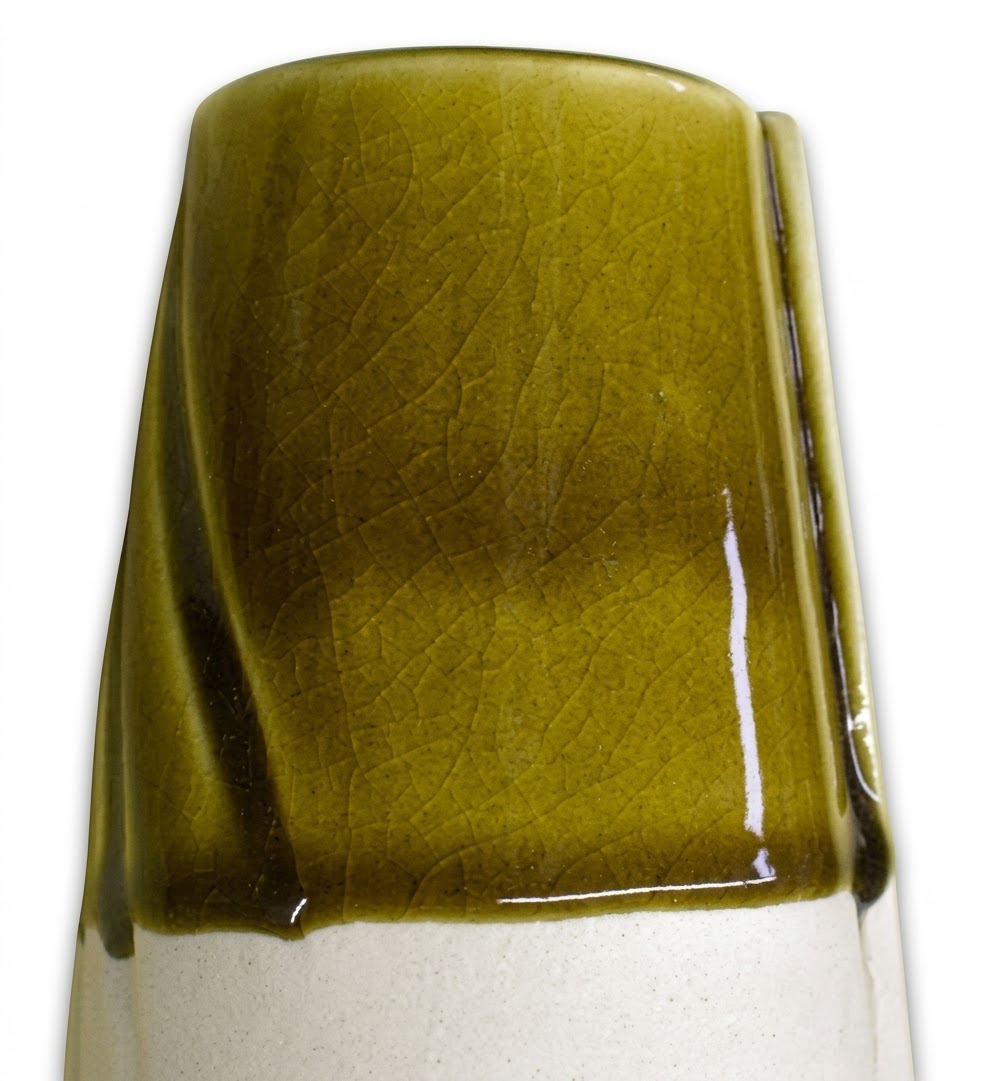
This reduction celadon is crazing badly. Why? Its chemistry is dominated by feldspar, which supplies lots of K2O and Na2O fluxes. Scores of recipes being traded online contain 50% or more feldspar; they benefit from these powerful fluxes but inherit their high thermal expansion (COE). Many work only because the body happens to have sufficiently high expansion - often aided by significant residual quartz.
Crazing is more than a cosmetic problem in functional pieces. It reduces ware strength and durability, can compromise food safety and turn into a customer complaint. Let's fix it, starting without chemistry:
- Use recipe logic: Transplant the color mechanism into a transparent base glaze that already fits the body. In this case, the celadon color is largely produced by an iron addition under reduction, so there is no need to preserve the high-feldspar base itself.
- Use material sense: A 2:1 silica:kaolin mix supplies an Si:Al ratio similar to typical glossy glaze chemistries. A 10% addition thus shouldn't change the degree of gloss but will likely lower the COE, reduce melt fluidity and improve durability.
- Use glaze chemistry. Substitute some of the high-expansion KNaO with much lower-expansion MgO. Both are fluxes, and even a 0.1-mole shift can make a significant difference. Couple that with an increase in SiO2 where the melt can tolerate it, and glaze fit can improve dramatically.
High feldspar glazes craze on functional:
Don't put up with it. Fix them.

This picture has its own page with more detail, click here to see it.
This glaze, "Bamboo Cone 10%", contains 50% potash feldspar, so it certainly qualifies as a high-feldspar glaze. K2O and Na2O are thus oversupplied. They have the highest thermal expansions of all oxides, by far. These are needed and valuable, but when grossly oversupplied the result is crazing. This glaze used to work on this body, H550. The previous version of H550 was firing near the bloating point of the body, about 1% porosity, so the recipe had to be changed to provide more margin for error. The new recipe has a more practical 2.0-2.5% porosity; it has no danger of bloating or warping and still has excellent maturity and strength. This glaze was crazing before, and pieces did not leak because the body was dense enough - so they were still watertight. But now it does not work. The solution is to do something that should have been done before: Use a silky matte base recipe that does not craze. I recommend the G2571A base (below right) - the Zircopax, rutile, and iron oxide in the original can be added to it instead.
Links
| Materials |
Feldspar
In ceramics, feldspars are used in glazes and clay bodies. They vitrify stonewares and porcelains. They supply KNaO flux to glazes to help them melt. |
| Materials |
Nepheline Syenite
|
| Troubles |
Glaze Crazing
Ask the right questions to analyse the real cause of glaze crazing. Do not just treat the symptoms, the real cause is thermal expansion mismatch with the body. |
 PayPal | No tracking, No ads, No paywall, No transient content! Just organized, concise information constantly updated and improved. Was this helpful? Consider supporting me. |
Got a Question?
Buy me a coffee and we can talk 

https://digitalfire.com, All Rights Reserved
Privacy Policy