A pottery glaze that can eat through a firebrick!
The melt fluidity tester was fired at cone 6. The glaze on the left is G2826A2, the 50:30:20 historically popular Gerstley Borate base recipe used for reactive and transparent glazes. The B2O3 in that glaze was 3x the normal amount in cone 6 glazes, making it so melt fluid it can eat through a firebrick!
The glaze on the right is G2926A3, an adjusted version that cuts the B2O3 level and adds SiO2 (from silica and nepheline). The result is more sane, although still very melt-fluid glaze. This is also a lesson in the chemistry that produces boron-blue: High B2O3 is not the key; my adjustment lowers it significantly. CaO/MgO is also lower, so that is not the key. The SiO2 appears to be the enabler here; it is much higher (from 2.6 to 3.48, a hugh increase). And, I am using 325 mesh silica, so it dissolves in the melt better, delivering even more SiO2. Boron blue thus seems to thrive on enough SiO2 coupled with high B2O3 and low Al2O3 with some MgO/CaO.

Related Pictures
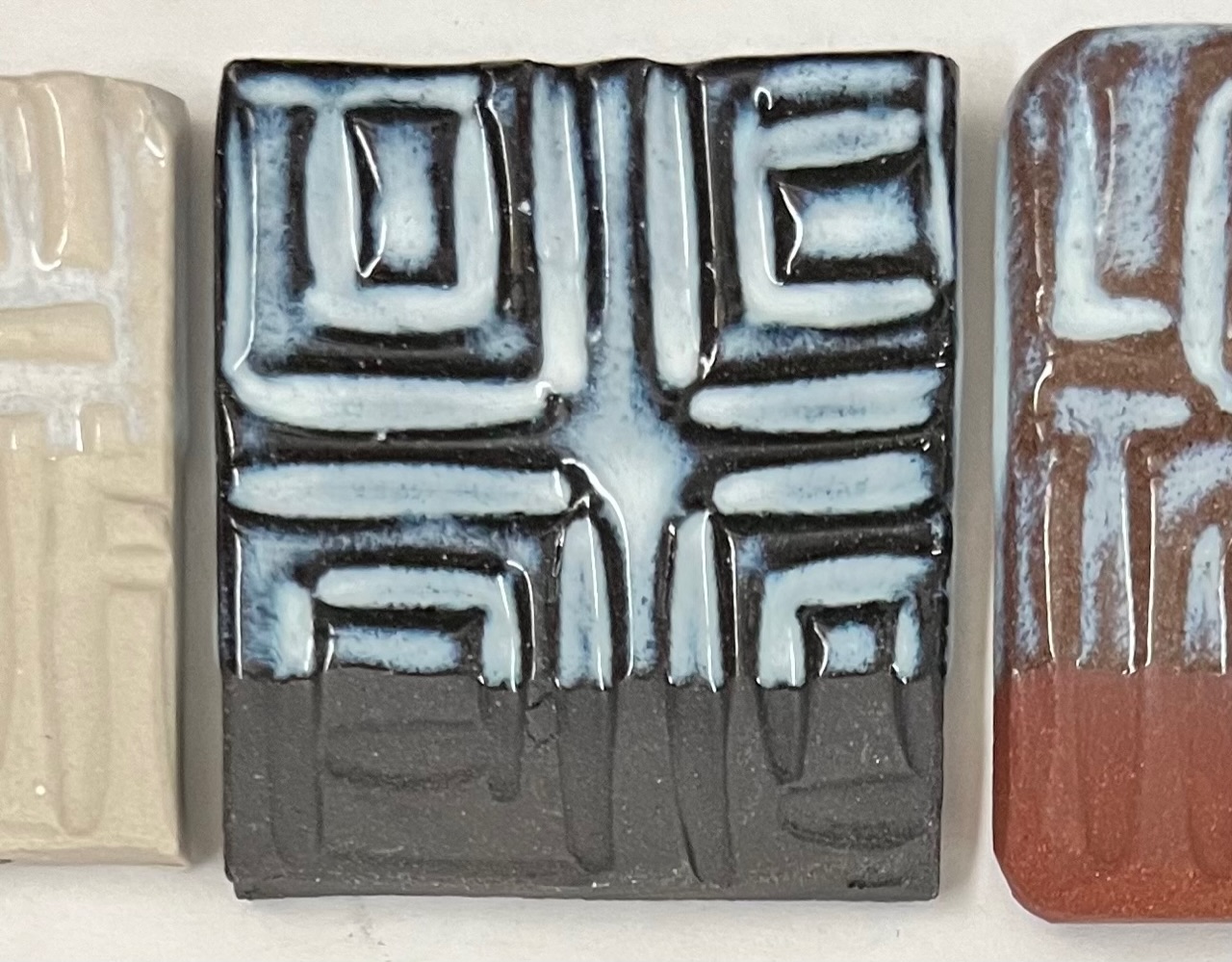
This boron blue effect depends on three things:
A dark body, variations in thickness, the right chemistry
This picture has its own page with more detail, click here to see it.
This is G2826A3, a transparent amber glaze at cone 6 on white (Plainsman M370), black (Plainsman 3B + 6% Mason 6666 black stain) and red (Plainsman M390) stoneware bodies. When the glaze is thinly applied, it is transparent. But at a tipping-point-thickness, it generates boron-blue that transforms it into a milky white. Glazes that are very glassy but on the edge of structural instability do this. So they are not good for functional ware.
This is an adjustment to the 50:30:20 Gerstley Borate base recipe (historically used for reactive glazes, often on functional surfaces! This cuts B2O3 and adds significant SiO2. But it still has double the boron of a typical functional glaze. While the chemistry of the original was within the territory of boron blue development (relatively low Al2O3), this one is better because of the increased SiO2 (the high MgO:CaO ratio is likely also helping). Boron blues like the lower Fe2O3 content or Gillespie Borate. One more factor: I am using 325 mesh silica here, it dissolves in the melt better.
Gillespie Borate is doing something very strange at 1700F

This picture has its own page with more detail, click here to see it.
On the left is G2826A3, a cone 6 transparent glaze (an improvement on the 50:30:20 classic Gerstley Borate base transparent recipe, substituting Gillespie Borate, reducing its percentage and increasing SiO2). Despite the improvements it exhibits this strange cracking and crawling. The G2826A1 on the right uses a frit to source the boron instead, clearly a better idea. These tiles were fired to 1700F. The problem is likely the ulexite mineral in the Gillespie Borate - it is known for this behavior of suddenly shrinking and then suddenly melting (the latter of which is just starting). Since Gillespie Borate is plastic and suspends slurries well, I thought calcined kaolin would be better than raw kaolin in the G2826A3 recipe (to minimize drying shrinkage). However, it did not improve the situation. All of this being said, this recipe is still working reasonably well at cone 6 (stopping and holding it at 1700F may exaggerate the problem).
Links
| Glossary |
Boron Blue
Boron blue is a glaze fault involving the crystallization of calcium borate. It can be solved using glaze chemistry. |
| Glossary |
Fluid Melt Glazes
Fluid melt glazes and over-melting, over fired, to the point that they run down off ware. This feature enables the development of super-floss and cyrstallization. |
| Glossary |
Melt Fluidity
Ceramic glazes melt and flow according to their chemistry, particle size and mineralogy. Observing and measuring the nature and amount of flow is important in understanding them. |
| Glossary |
Reactive Glazes
In ceramics, reactive glazes have variegated surfaces that are a product of more melt fluidity and the presence of opacifiers, crystallizers and phase changers. |
 PayPal | No tracking, No ads, No paywall, No transient content! Just organized, concise information constantly updated and improved. Was this helpful? Consider supporting me. |
Got a Question?
Buy me a coffee and we can talk 

https://digitalfire.com, All Rights Reserved
Privacy Policy