How far can a terra cotta clay go before it melts down?
These bars of a locally collected wild clay were fired, from bottom to top, at cones 2, 6, 8 and 10. At cone 2, the clay has already vitrified to stoneware density while retaining a reddish colour—well above the usual cone 06–04 terra cotta firing range. Additional tests, not shown here, reveal that it turns brown by cone 3 and begins to soften and bloat by cone 4. By cone 6, the second bar from the bottom has an “Aero chocolate bar” interior! Gas-producing reactions within the softening body expand it into a ceramic foam.
At cones 8 and 10, the bars are severely swollen and glassy, yet still recognizably bar-shaped. Why haven’t they flowed into puddles? Even with extensive melting, the material surrounding the bubbles remains viscous enough to resist collapse. This clay demonstrates that vitrification, bloating and flowing freely are very different stages of firing.

Related Pictures
Technicians study the physics of Yixing clay
To determine the ideal firing temperature
This picture has its own page with more detail, click here to see it.
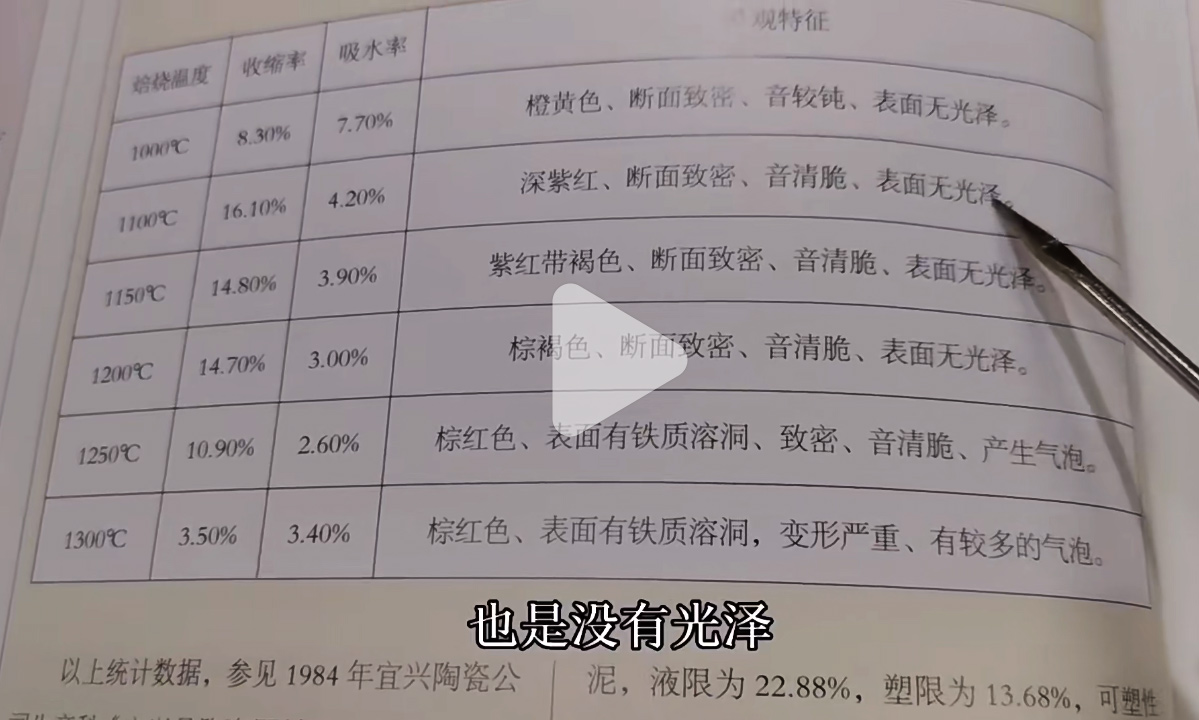
The clay here is called jiani, it’s found in various layers along with other yixing clay (but not used for teapots). The translation of this video screen capture (below), provides a fascinating insight into how they judge the suitable temperature at which to fire. First, technicians measure the porosity and firing shrinkage over a range of temperatures, likely looking for a firing "sweet spot". Notice shrinkage reaches a maximum at 1100C, then drops off as the clay begins to expand. But this is not the only thing considered. Notice, in the comments, that they are also looking for "surface luster" (which is not found). They also comment about a "dull sound" and "crisp/clear sound" (so they must create a sounding vessel of some sort). They also break a fired piece and comment of the nature of the cross section, revealing something else interesting: The clay holds on to a dense cross section for 100C degrees after reaching maximum fired shrinkage.
| Temp | Shrinkage | Porosity | Visual & Physical Characteristics |
|---|---|---|---|
| 1000°C | 8.3% | 7.7% | Orange-yellow, dense cross-section, relatively dull sound, matte surface (no luster). |
| 1100°C | 16.1% | 4.2% | Deep purplish-red, dense cross-section, crisp/clear sound, matte surface (no luster). |
| 1150°C | 14.8% | 3.9% | Purplish-red with a hint of brown, dense cross-section, crisp/clear sound, matte surface (no luster). |
| 1200°C | 14.7% | 3.0% | Brownish-red, dense cross-section, crisp/clear sound, matte surface (no luster). |
| 1250°C | 10.9% | 2.6% | Brownish-red, iron-rich melt-holes on the surface, dense, crisp/clear sound, produces bloating/bubbles. |
| 1300°C | 3.5% | 3.4% | Brownish-red, iron-rich melt-holes on the surface, severe deformation, has a relatively large amount of bloating/bubbles. |
A super-fine, super-plastic wild clay that comes with baggage

This picture has its own page with more detail, click here to see it.
#1: I got it in a foot-thick layer in a gravel pit in Leader, Saskatchewan (half way up the slope). I code numbered it L3822.
#2: The two lower bars are L3822, fired at cone 1 and 2 (at cone 2 the center Aero-chocolate textured material bursts out). The upper bars, 3822A, are a 50:50 mix with Pioneer kaolin (also cone 1 and 2).
#3: L3822A fired at cones 04,03,02,01,3 (top to bottom).
#4: 90:10 mix of M2, the mid-temperature red burning material Plainsman Clays uses, and L3822 (Cone 06,04,03,02,01 bottom to top). The 10% addition supercharges the M2 plasticity beyond what is practical to dry.
#5: The pure material, leather hard mugs (with exceptionally thin walls (because it is so plastic).
#6: The pure material cracks, only one of the 50:50 mix survived drying (even though they were dried over a period of weeks).
#7: Bisque fired 50:50 and pure material mugs.
#8: Cone 6 mug of the 50:50 mix. Notice it gases and clouds the clear glaze.
What is this clay? It is not a balanced material, but highly bentonitic. With lots of fluxes (like KNaO, CaO, MgO), it matures below what is possible with mixes of feldspar and kaolin. Its super fine particle size (and thus high surface area) enable imposing its maturity (even when mixed with a refractory material like kaolin). Treating this as a bentonite seems best, adding no more than 5% to improve body plasticity. Notice that it fires to a much nicer surface than the commercial raw bentonites shown below.
 PayPal | No tracking, No ads, No paywall, No transient content! Just organized, concise information constantly updated and improved. Was this helpful? Consider supporting me. |
Got a Question?
Buy me a coffee and we can talk 

https://digitalfire.com, All Rights Reserved
Privacy Policy