Idea: Gather rocks and fire them. Unexpected results!
I gathered these downstream from the Oldman River dam in southern Alberta, not far from where the river exits the Rocky Mountains (it cuts through many different rock strata upstream, including both limestone and dolostone, as well as quartz sandstone and siltstone). Upper left: The gravel bar where I collected them. Upper right: The rocks as gathered. Lower left: After firing to cone 04 (about 1900°F). Lower right: After I poured water on them!
Seven disintegrated before my eyes—with sound effects, intense heat and even steam! That identifies them as carbonate-rich rocks, likely limestone or dolostone. Firing drove off their CO2 and caused considerable weight loss, converting the calcium carbonate to calcium oxide—quicklime. Dolostone also produces magnesium oxide. When water was added, the CaO rapidly hydrated to calcium hydroxide, releasing enough heat to break the rocks apart. Two others cracked badly just from the firing. The survivors appear to be more silicate-rich siltstones and sandstones—and some of them can withstand considerably higher temperatures.
The exciting part of this: A river gravel bar is really a randomly assembled collection of ceramic raw materials. Next project is to fire more rocks to cone 6 and 10.

Related Pictures
Rocks fired at cone 02 with underglazes

This picture has its own page with more detail, click here to see it.
These were gathered from the bank of the Oldman river. I fired more than a dozen types and found the siltstone ones to be the most stable for this.
The orange is not developing well, it is flaking off #2 and #6. The black is flaking off #2. The yellow works on everything. The degree of flaking on #6 indicates the rock is likely quartz.
What happens when a limestone:clay mix is fired to cone 6?
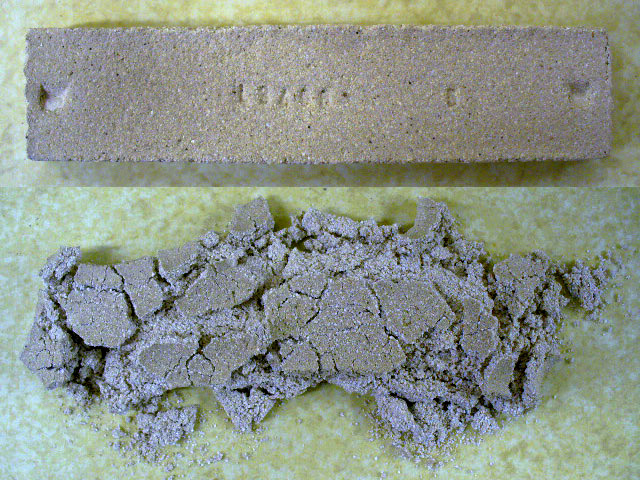
This picture has its own page with more detail, click here to see it.
The top bar is a mix of calcium carbonate and a middle-temperature stoneware clay (equal parts), part of an earth plaster project. On removal from the kiln, it appears and behaves like a normal stoneware clay body, hard and strong. However, pour water on it and something incredible happens: in a couple of minutes, it disintegrates (as it rehydrates). And generates lots of heat as it does so.
Links
| URLs |
https://miningmatters.ca/school-programs/students/rock-and-mineral-identification-guides/rock-identification-guide
Identify a Rock Complete with photos and information about each rock’s distinguishing characteristics. |
| Minerals |
Limestone
Limestone is a sedimentary rock composed predominantly of calcium carbonate, usually as calcite. It |
| Minerals |
Dolomite
Dolomite, as a rock, is called "dolomitic limestone". It is a carbonate, similar to limestone, but h |
| Materials |
Quicklime
Made by heating limestone sufficiently to drive off carbon dioxide. The only ceramic use is the production of refractories (because of its high melting point). |
 PayPal | No tracking, No ads, No paywall, No transient content! Just organized, concise information constantly updated and improved. Was this helpful? Consider supporting me. |
Got a Question?
Buy me a coffee and we can talk 

https://digitalfire.com, All Rights Reserved
Privacy Policy