G3948A iron red cone 6 oxidation glaze at its best
This spoon jar is glazed with the G3948A recipe. It was fired using our standard cone 6 C6DHSC slow cool schedule. The body is Plainsman Coffee Clay. The inside glaze is GA6-B, although honey transparent, it fires jet black on this body. The metallic outer appearance was achieved because of the thick application. But this glaze has a fluid melt and should have run on to the kiln shelf. Why didn't it do that? Because of the way I glazed it. The inside was done first. Then wax was applied over the rim and down the inside for a couple inches. Then I applied a thin layer of the iron red to the bottom half to act as a catch glaze (by pushing the piece down into the bucket of dipping glaze for only a second). That dried in about 5 seconds, enabling flipping it over and pressing it down to do the upper half. I held it down longer and got a much thicker layer (with a little overlap with the thin section). During firing it all evened out - leaving only a little evidence of this method near the base.

Related Pictures
G3948A Iron-Red glaze recipe moving to the UK
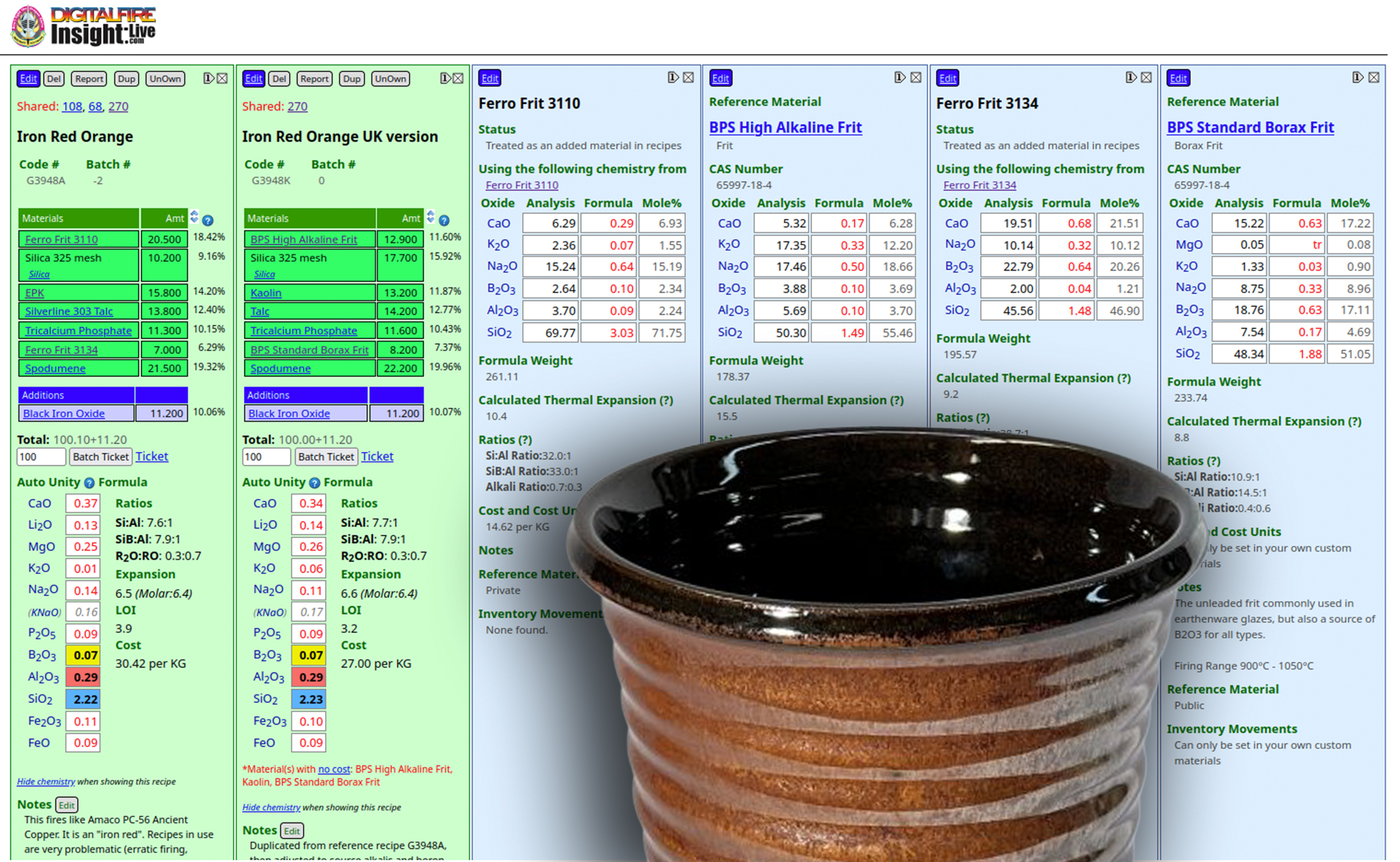
This picture has its own page with more detail, click here to see it.
This jar is glazed with my G3948A cone 6 iron red recipe. It employs two Ferro Frits: High soda, low boron, low alumina 3110 and high boron, high soda/calcia, low alumina 3134. These frits are becoming increasingly expensive and difficult to get in many parts of the world (even North America).
A potter in the UK has access to locally produced BPS (Bath Potters' Supplies) frits. They have ones that roughly match the Ferro products, calling them "Standard Borax" and "High Alkaline". These frits are shown side-by-side in this screenshot; they are too different to just substitute; chemistry is essential here. My original G3948A recipe is also shown side-by-side with the chemical equivalent I just calculated. I am using generic talc, kaolin and spodumene materials (the chemistry of these needs to be entered to make the calculation more accurate, especially the spodumene, an important factor in how this glaze fires).
I will update this post as we get more information and, finally, fired tests. Hopefully we can bring floating blue to the UK using this same method.
Links
| Glossary |
Iron Red Glaze
A type of ceramic glaze, typically fired around 2200F, where iron oxide in the cooling glass precipitates out to form a striking red crystalline mesh on the surface. |
 PayPal | No tracking, No ads, No paywall, No transient content! Just organized, concise information constantly updated and improved. Was this helpful? Consider supporting me. |
Got a Question?
Buy me a coffee and we can talk 

https://digitalfire.com, All Rights Reserved
Privacy Policy