Custer Feldspar update
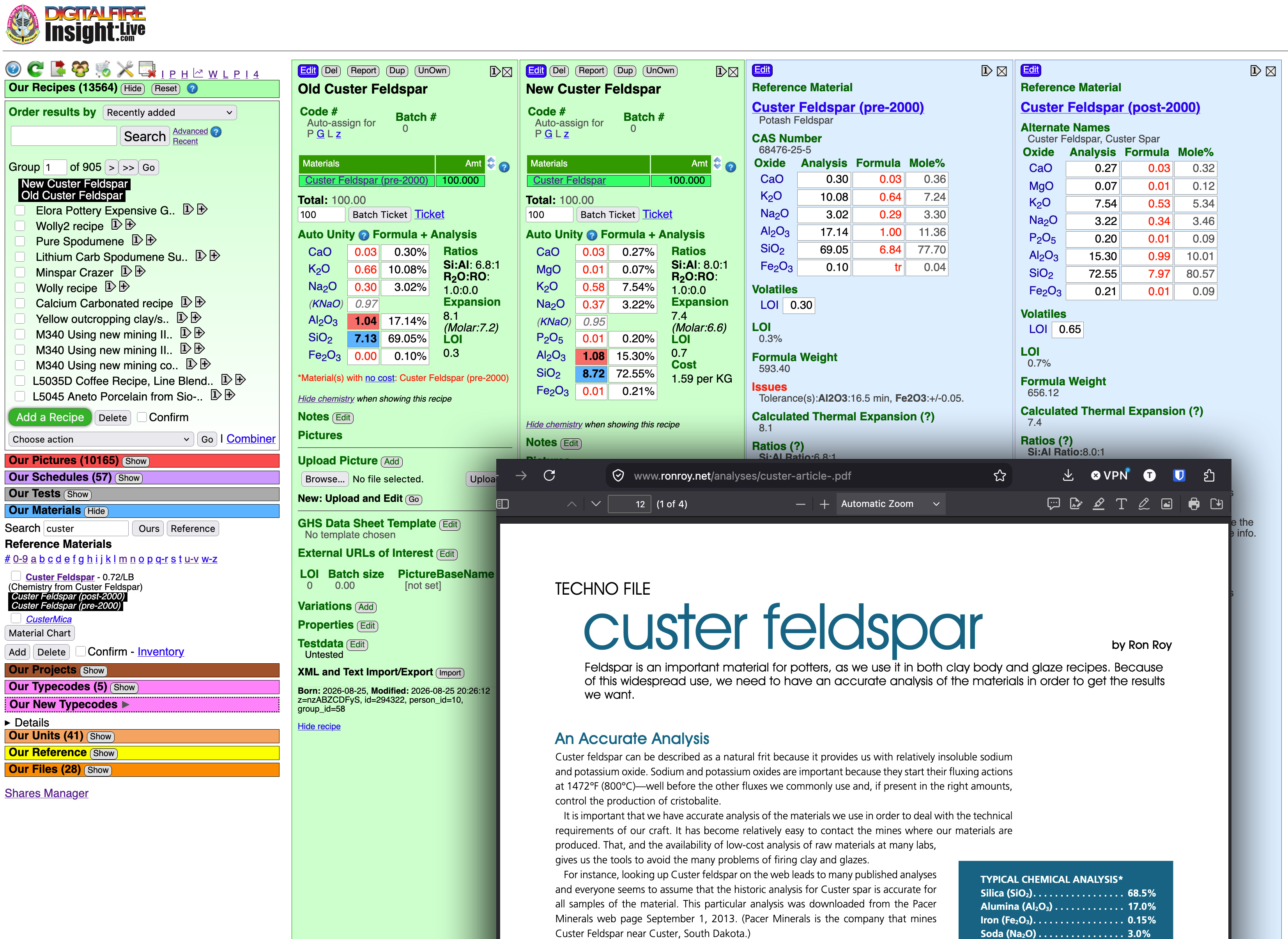
The chemistry for Custer Feldspar has been updated in the materials at Digitalfire and Insight-live. Until now, the Pacer-published values have been used, but at Ron Roy's request, this has been changed (see the link to his article below). The average of assays done from 2000 to 2012 has been used for the chemistry. The material name has been changed to "Custer Feldspar (post-2000)". However, Insight-live will still find it in recipes when needing its chemistry, since "Custer Feldspar" has been included as an alternate name. The old material's name has been changed to "Custer Feldspar (pre-2000)".
In this image, you can see the material chemistries on the right and each of them being used in a one-material recipe on the left. To verify they are calculating correctly, the calculation of each has been set to formula plus analysis.
If you have defined your own material for this (typically done to set a cost), everything should still work correctly (using your chemistry if you provided it).
Related Pictures
Don’t overthink Custer Feldspar replacement:
It’s usually straightforward

This picture has its own page with more detail, click here to see it.
In a clay body: In a clay body: Compare the original body with one containing the proposed replacement using SHAB test bars fired together. Adjust the replacement percentage to approach the original absorption and firing shrinkage (and fired color, deformation and glaze fit). Nepheline syenite or a suitable soda feldspar may achieve the required maturity at a lower percentage.
In a glaze: Start by matching KNaO—the combined molar amounts of K2O and Na2O. This gives more freedom to use available feldspars without requiring an exact match of potassium and sodium separately. Confirm the result by firing tests. The following are practical starting points, not fixed percentage rules:
- About 20% feldspar or less: Try a one-for-one substitution with a comparable feldspar recommended by your supplier. Compare fired tests before changing a production batch.
- About 20–40% feldspar: A chemistry adjustment becomes more worthwhile. Use the replacement feldspar to match KNaO, then adjust the other ingredients to bring Al2O3, SiO2 and the remaining oxides into line.
- More than about 40% feldspar: Check glaze fit carefully. If the glaze crazes, this may be an opportunity to fix both issues (reduce KNaO and increase suitable lower-expansion fluxes, such as CaO or MgO). Test for changes in melting, surface and color.
- Special-effect or reactive glazes: Identify what produces the effect and preserve the relevant chemistry, materials and firing conditions. Matching total KNaO is a useful first step; if the effect changes, investigate the K2O:Na2O ratio as well as other differences.
- Glazes with too little clay to suspend or adhere well: Consider fixing this issue at the same time, supplying some KNaO from a low-alumina frit such as Frit 3110. This can make room for more clay while maintaining the Al2O3 target. Rebalance the other oxides and test both slurry behavior and fired results.
Replace Custer Feldspar in a cone 10R glaze:
Two minutes of glaze chemistry
This picture has its own page with more detail, click here to see it.
My G2571A and G1947U cone 10R glaze recipes are both in use in Ecuador. One user has been importing Custer feldspar, but now needs to substitute a local one. That material is much higher in SiO2 and much lower in Al2O3 and KNaO (so a pound-for-pound substitution is likely not going to work). Here is how I did the chemistry. It turned out to be a matter of increasing the new feldspar to match the KNaO (which also matched the Al2O3) and then reducing the silica to match the SiO2. The amount by which I had to change the feldspar is a testament to how different the chemistry of these materials can be from country to country.
If you do this calculation, please note the following: In August 2026 the name for Custer Feldspar was changed to "Custer Feldspar (post-2000)" (both here and in the Insight-live reference materials). There is also one for "Custer Feldspar (pre-2000)".
Links
| URLs |
https://www.ronroy.net/analyses/custer-article-.pdf
Ron Roy article about changes in Custer Feldspar |
| Materials |
Custer Feldspar (post-2000)
The most common potash feldspar used in ceramics in North America, a standard for many decades, but no longer available. Its chemistry shifted around 2000. |
| Materials |
Custer Feldspar (pre-2000)
The most common potash feldspar used in ceramics in North America, a standard for many decades, but no longer available. Its chemistry shifted around 2000. |
 PayPal | No tracking, No ads, No paywall, No transient content! Just organized, concise information constantly updated and improved. Was this helpful? Consider supporting me. |
Got a Question?
Buy me a coffee and we can talk 

https://digitalfire.com, All Rights Reserved
Privacy Policy