What does it take to fix a crazing glaze?
Consider a thought experiment in what it takes to craze it.
Crazing is one of the most common glaze defects and A.I chatbots still recycle oversimplified advice on the issue. To illustrate, consider two mugs made from a speckled stoneware, a clay having lots of ball clay and quartz. Such body’s are easy to fit glazes to, so what would it take to craze this glaze on this body? A lot. Glazes that craze out of the kiln on quartz-rich bodies are not "slightly misfit"; they are "hugely misfit". Under or over-firing or holding less time at temperature, would not be enough to craze the mug on the left. And, reducing the silica enough to start severe crazing would fundamentally alter the surface character and transparency.
This is not a recipe-level problem (e.g. reducing feldspar for silica or zinc oxide), it is an oxide chemistry issue. By far the best way to put the glaze under tension, to craze it, is to trade low thermal expansion oxides for high ones. In this case, shifting flux unity away from CaO/MgO toward KNaO (the latter being the highest thermal expansion oxide, by far). So to fix it you do the opposite!
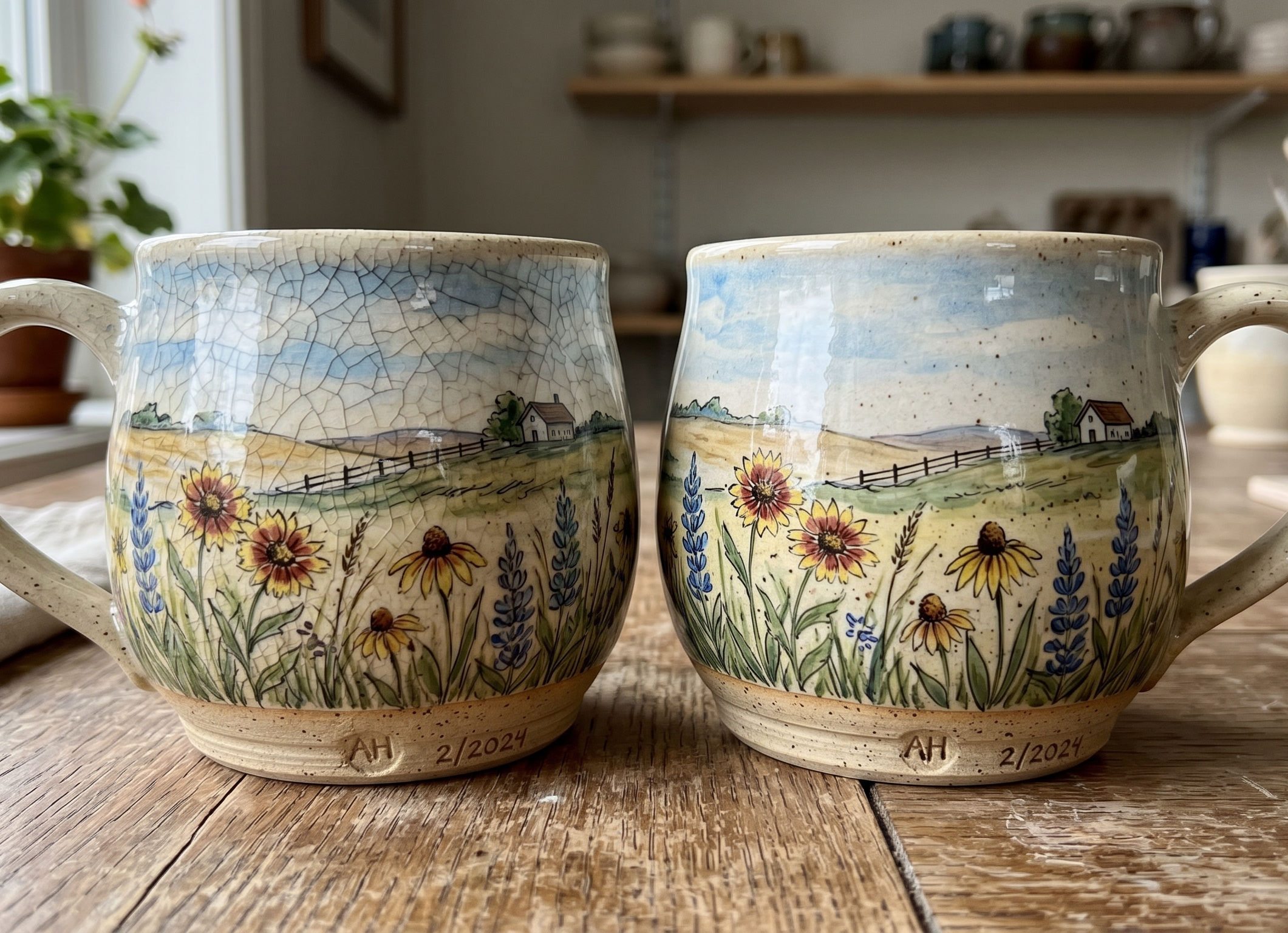
Gemini generated image for "Two pottery mugs, one is crazed. Both are made by the same potter and are the same shape and size. Both have a transparent glaze and underglaze prairie motif brushwork." AI Policy
Links
| Glossary |
A.I. in Ceramics
Unbelievable things are happening. Good and bad. A.I. Is polarizing and revolutionizing ceramics. For us at Digitalfire, perhaps the biggest benefit is more enablement of DIY. |
| Glossary |
Glaze Crazing
Crazed ceramic glazes have a network of cracks. Understanding the causes is the most practical way to solve it. 95% of the time the solution is to adjust the thermal expansion of the glaze. |
 PayPal | No tracking, No ads, No paywall, No transient content! Just organized, concise information constantly updated and improved. Was this helpful? Consider supporting me. |
Got a Question?
Buy me a coffee and we can talk 

https://digitalfire.com, All Rights Reserved
Privacy Policy