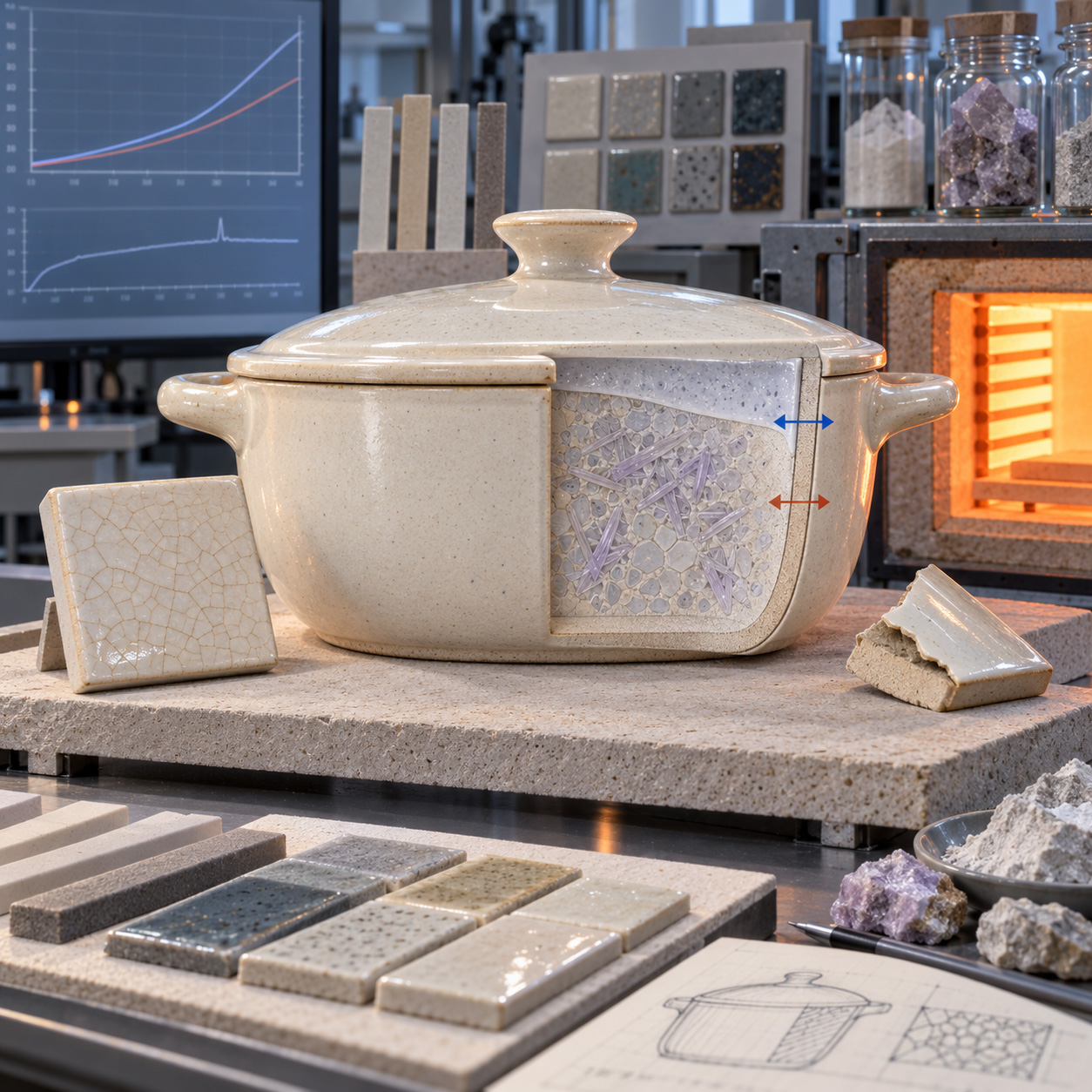
Super-low expansion body:glaze at cone 6:
Yes, it's possible with spodumene, but tricky
The first issue is the price of spodumene. Maybe it will again become available in a ceramic grade. After all, spodumene-bearing rock is abundant, and battery technology is finding other solutions.
Second, in an LAS body the spodumene, kaolin and silica need to be in the proportions needed to form β-spodumene LiAlSi₂O₆ or β-eucryptite LiAlSiO₄ (along with residual quartz and glass phase). The testing program with meticulous records is needed. Repeat cycles of creating a body recipe, firing specimens at many temperatures below and above cone 6, and doing physical measurements on each.
Third, a dilatometer is needed to verify where on the firing curve the best low thermal expansion has been achieved. When that point is at cone 6 you have succeeded. As the cycling proceeds it will be evident if a more or less plastic kaolin is needed (or a bentonite addition).
Fourth, the super-low thermal expansion glaze (e.g. a high percentage of Frit 3249). Fortunately, it only needs to be slightly compressive. But ordinary glaze-fit tests are insufficient; this requires more thermal cycling with stovetop-like gradients.
 PayPal | No tracking, No ads, No paywall, No transient content! Just organized, concise information constantly updated and improved. Was this helpful? Consider supporting me. |
Got a Question?
Buy me a coffee and we can talk 

https://digitalfire.com, All Rights Reserved
Privacy Policy