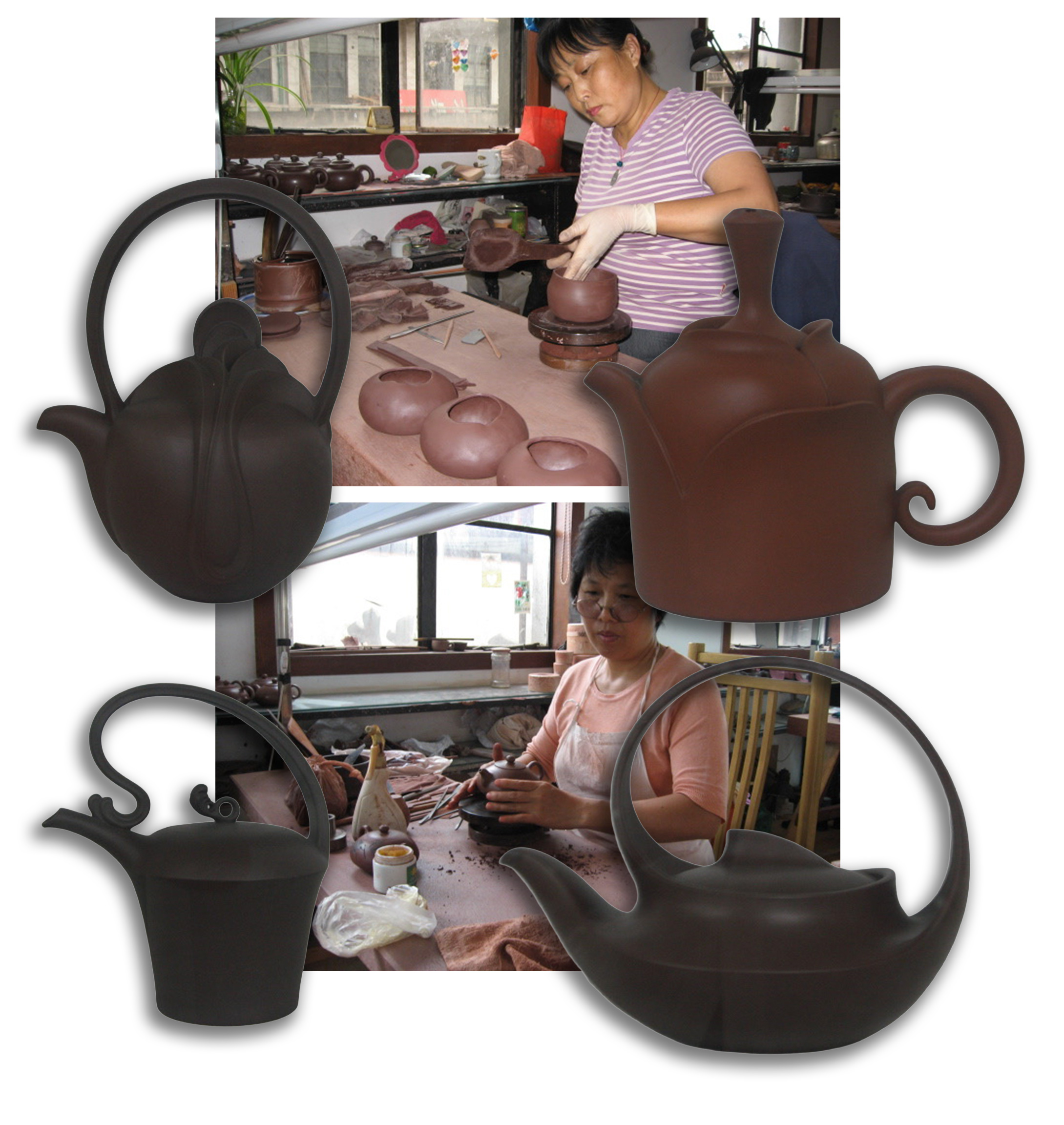
Yixing craftswomen at work
The Yixing teapot craftsmen appear to break all the rules and yet produce impossibly delicate and symmetrical pieces. Hao-Tong Yan, one of those craftsmen, and I have been trying to understand the technical reasons for how this amazing craft is possible. It turns out not to be magic, but actually a highly evolved understanding of a very unusual material. Here are some of the things that we are coming to understand (which is making it possible to create a facsimile of the clay in North America).
-The clay is not highly plastic; the workability comes from surprising places.
-The clay has impossibly low water content, yet can be formed.
-Craftsmen flatten the clay with a mallet, instead of rolling it, yet it does not stick to the board.
-Sections are simply glued with slip, yet they hold.
-The clay burnishes, yet is not smooth.
-Fired ware is smooth, yet the soft clay appears sandy.
-The fired surface is glossy, yet there is no glaze.
-The fired clay appears super dense yet does have porosity.
-The Yixing ore can have the appearance of being like rocks, yet they make a workable clay body from it.
Links
| Projects |
Yixing Teapots
Hao-Tong Yan, a Yixing teapot craftsmen, and I have been trying to understand the technical reasons for how this amazing craft is possible. It is a fascinating story that culminates in the possibility of making your own Yixing-like clay body. |
 PayPal | No tracking, No ads, No paywall, No transient content! Just organized, concise information constantly updated and improved. Was this helpful? Consider supporting me. |
Got a Question?
Buy me a coffee and we can talk 

https://digitalfire.com, All Rights Reserved
Privacy Policy