Mullite and anorthite porcelains:
The microstructure was only understood recently
The porcelains that potters and traditional industry (sanitaryware, electrical insulators, common tableware) know and love are actually "mullite porcelains", named such because the fundamental source of strength (both fired and pyroplastic) is the needle-shaped mullite crystals that grow during the final stages of firing. The mug on the left is fired at 2200F and is made of high-feldspar Polar Ice. The kaolin crystals converted to mullite rather than dissolving in the feldspar glass.
Bone china, by contrast, is a calcium aluminosilicate glass-ceramic. It is "anorthite porcelain", relying on calcium from bone ash reacting with SiO2 and Al2O3 (from the kaolin and feldspar) to form anorthite crystals. The reward is strength and translucency (without brittleness), having fine and evenly dispersed crystals and outstanding density (no pores to scatter light). The refractive indices between the glass and crystal phases are also very similar, further preventing light scattering.
Both of these crystal types can be found in nature. But here, they are grown spontaneously during firing. Gradual recognition of these mechanisms was two centuries in the making, but not clear until the 1960s-1980s! Anorthite system mapping being the latter. Understanding and relationships with thermal expansion and translucency and kinetic control in fast-fire kilns has happened since then.
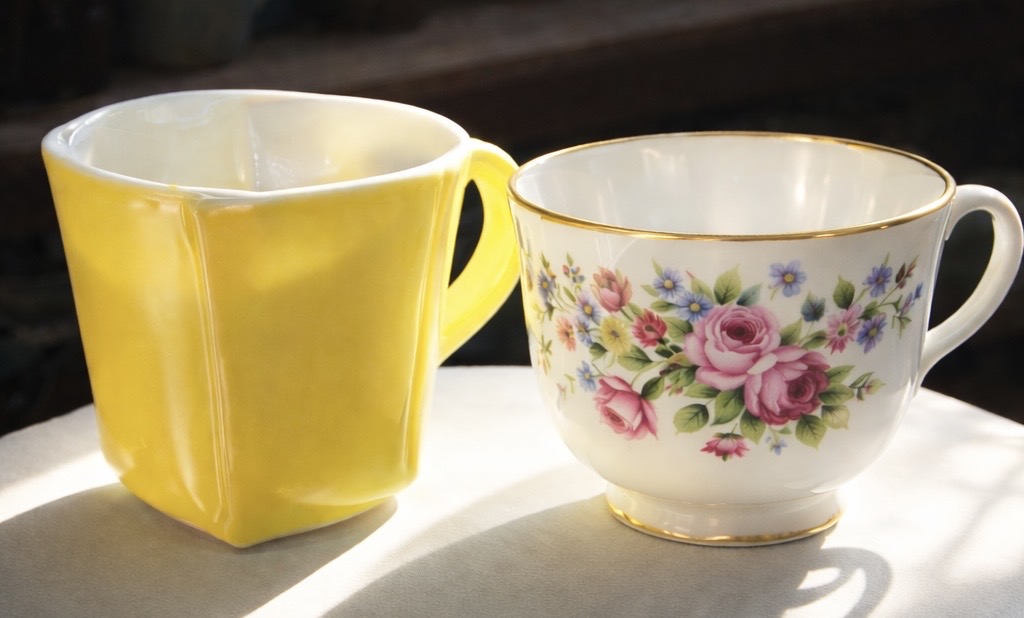
Produced by Gemini, combining a picture of a mug I made with a generated bone china one. AI Policy
Links
| Glossary |
Bone China
A ceramic whose priorities are translucency, whiteness, fired strength and resistance to thermal shock failure. |
| Glossary |
Porcelain
How do you make porcelain? There is a surprisingly simple logic to formulating them and to adjusting their working, drying, glazing and firing properties for different purposes. |
| Glossary |
Translucency
A highly sought-after property in porcelain, fired close enough to melting to take on the glass-like property of passing light. Translucency implies tendency to warp during firing. |
| Glossary |
Porcelain Insulators
Among the most difficult ceramic product to make. They demand electrical reliability, mechanical strength, weather resistance, and dimensional consistency over decades of outdoor service. |
 PayPal | No tracking, No ads, No paywall, No transient content! Just organized, concise information constantly updated and improved. Was this helpful? Consider supporting me. |
Got a Question?
Buy me a coffee and we can talk 

https://digitalfire.com, All Rights Reserved
Privacy Policy