Li2O from Spodumene instead of Lithium Carbonate:
Good chemistry and economy, but bad physics
Lithium carbonate is now ultra-expensive. Yet the reactive glaze on the left needs it. Spodumene has a high enough Li2O concentration to be a possible source here. It also has a complex chemistry, but the other oxides it contains are those common to glazes anyway. I did recipe rescue calculations and got a pretty good match in the formulas (lower section in the green boxes). Then I made 10-gram balls and did a GLFL test at 2200F.
Not surprisingly, this recipe is very runny; that's why the tiny yellow crystals grow during cooling. The new version fires very similarly, perhaps better. My calculated cost to mix these in 2022 was $17.84/kg vs. $10.40/kg. In 2026, the difference is even greater! But there is a practical cost: Poor slurry properties. The spodumene sources so much Al2O3 that 70% Alberta Slip had to be dropped to accommodate it! How does one use this type of glaze without ruining kiln shelves? Using a catcher glaze is one answer.

Related Pictures
Why is spodumene so expensive?
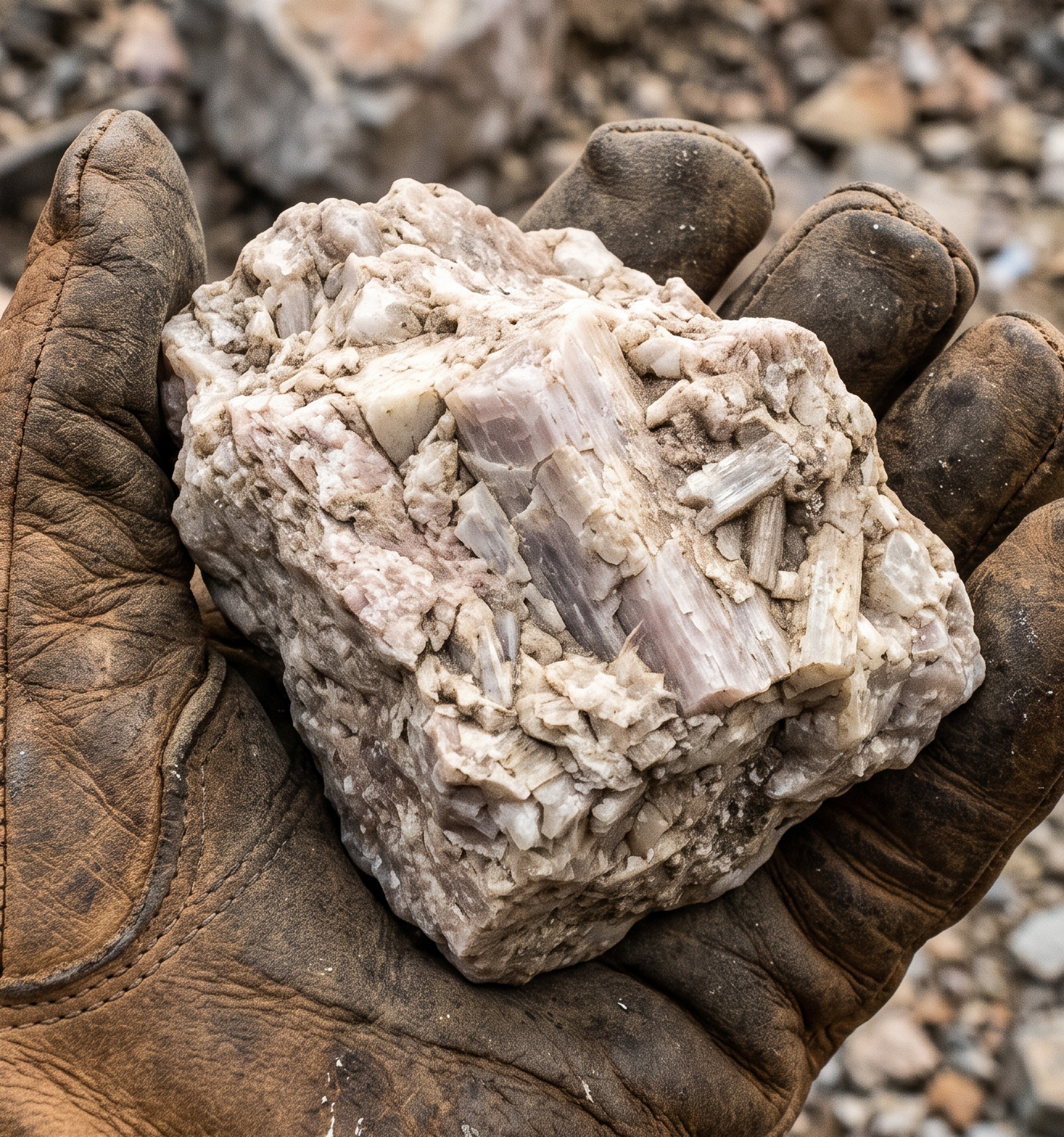 Made by Gemini in response to a query to create a fist-sized spodumene ore rock. AI Policy
This picture has its own page with more detail, click here to see it.
Industrial spodumene is found in massive quantities across major mining regions like Australia, Africa, and North America. Spodumene exists as mine concentrate, technical/ceramic grade and battery-grade material (the battery industry it has effectively repriced a ceramic feldspathic mineral as "lithium ore"). Still, if this 1.5kg rock was pure spodumene, it could be processed to ceramic grade and sold for $45 (June 2026). The actual mining commodity price at that time was US$2,100/tonne (pricing this rock at $3). That means finely ground ceramic spodumene is currently selling for 10+ times the mine/concentrate price.
Spodumene pricing is disconnected from mine-markets
The battery market continues to set the economic context for ceramic spodumene and lithium carbonate. Zimbabwe suspended exports of raw minerals and lithium concentrates in February 2026, briefly pushing Chinese lithium-carbonate futures above 178,000 yuan/tonne. Earlier data showed spodumene concentrate recovering from about US$610/tonne in June 2025 to above US$2,000 in early 2026. Prices subsequently fell sharply in March, illustrating how disconnected ceramic-supplier pricing can be from rapidly changing mine-market values. Reuters: Zimbabwe suspension, Reuters: spodumene production and prices, Reuters: March price reversal.What about lithium carbonate?
Albemarle reported an average industrial price of US$19.53/kg in Q2 2026. So potters currently pay only up to 8 times that! Yet, the processing is formidable: The ore must be crushed and beneficiated, then subjected to a high-temperature calcination that converts alpha spodumene to the more reactive beta form, followed by acid roasting, leaching, neutralization, impurity removal and further conversion.As evidence that lithium is still important, one potter just purchased a 50-pound bag of spodumene for $1200 so she wouldn’t have to worry about it for the rest of her career!
Glaze chemistry and willingness to do testing insulates you
Fortunately, our kilns don’t care where the Li2O comes from. Spodumene substitutions for lithium carbonate must be done oxide-for-oxide (their accompanying SiO2 and Al2O3 make weight-for-weight replacement invalid). Melt-flow, crystallization, thermal-expansion and slurry tests, not just unity-formula matching, are not only important in industrial settings but valuable to potters (insight-live.com is designed for this). Ceramic suppliers should be asked for current chemistry, mineral form and particle-size specifications; “spodumene” alone is insufficient..Sometimes it is better to replace the base in a production glaze recipe

This picture has its own page with more detail, click here to see it.
Almost all ceramic glazes are a base recipe with additions of colors, opacifiers, variegators, etc. Our traditional G3933 oatmeal glaze is a good example (recipe on the left). It can produce rich brown silky matte surfaces, especially on dark burning bodies. But problems have emerged, especially a tendency to crawl. Much testing has yet to reveal the reason. Would it be possible to base the recipe on Ravenscrag Slip and achieve the same chemistry? Yes. And some unexpected benefits accrue. In the recipe on the right, I sourced MgO (the key to the matte surface) from dolomite and Ferro Frit frit 3249 (earlier tests sourcing from talc were unsuccessful, off-gassing from the talc was puffing up the glaze with micro-bubbles). This G3933E recipe has the same chemistry (I derived it in my account at insight-live.com). It is not likely to be without problems, but it looks identical (with richer color from a little more iron oxide), it does not crawl, and it's recipe and chemistry are flexible. It is glossy when cooled fast and silky matte when cooled slowly. The mix of calcine and raw Ravenscrag Slip also enable control over the slurry and application properties. I later tuned this recipe a little more and settled on G3933EF.
Why Petalite and Spodumene will seldom substitute for Lithium Carbonate

This picture has its own page with more detail, click here to see it.
Of course, if a recipe only calls for 1-2% lithium carbonate, either of these might be candidates to supply the Li2O. But Petalite is 8x less concentrated and Spodumene 5x less. Not surprisingly, prices reflect this (unless availability is the issue). But when a recipe calls for 5% lithium carbonate, there is another problem: Petalite is extremely high in SiO2 and spodumene is very high in Al2O3. Introducing enough of either of them to supply the same amount of Li2O as 5% lithium carbonate can easily oversupply either. While extra SiO2 can often be accommodated because most glazes contain significant silica, bringing in a lot of Al2O3 necesitates cutting the most important normal source: Clay. The result is a slurry that does not harden and does not stay suspended.
Lithium is no longer affordable for ceramics.
Yet in many cases it seems indispensable
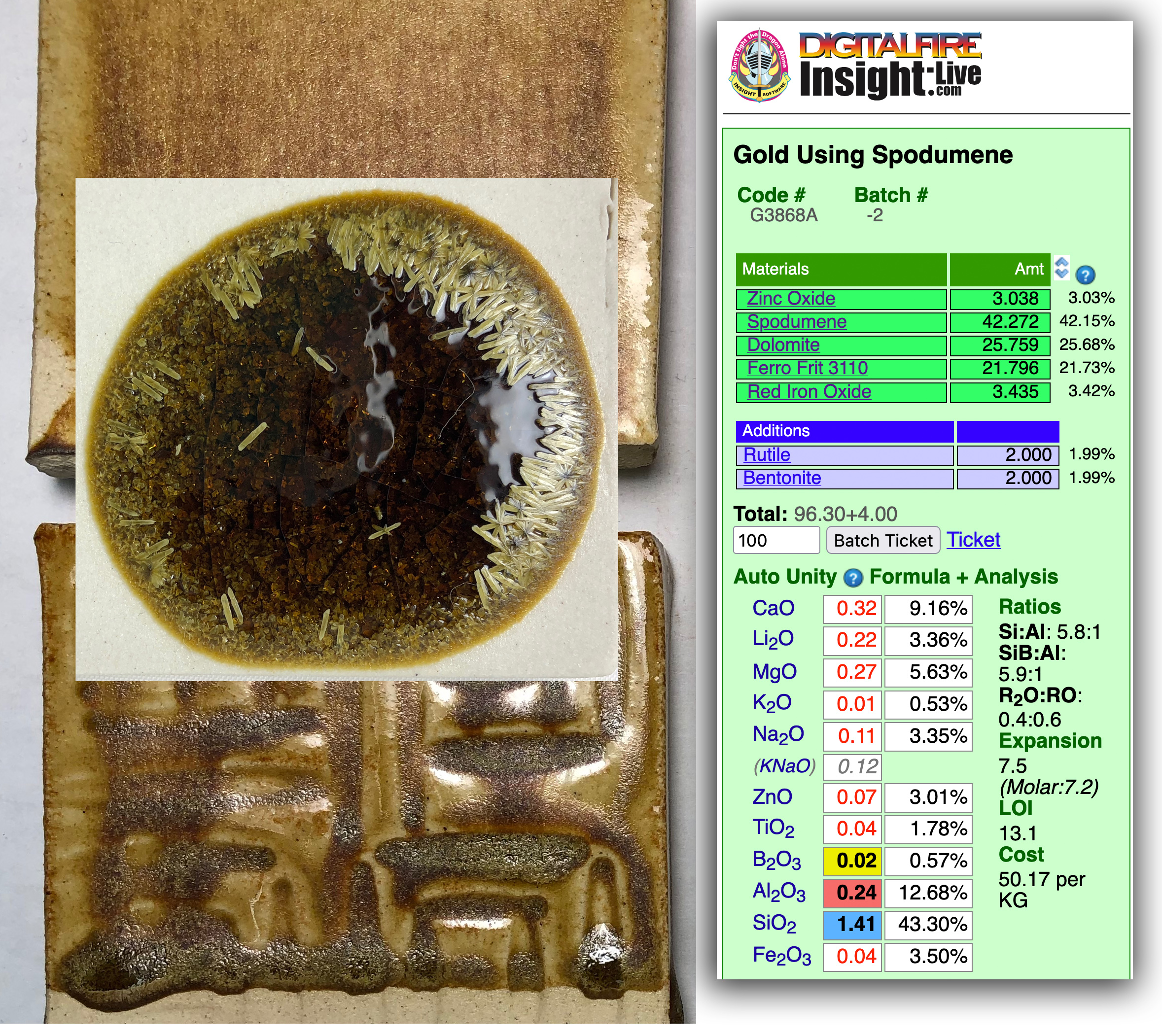
This picture has its own page with more detail, click here to see it.
The crystals that form as this cone 6 fluid-melt glaze solidifies are one of the minerals in the recipe: Spodumene. Actually β-spodumene. But it is so expensive, and there is 42% here! What would it take to reduce the cost of making this glaze ($52/kg in 2026)? Another flux could certainly make it just as melt-fluid, but it would not grow spodumene crystals.
β-spodumene is Li2O - Al2O3 - 4SiO2 So the 0.22 Li2O in this glaze would require 0.22 Al2O3 and 0.88 SiO2 to crystallize as a β-spodumene-type lithium aluminosilicate. The glaze contains 0.24 Al2O3 and 1.41 SiO2. There is almost exactly enough lithium to combine with nearly all of the alumina as β-spodumene. The 2% rutile supplies TiO2; it acts as a nucleating agent. Replacing Li2O with another flux could maintain the melt fluidity, but Na2O, K2O or B2O3 cannot simply take the place of Li2O in β-spodumene.
It is possible that less spodumene could still do this. That could be tested by reducing Li2O to 0.1 and increasing Na2O to 0.23 (while maintaining the other oxides as-is). B2O3 could also be tried (it has a far lower thermal expansion). Of course, effecting changes in specific oxides requires some glaze chemistry.
How to make Spodumene using Lithium Carbonate
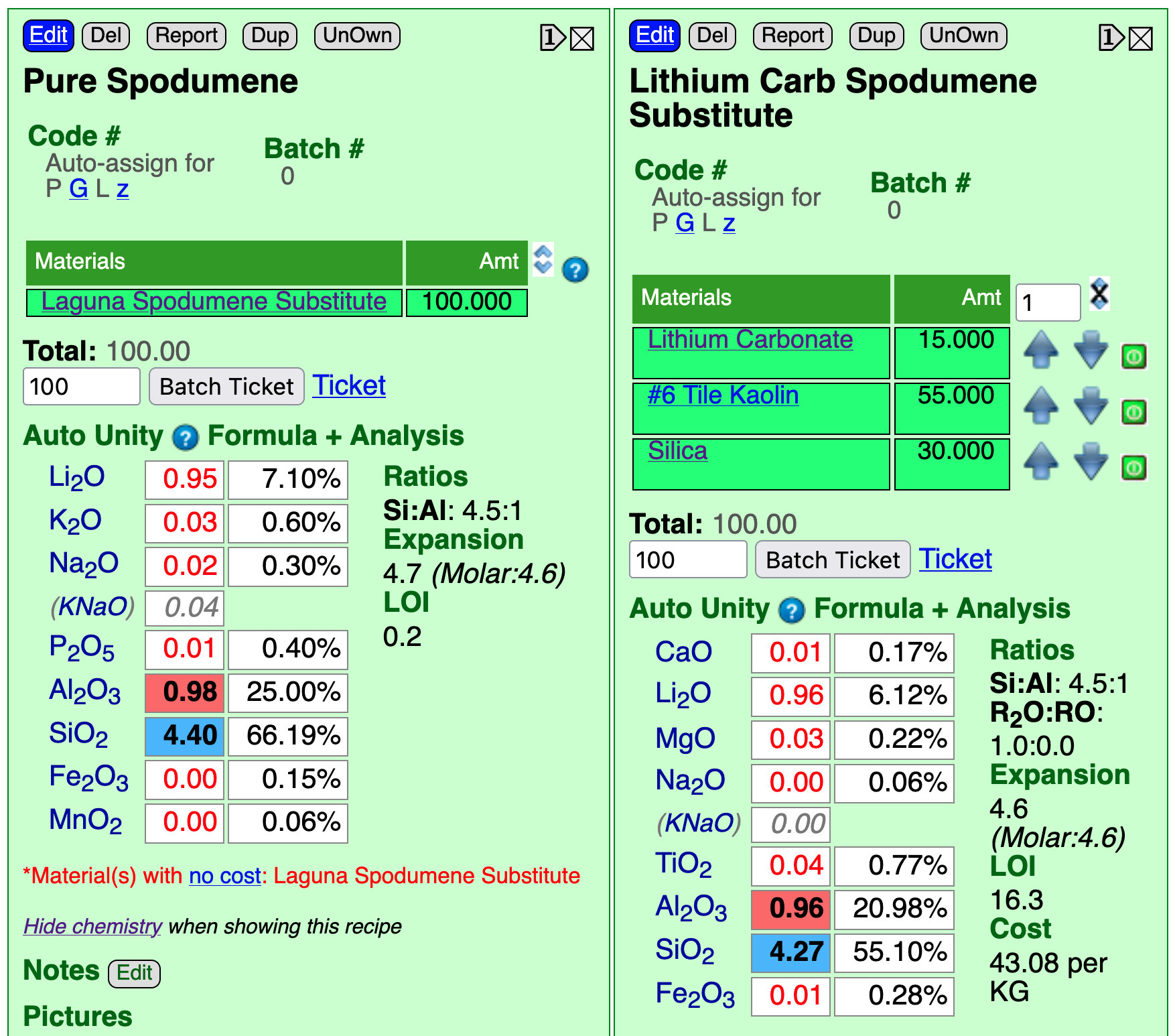
This picture has its own page with more detail, click here to see it.
Spodumene is super expensive; one dunk in a dipping glaze can now cost dollars. But lithium carbonate is even more so. However, both are used as a source of Li2O. The latter is 6+ times more concentrated. And spodumene is more troublesome in glazes (issues with settling, dusting, slurry properties, consistency). And it can be hard to get. So using lithium carbonate might be a better choice for you.
This side-by-side calculation seems to indicate that 15 Lithium Carbonate, 55 Kaolin and 30 Silica can substitute for 100 parts by weight of Laguna Spodumene Substitute. However, that is not quite correct. Note that my substitute recipe calculates to an LOI of 16.3. If I assume the Laguna material has no LOI (for convenience, it actually has 0.2%), that means each of the amounts need to be divided by (100-16.3)/100=0.84. Thus, to substitute for 100 parts of spodumene, you need ~120 of this mix (18 lithium carbonate, 66 kaolin and 36 silica).
Links
| Typecodes |
Glaze Chemistry
Case studies where glaze chemistry was used to solve a problem. |
| Typecodes |
Glaze Rescue
Taking an alluring recipe found on-line and using recipe logic and materials sense to determine if it is worth spending time on. Quite often, reactive glazes (the most popular) can be recognized on sight as having many strings attached. Rather than just mixing them as given, it is worthwhile to investigate improving them on the way into your studio or plant. At one extreme, this may just involve transplanting the mechanism into another base. At the other, glaze chemistry can enable a whole range of improvements and fixes. |
| Materials |
Lithium Carbonate
A powerful melter very valuable in ceramic glazes. It is 40% Li2O and has an LOI of 60% (lost as CO2 on firing). This material in now incredibly expensive. |
| Materials |
Spodumene
Spodumene is a lithium sourcing feldspar, an alternative to lithium carbonate to supply Li2O to ceramic glazes. Contains up to about 8% Li2O. |
 PayPal | No tracking, No ads, No paywall, No transient content! Just organized, concise information constantly updated and improved. Was this helpful? Consider supporting me. |
Got a Question?
Buy me a coffee and we can talk 

https://digitalfire.com, All Rights Reserved
Privacy Policy