Custer Feldspar (post-2000)
Alternate Names: Custer - low KnO
| Oxide | Analysis | Formula | Tolerance |
|---|---|---|---|
| SiO2 | 72.40% | 8.63 | |
| Al2O3 | 15.27% | 1.07 | |
| Fe2O3 | 0.21% | 0.01 | |
| K2O | 7.52% | 0.57 | |
| Na2O | 3.21% | 0.37 | |
| CaO | 0.27% | 0.03 | |
| MgO | 0.07% | 0.01 | |
| P2O5 | 0.20% | 0.01 | |
| LOI | 0.65% | n/a | |
| Oxide Weight | 710.43 | ||
| Formula Weight | 715.08 | ||
Notes
This is an average of actual assays done. See the notes for Custer Feldspar (pre-2000) for more info.
Related Information
Custer Feldspar update
This picture has its own page with more detail, click here to see it.
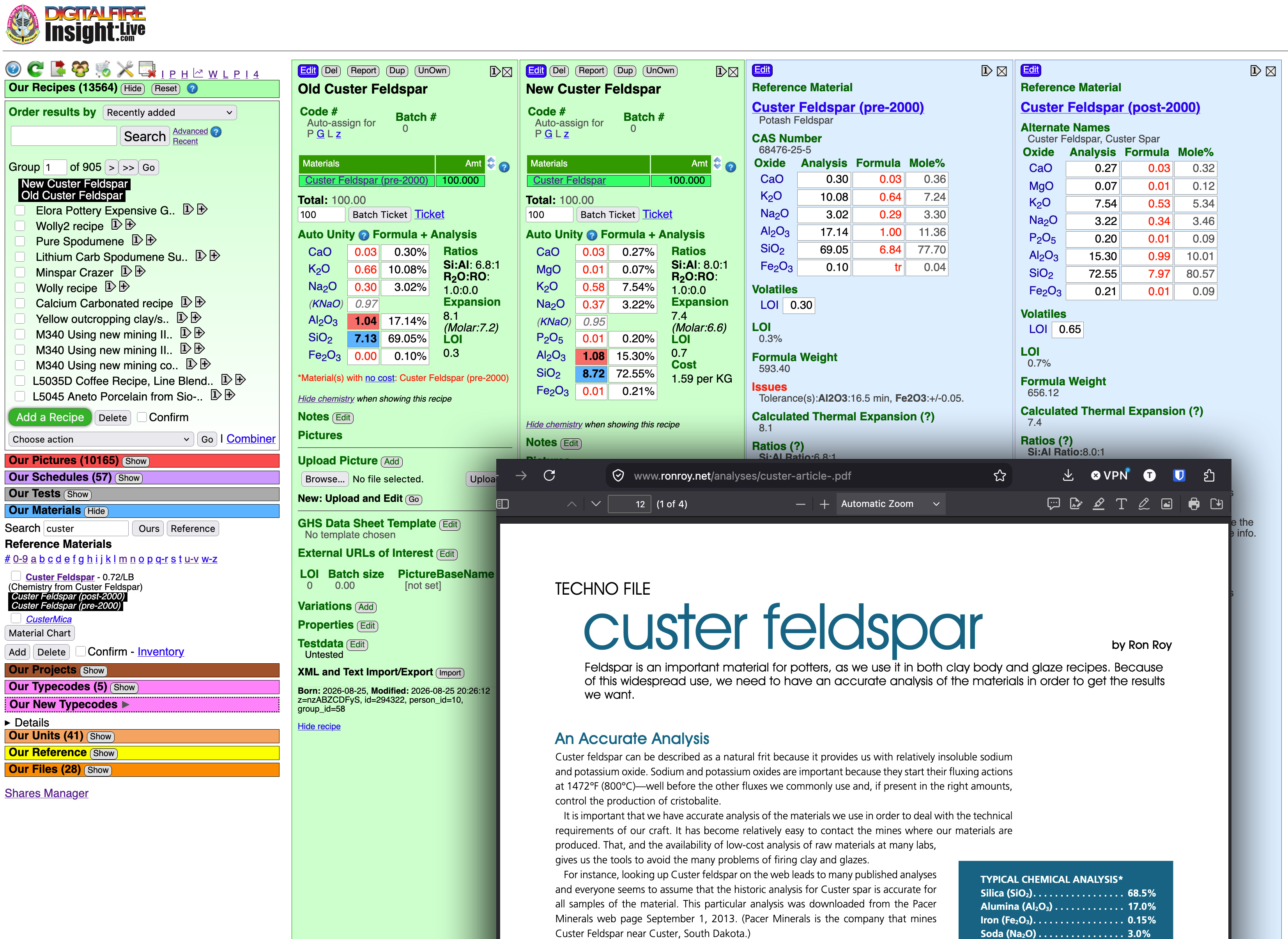
The chemistry for Custer Feldspar has been updated in the materials at Digitalfire and Insight-live. Until now, the Pacer-published values have been used, but at Ron Roy's request, this has been changed (see the link to his article below). The average of assays done from 2000 to 2012 has been used for the chemistry. The material name has been changed to "Custer Feldspar (post-2000)". However, Insight-live will still find it in recipes when needing its chemistry, since "Custer Feldspar" has been included as an alternate name. The old material's name has been changed to "Custer Feldspar (pre-2000)".
In this image, you can see the material chemistries on the right and each of them being used in a one-material recipe on the left. To verify they are calculating correctly, the calculation of each has been set to formula plus analysis.
If you have defined your own material for this (typically done to set a cost), everything should still work correctly (using your chemistry if you provided it).
Replace Custer Feldspar in a cone 10R glaze:
Two minutes of glaze chemistry
This picture has its own page with more detail, click here to see it.
My G2571A and G1947U cone 10R glaze recipes are both in use in Ecuador. One user has been importing Custer feldspar, but now needs to substitute a local one. That material is much higher in SiO2 and much lower in Al2O3 and KNaO (so a pound-for-pound substitution is likely not going to work). Here is how I did the chemistry. It turned out to be a matter of increasing the new feldspar to match the KNaO (which also matched the Al2O3) and then reducing the silica to match the SiO2. The amount by which I had to change the feldspar is a testament to how different the chemistry of these materials can be from country to country.
If you do this calculation, please note the following: In August 2026 the name for Custer Feldspar was changed to "Custer Feldspar (post-2000)" (both here and in the Insight-live reference materials). There is also one for "Custer Feldspar (pre-2000)".
Links
| Materials |
Custer Feldspar (pre-2000)
The most common potash feldspar used in ceramics in North America, a standard for many decades, but no longer available. Its chemistry shifted around 2000. |
| URLs |
https://www.ronroy.net/analyses/custer-article-.pdf
Ron Roy article about changes in Custer Feldspar |
 PayPal | No tracking, No ads, No paywall, No transient content! Just organized, concise information constantly updated and improved. Was this helpful? Consider supporting me. |
| By Tony Hansen Follow me on        |  |
Got a Question?
Buy me a coffee and we can talk 

https://digitalfire.com, All Rights Reserved
Privacy Policy