Floating Blue on the way to the UK:
Courtesy of a little glaze chemistry
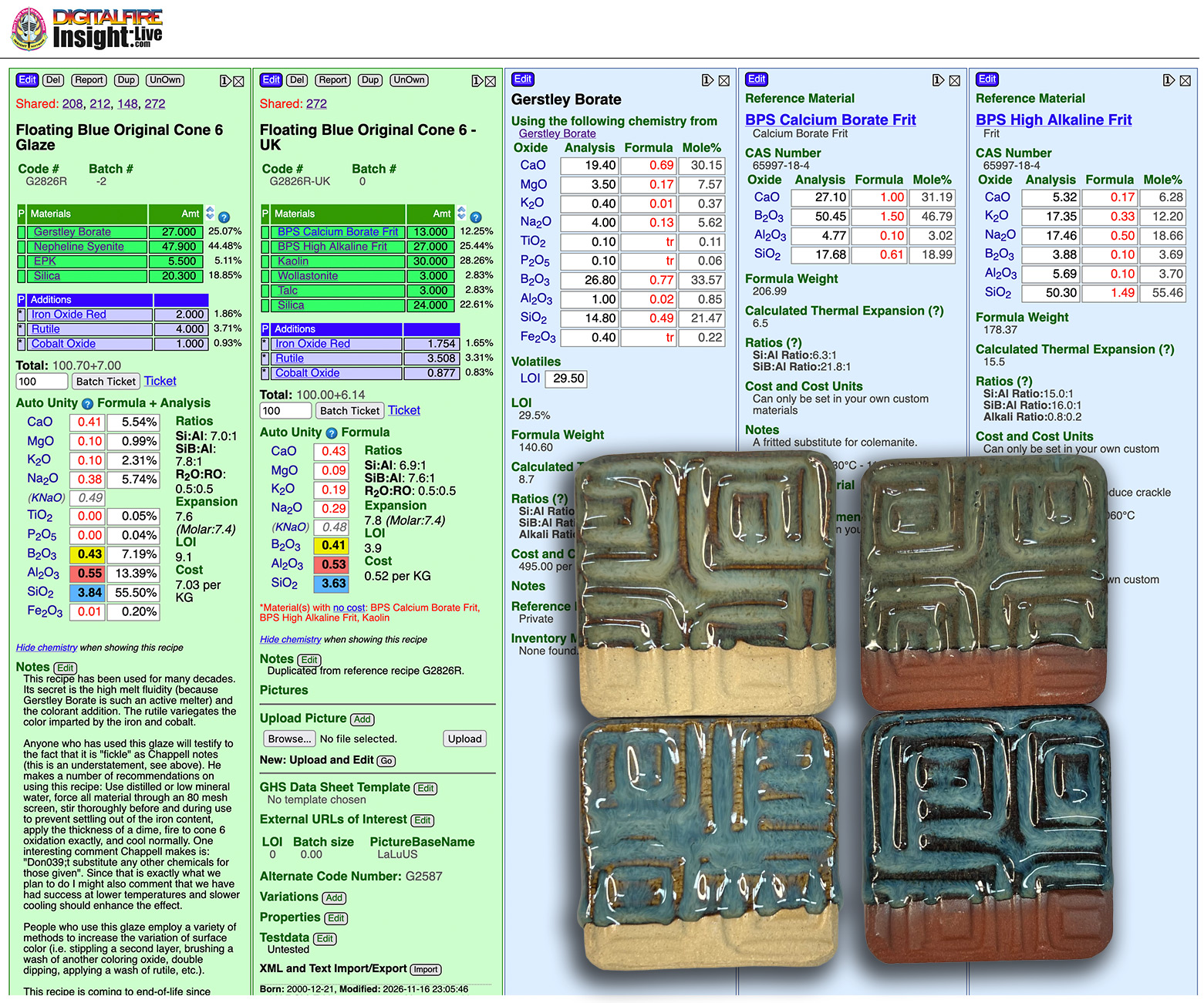
Gerstley Borate is not available in the UK, so I calculated a recipe that employs BPS frits to supply the high levels of B2O3 and KNaO needed. This is possible because floating blue is not so much a glaze recipe as a recipe mechanism (in this case a transparent with a 4:2:1 addition of rutile, iron and cobalt). The original floating blue had one of the most troublesome base recipes, the infamous 50:30:20. Not just because it created a bucket of jelly and ran off ware in the kiln, but the main material, Gerstley Borate, was inconsistent. As a result, sometimes it did not fired the right color (as can be seen on these cone 6 fired tiles, the upper two are a new batch of GB, the lower two are with Gillespie Borate, a challenging material in its own right). Variation in ceramic rutile particle size is also a common cause of issues.
Related Pictures
Titanium instead of rutile for floating blue:
With no cobalt oxide!

This picture has its own page with more detail, click here to see it.
Rutile blue glazes are actually titanium blues (because rutile mineral is an impure source of TiO2 and Fe2O3). The iron and titanium in the rutile react to form the floating blue effect. The GA6-C recipe has always relied on a 4% rutile addition. Its GA6-A base recipe contains significant iron (because of the 80% Alberta Slip), so could titanium oxide deliver the same floating blue effect? Yes.
These mugs are M390 clay. The top left one is the standard GA6-C (with rutile) fired using the C6DHSC slow-cool firing schedule (the bottom left normal cool PLC6DS schedule produces little color). But the ones on the right switch the 4% rutile for titanium dioxide (the L4655 recipe). The top right was fired using the slow cool, the bottom right was the normal cool schedule.
Titanium thus seems more consistent and reliable material than rutile. An excellent blue color is produced even without a slow cool (lower right).
 PayPal | No tracking, No ads, No paywall, No transient content! Just organized, concise information constantly updated and improved. Was this helpful? Consider supporting me. |
Got a Question?
Buy me a coffee and we can talk 

https://digitalfire.com, All Rights Reserved
Privacy Policy