Decomposition During Ceramic Firing
How ceramic raw materials decompose during firing, releasing water, carbon dioxide and other gases that can cause bloating, pinholes and glaze defects.
Key phrases linking here: decomposition, decomposed, decompose - Learn more
Details
Ceramic kilns are molecule-breaking machines! They subject mineral powders to temperatures that can destroy their original crystal structures, release chemically bound gases and enable entirely new materials to form. Some minerals begin decomposing at surprisingly low temperatures, long before any melting occurs. Others resist decomposition until much higher temperatures. Still others melt, dissolve into developing glass phases or undergo changes in crystal structure without decomposing at all. A ceramic firing is thus a complex sequence of chemical and physical transformations, many occurring simultaneously.
Decomposition is a chemical reaction in which a compound breaks down into simpler substances. In ceramics, we are especially interested in thermal decomposition because it often produces gases that must escape during firing. Temperature is the driving force, but the rate and extent of decomposition are also influenced by particle size, heating rate, kiln atmosphere, surrounding materials and the time available for reactions to occur.
Clay minerals decompose long before the body matures
Kaolin provides a good example. Its principal mineral, kaolinite, contains chemically bound hydroxyl groups (OH) as part of its crystal structure. Ordinary drying cannot remove these. But during firing, generally between about 450–650°C, the kaolinite undergoes dehydroxylation: the hydroxyl groups combine to form water vapour, the original crystal structure breaks down and a disordered material called metakaolin remains. This structural transformation is irreversible under normal ceramic processing conditions. Pure kaolinite loses about 14% of its weight during this process! Yet this is generally manageable because it takes place well before significant vitrification. The body is still porous enough to allow the vapour to escape. Other clay minerals, including illite and smectite, also undergo dehydroxylation, although their thermal behaviours differ.
As temperatures rise further, other changes occur. Quartz may remain as recognizable grains, although it undergoes reversible crystal-structure changes, including the familiar quartz inversion at 573°C. Feldspars contribute to liquid-phase formation, and the developing melt begins dissolving other constituents. New crystalline phases can also develop. These are not all decomposition reactions, but they are part of the larger transformation from a collection of mineral powders into a ceramic.
Natural clays can be complicated mixtures
Refined glaze and porcelain materials are often relatively consistent in chemistry, mineralogy and particle size. Natural clays, especially those receiving minimal processing, can be much more complicated. They may contain particles of quartz, feldspar, mica, carbonates, iron minerals, sulphides, sulphates and organic matter, in addition to the clay minerals themselves. The proportions, particle sizes and distributions of these components can vary considerably. Each constituent has its own thermal behaviour. Some decompose, some oxidize, some undergo structural transformations and others react with surrounding minerals. The resulting gases can include water vapour, carbon dioxide, carbon monoxide and sulphur oxides. Under certain conditions, volatile compounds of other elements may also be released. The important point is that a clay body does not have one decomposition temperature. It has a sequence of overlapping reactions occurring across a wide temperature range.
Why decomposition causes defects
Some relatively clean-burning stoneware and porcelain bodies release most of their gases before substantial vitrification begins. By contrast, iron-bearing terra cotta and other naturally occurring clays can contain a much greater diversity of gas-producing minerals. Their decomposition and oxidation reactions may continue as the body begins to densify. This creates a problem: The developing glass phase progressively closes the interconnected pores through which gases previously escaped. If gas production continues, pressure can build inside the body, producing bloating. Escaping gases can also disturb an overlying glaze, creating bubbles, pinholes and blisters. A particularly troublesome situation occurs when a glaze begins melting and sealing the surface while the body is still releasing gases. The gases must then pass through a viscous melt. Some escape, but others become trapped as bubbles or break through the surface and leave defects.
This is why the timing of decomposition matters as much as the total amount of gas released. A clay containing significant amounts of gas-producing materials may fire successfully if the gases escape while the body is still open and porous. Another clay, containing much less gas-producing material, may cause more trouble if gas release continues after its pores have begun closing.
Carbonates, sulphates and other gas-producing materials
Carbonates are among the most important sources of decomposition gases in ceramic firing. Calcium carbonate, dolomite and barium carbonate contain carbonate groups (CO₃) in their crystal structures. When these decompose, carbon dioxide is released. Calcium carbonate, for example, undergoes this reaction:
CaCO₃ → CaO + CO₂↑
The CO₂ represents about 44% of the original calcium carbonate weight. The resulting CaO can then react with surrounding materials or become incorporated into a glaze melt.
Sulphates can also decompose, releasing sulphur-containing gases, including SO₂ and SO₃, depending on the material and firing conditions. Sulphides and organic sulphur compounds can release sulphur oxides through oxidation. The timing of these reactions varies considerably.
Some materials introduce such inconvenient decomposition behaviour that they are rarely desirable as glaze ingredients. Hydrated lime, Ca(OH)₂, is an example. Although it is a source of CaO, it decomposes at approximately 400–500°C, releasing about 24% of its weight as water vapour. That is an extraordinary gas release for a material intended to contribute a simple flux oxide! Calcium carbonate, although it also has a high LOI, is generally a much more practical source of CaO.
Loss on ignition measures how much, not when
Loss on ignition (LOI) expresses the percentage of a material's weight lost during heating to a specified temperature. It is a useful indicator of the amount of volatile material present, but it does not tell us when that loss occurs or identify which gases are released.
For example, kaolin loses chemically bound water at intermediate temperatures, calcium carbonate releases CO₂ at higher temperatures, and some other materials can continue releasing gases as glaze melting is underway.
This explains why two materials having the same LOI can behave very differently in firing. It also explains why understanding a material's thermal decomposition profile can be much more valuable than knowing its LOI alone.
How does this relate to oxide chemistry?
Ceramic chemistry is commonly expressed in terms of oxides: SiO₂, Al₂O₃, CaO, Na₂O and others. This is an extremely useful convention for calculating and comparing glazes, but it does not mean that every ceramic mineral literally breaks apart into independent oxide molecules during firing.
Soda feldspar, for example, has the formula NaAlSi₃O₈, commonly represented in ceramic oxide calculations as Na₂O·Al₂O₃·6SiO₂. These oxide proportions describe its composition, not separate oxide molecules bonded together inside the feldspar crystal. The atoms are arranged in a connected three-dimensional aluminosilicate framework.
When feldspar participates in melting, that framework is progressively disrupted and its chemical components become incorporated into the developing liquid. Other minerals can dissolve into that liquid and react with it. On cooling, the melt may form glass, crystals or a combination of both.
Thus, oxide chemistry describes what a ceramic material contains chemically; mineralogy describes how those elements are organized before firing; and firing determines how that organization changes.
Understanding the terminology
Some basic chemistry terms help distinguish these processes:
Elements: Substances consisting of one type of atom, such as silicon, aluminum, oxygen and calcium. Each element is defined by the number of protons in its atomic nucleus.
Compounds: Substances whose elements are chemically combined in definite proportions. Calcium carbonate (CaCO₃) and kaolinite are examples.
Oxides: Compounds of oxygen with another element. Ceramic oxide formulas are also used to represent the chemical composition of complex minerals and glassy materials.
Molecules: Distinct groups of chemically bonded atoms, such as H₂O and CO₂. Many ceramic minerals, however, are extended crystal structures rather than collections of separate molecules.
Mixtures: Materials containing two or more substances not chemically combined into a single compound. A bucket of glaze slurry containing feldspar, kaolin and silica particles suspended in water is an example.
Solutions: Homogeneous systems in which substances are dissolved in a solvent. Saltwater is a familiar example: NaCl dissociates into hydrated sodium and chloride ions. Molten ceramic glazes can also dissolve additional materials, but their structure is much more complex than that of ordinary saltwater.
Glass: A noncrystalline solid, commonly formed when a melt cools without sufficient crystallization. It retains a disordered atomic structure rather than forming a regular crystal lattice.
Why understanding decomposition matters
A ceramic recipe is not just a list of ingredients that will eventually melt together. It is a collection of minerals, each following its own path through firing. Some release gases, some remain relatively stable, some dissolve and others react to form new phases.
Knowing which reactions occur, when they occur and whether the gases can escape is central to understanding bloating, pinholing, blistering and other firing defects. It also explains why changes in raw materials, particle size, glaze thickness, firing atmosphere and heating schedule can dramatically affect the fired result—even when the calculated oxide chemistry remains unchanged.
Related Information
The perfect storm of high surface tension and high LOI: Blisters.
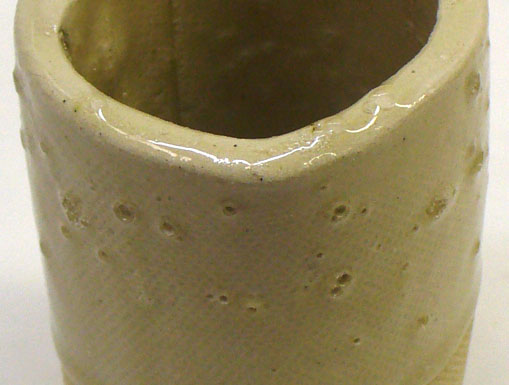
This picture has its own page with more detail, click here to see it.
An example of how calcium carbonate can cause blistering as it decomposes during a fast firing in our electric kiln. This is a cone 6 borosilicate glaze with 15% calcium carbonate added (there is no blistering without it). Calcium carbonate has a very high loss on ignition (LOI), and for this early-melting glaze, the gases of its decomposition are still escaping after melting begins. Another factor is also involved: Although the glaze has good melt fluidity, bubbles survived till near the end of the firing, resisting rupture (likely because of the high surface tension of the melt). When the bubbles finally did burst, there was inadequate time for healing to occur.
Calcium carbonate and glaze bubbles

This picture has its own page with more detail, click here to see it.
The two cone 04 glazes on the right have the same chemistry but the center one sources it's CaO from 12% calcium carbonate and ulexite (the other from Gerstley Borate). The glaze on the far left? It is almost bubble free yet it has 27% calcium carbonate. Why? It is fired to cone 6. At lower temperatures carbonates and hydrates (in body and glaze) are more likely to form gas bubbles because that is where they are decomposing (into the oxides that stay around and build the glass and the ones that are escaping as a gas). By cone 6 the bubbles have had lots of time to clear.
Carbonate gassing can cause glaze blisters

This picture has its own page with more detail, click here to see it.
An example of how a carbonate can cause blistering. Carbonates produce gases during decomposition. This glaze (G2415B) contains 10% lithium carbonate, which likely pushes the initial melting temperature down toward the most active decomposition temperatures.
The difference between these low fire transparents: Gerstley Borate vs. Ulexite

This picture has its own page with more detail, click here to see it.
Left: Worthington Clear cone 04 glaze (A) uses Gerstley Borate to supply the B2O3 and CaO. Right: A substitute using Ulexite and 12% calcium carbonate (B). The degree of melting is the same but the gassing of the calcium carbonate has disrupted the flow of B. Gerstley Borate gasses also, but does so at a stage in the firing that does not disrupt this recipe. However, as a glaze, B does not gel and produces a clearer glass. A further adjustment to source CaO from non-gassing wollastonite would likely improve it.
Let me count the reasons this glossy white cone 6 glaze is pinholing

This picture has its own page with more detail, click here to see it.
First, the layer is very thick. Second, the body was only bisque fired to cone 06 and it is a raw brown burning stoneware with lots of coarser particles that generate gases as they are heated. Third, the glaze contains zircopax, it stiffens the melt and makes it less able to heal disruptions in the surface. Fourth, the glaze is high in B2O3, so it starts melting early (around 1450F) and seals the surface so the gases must bubble up through. Fifth, the firing was soaked at the end rather than dropping the temperature a little first (e.g. 100F) and soaking there instead.
White spots and blisters in a high zircon glaze at cone 6
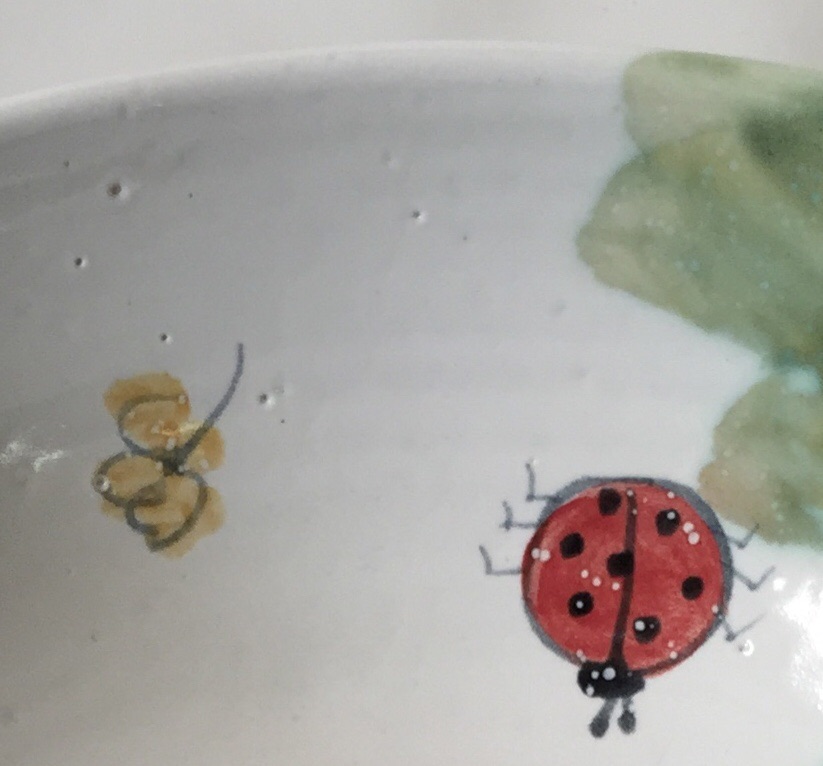
This picture has its own page with more detail, click here to see it.
This is also a common problem at low fire on earthenware clay (but can also appear on a buff stonewares). Those white spots you see on the beetle also cover the entire glaze surface (although not visible). They are sites of gas escaping (from particles decomposing in the body). The spots likely percolate during soaking at top temperate. Some of them, notably on the almost vertical inner walls of this bowl, having not smoothed over during cool down.
What can you do? Use the highest possible bisque temperature, even cone 02 (make the glaze thixotropic so it will hang on to the denser body, see the link below about this). Adjust the glaze chemistry to melt later after gassing has finished (more zinc, less boron). Apply a thinner glaze layer (more thixotropy and lower specific gravity will enable a more even coverage with less thickness). Instead of soaking at temperature, drop 100 degrees and soak there instead (gassing is much less and the increasing viscosity of the melt overcomes the surface tension). Use a body not having any large particles that decompose (and gas) on firing. Use cones to verify the temperature your electronic controller reports.
Ceramic Oxide Periodic Table

Pretty well all common traditional ceramic base glazes are made from less than a dozen elements (plus oxygen). Go to the full picture of this table and click or tap each of the oxides to learn more (on its page at digitalfire.com). When materials melt, they decompose, sourcing these elements in oxide form. The kiln builds the glaze from them, it does not care what material sources what oxide (assuming, of course, that all materials do melt or dissolve completely into the melt to release those oxides). Each of these oxides contributes specific properties to the glass. So, you can look at a formula and make a good prediction of the properties of the fired glaze. And know what specific oxide to increase or decrease to move a property in a given direction (e.g. melting behavior, hardness, durability, thermal expansion, color, gloss, crystallization). And know about how they interact (affecting each other). This is powerful. A lot of ceramic materials are available, hundreds - that is complicated when individual materials source multiple oxides. Viewing a glaze as a simple unity formula of ceramic oxides is just simpler.
Exploding clay. How do you do that?

This picture has its own page with more detail, click here to see it.
The top two terra cotta clay test bars were fired at cone 01 and cone 02. Notice how they puff up inside and eventually split open the outer layer revealing an "Aero chocolate bar" interior. Why? The fine-particled clay at the surface has vitrified and oxidized enough to become an almost porcelain-like surface, sealing it. But terra cotta clays have particulates of many minerals, inside the bars where oxygen is lacking some of them are decomposing and melting (and releasing CO2) at the very same temperature. Guess what happened when I mixed this clay 50:50 with Redart: This effect was gone, it fired to a stable and strong red stoneware. Redart, although also a terra cotta, raises the temperature at which the surface seals, beyond when the gas escape is happening. Some people actually seek this effect. The secret of making it happen is finding a native clay that vitrifies completely at the same temperature as mineral particles are decomposing to create gases.
Links
| Projects | Temperatures |
| Tests |
Decomposition Temperature
|
| URLs |
https://digitalfire.com/4sight/temperatures/index.html
Milestone temperatures during firing |
| URLs |
http://www.scielo.br/scielo.php?script=sci_arttext&pid=S0366-69132008000300001
A study of the cmparative decompositions of MgCO3, CaCO3, SrCO3 and BaCO3 |
| Glossary |
Water in Ceramics
Water is the most important ceramic material, it is present every body, glaze or engobe and either the enabler or a participant in almost every ceramic process and phenomena. |
| Glossary |
Water Smoking
In ceramics, this is the period in the kiln firing where the final mechanical water is being removed. The temperature at which this can be done is higher than you might think. |
| Glossary |
Glaze Blisters
Blistering is a common surface defect that occurs with ceramic glazes. The problem emerges from the kiln and can occur erratically in production. And be difficult to solve. |
| Glossary |
Ceramic Oxide
In glaze chemistry, the oxide is the basic unit of formulas and analyses. Knowledge of what materials supply an oxide and of how it affects the fired glass or glaze is a key to control. |
| Glossary |
Glass vs. Crystalline
In ceramics, understanding the difference between what a glass and crystal are provides the basis for understanding the physical presence of glazes and clay bodies. |
| Glossary | Volatiles |
| Glossary |
Glaze Chemistry
Glaze chemistry is the study of how the oxide chemistry of glazes relate to the way they fire. It accounts for color, surface, hardness, texture, melting temperature, thermal expansion, etc. |
| Articles |
Where do I start in understanding glazes?
Break your addiction to online recipes that don't work or bottled expensive glazes that you could DIY. Learn why glazes fire as they do. Why each material is used. How to create perfect dipping and brushing properties. Even some chemistry. |
 PayPal | No tracking, No ads, No paywall, No transient content! Just organized, concise information constantly updated and improved. Was this helpful? Consider supporting me. |
| By Tony Hansen Follow me on        |  |
Got a Question?
Buy me a coffee and we can talk 

https://digitalfire.com, All Rights Reserved
Privacy Policy