Porcelain Insulators
Among the most difficult ceramic product to make. They demand electrical reliability, mechanical strength, weather resistance, and dimensional consistency over decades of outdoor service.
Key phrases linking here: electrical porcelains, porcelain insulators - Learn more
Details
Electrical porcelain insulators are among the most technically demanding ceramic products to make. Electrical reliability, mechanical strength, weather resistance, and dimensional consistency over decades of outdoor service are essential. Even though polymers now compete, porcelain remains important because it offers very long service life, UV resistance, thermal stability, excellent compressive strength and predictable aging (many remain in service for 50+ years).
Very pure kaolins, feldspar and quartz recipes host a dense matrix with lots of mullite crystal development. Additions of alumina maximize dielectric and mechanical strength. Materials are wet ball milled to achieve tightly controlled particle size distribution and enable magnetic separation of all possible iron contamination.
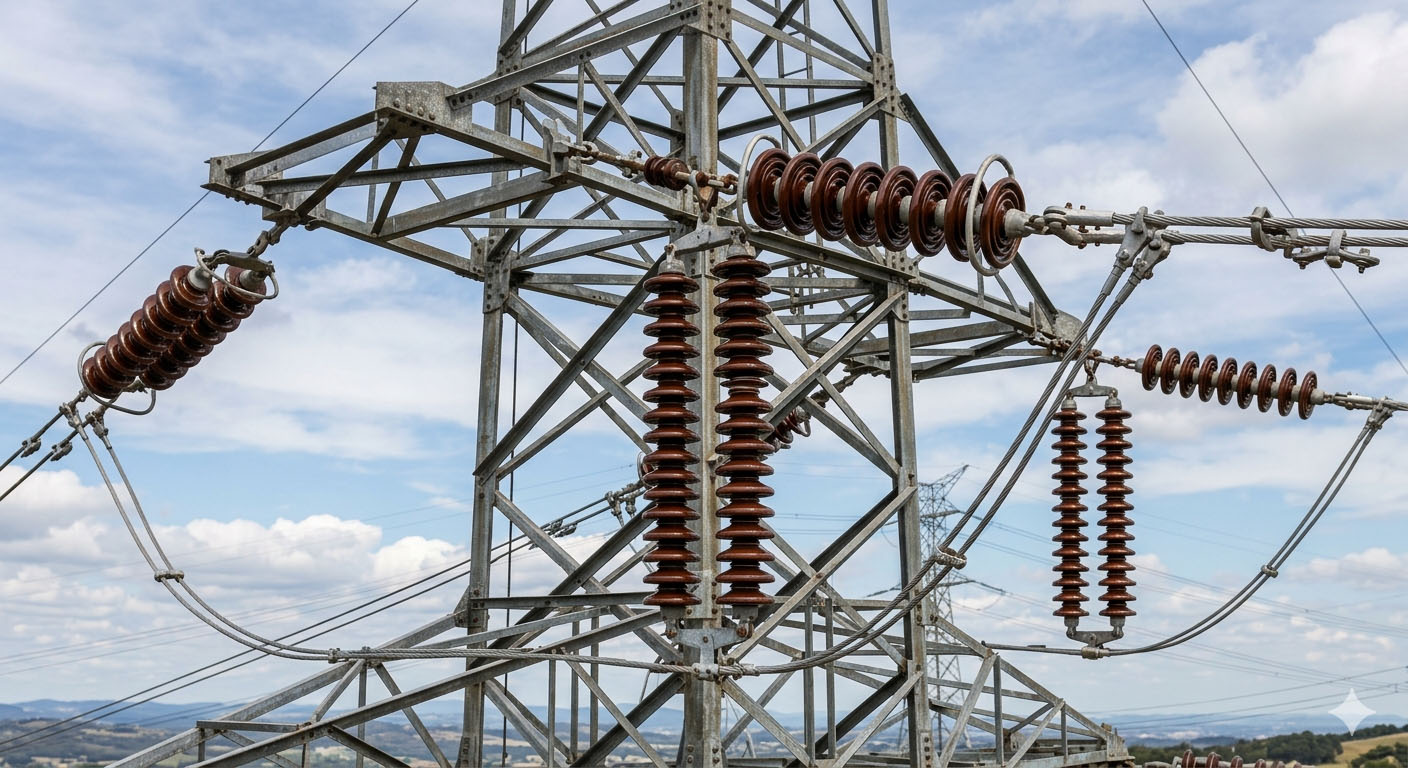
Taken for granted, these porcelain insulators are atop even power pole. They are surprisingly difficult to manufacture.
The drying process must be highly controlled to minimize internal moisture gradients that produce cracking (parts are thick and often asymmetrical, a hidden drying crack can destroy electrical reliability years later). Insulator porcelains are fired 1250–1400°C with long soaking cycles and tightly controlled atmosphere. The objective is near-zero open porosity (a tiny amount of residual porosity can absorb moisture, reduce dielectric strength leading to failure under voltage stress).
Insulator glaze is mainly protective: It seals surface pores, improves weather resistance and prevents contamination buildup to reduce surface leakage currents. Glazes are usually feldspathic, applied thinly, highly fitted and extremely smooth. The traditional glossy brown surface results for an iron oxide addition. While iron inside the porcelain body is dangerous because it becomes part of the dielectric structure; in the glaze it is acceptable because it is locked in a thin surface layer that not part of the main insulating duty. In addition, it does not form conductive particles are pathways, instead it exists as ions dissolved in the glass network. The brown glaze also makes crazing, pinholes, thin spots and firing defects easier to see (helping reject defective pieces before shipment). Insulators are also made in gray, it looks cleaner in urban installations and blends visually with metal structures.
Since a failed transmission insulator can collapse an entire power line, each one must undergo mechanical and electrical testing for dielectric breakdown, mechanical load, thermal shock testing, puncture hidden cracks. Hardware integration is also critical since many porcelain insulators are assembled with metal fittings (e.g. steel caps, pins, threaded inserts) which must survive thermal expansion mismatch. Cement systems are engineered carefully so porcelain is not stressed during service.
Related Information
High tension porcelain insulators
Not like the porcelain you use for pottery
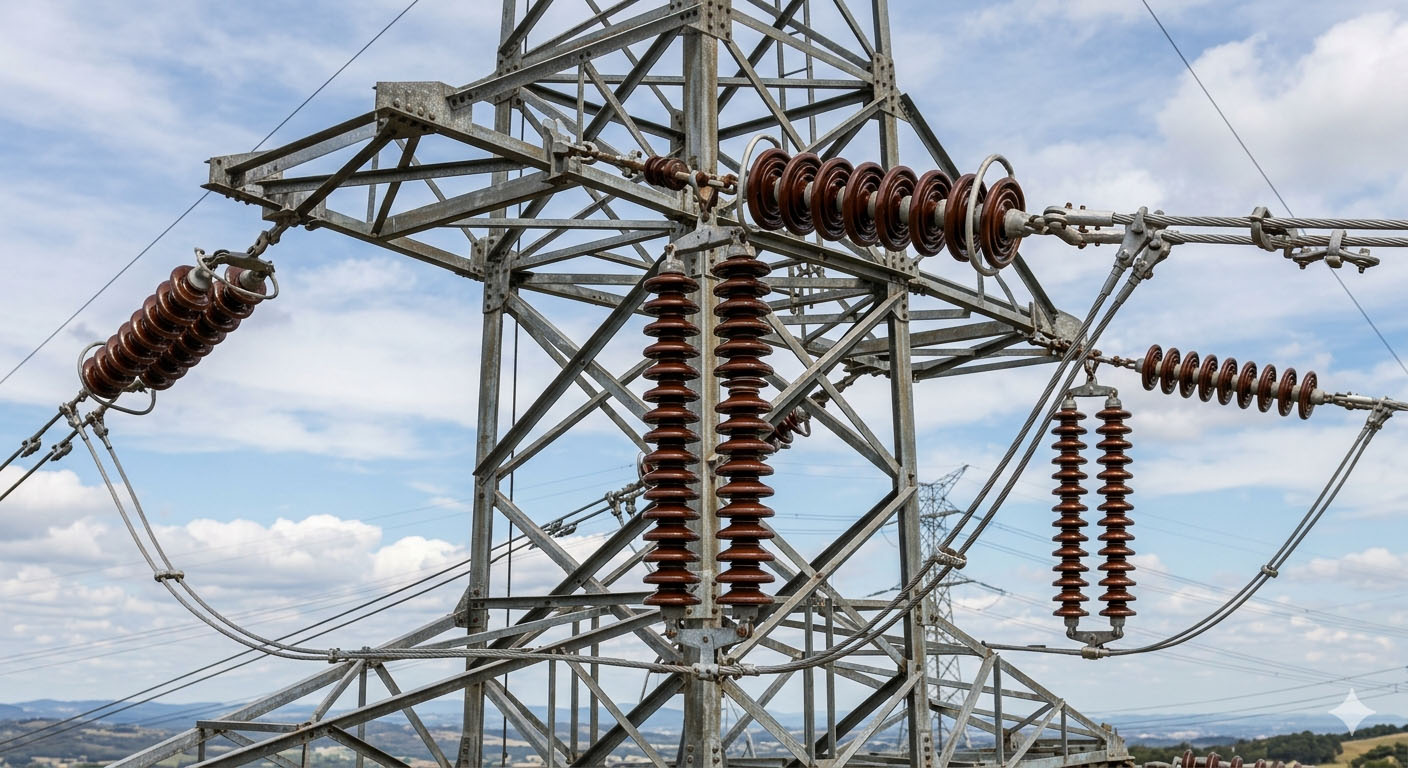 Created by Google Gemini AI Policy
This picture has its own page with more detail, click here to see it.
Electrical insulators most often employ aluminous porcelains. Like sanitaryware and tableware (mullite porcelains), feldspar still forms some glass, but the microstructure of electrical porcelains is dominated by angular, size-controlled, alumina grains. Only a small amount of mullite forms. The result is a matrix having much better mechanical and dielectric strength, better insulating properties and resistance to thermal shock. How can this be affordable given that calcined alumina is many times more expensive than other common porcelain ingredients? When producers are already extremely careful to meet specifications, rejects are low enough that the added cost of alumina is acceptable given the performance gains.
What about the glossy brown glaze? Brown hides dirt, dust, and industrial grime. Slight variations in firing are less visible and the glassy finish causes rainwater to form discrete droplets rather than a continuous conductive film. The Iron-oxide-based brown is self-opacifying so it does not require zircon. And it is highly resistant to uV degradation and compatible with the chemistry needed to achieve glaze compression (to minimize crazing).
When kilns are not candled long enough
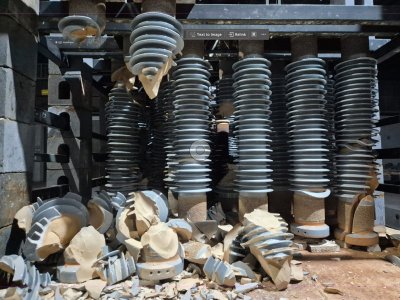
This picture has its own page with more detail, click here to see it.
Candling of kilns is the final stage of drying. Driers cannot achieve the temperatures needed to remove all water, so almost all industries rely on early stages of firing to remove it fully. Failures like this are part of the learning curve of every company (because there is always pressure to fire as fast as possible).
Although much more common in heavy clay industries, porcelain insulators are one of the less likely products for this to happen with. This is because machine-forming methods make it possible to use aluminous porcelain bodies having very little clay. Thus, faster drying (with less shrinkage and fewer residual internal stresses) also makes it possible for early stages of firing to be quicker. But there are limits. These insulators are solid, thick and heavy. And they have extreme variations in thickness (thin skirts to solid spindle). So, for even these, early stages of firing must be conducted carefully. For such products, periodic firings of days is often needed.
Mullite and anorthite porcelains:
The microstructure was only understood recently
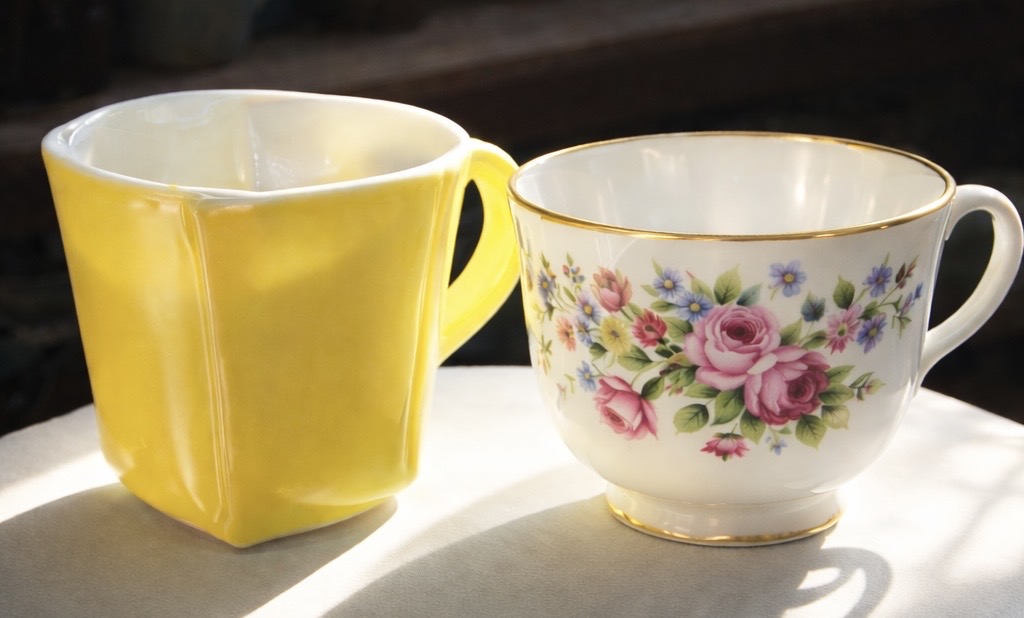 Produced by Gemini, combining a picture of a mug I made with a generated bone china one. AI Policy
This picture has its own page with more detail, click here to see it.
The porcelains that potters and traditional industry (sanitaryware, electrical insulators, common tableware) know and love are actually "mullite porcelains", named such because the fundamental source of strength (both fired and pyroplastic) is the needle-shaped mullite crystals that grow during the final stages of firing. The mug on the left is fired at 2200F and is made of high-feldspar Polar Ice. The kaolin crystals converted to mullite rather than dissolving in the feldspar glass.
Bone china, by contrast, is a calcium aluminosilicate glass-ceramic. It is "anorthite porcelain", relying on calcium from bone ash reacting with SiO2 and Al2O3 (from the kaolin and feldspar) to form anorthite crystals. The reward is strength and translucency (without brittleness), having fine and evenly dispersed crystals and outstanding density (no pores to scatter light). The refractive indices between the glass and crystal phases are also very similar, further preventing light scattering.
Both of these crystal types can be found in nature. But here, they are grown spontaneously during firing. Gradual recognition of these mechanisms was two centuries in the making, but not clear until the 1960s-1980s! Anorthite system mapping being the latter. Understanding and relationships with thermal expansion and translucency and kinetic control in fast-fire kilns has happened since then.
Links
| URLs |
https://www.instagram.com/reel/DWTTj4rDpxv
High voltage testing of electrical insulators |
| URLs |
https://www.instagram.com/reel/DWi2Y5mjj1G
Glazing Porcelain insulators |
| URLs |
https://www.instagram.com/reel/DW8gPtrjdIS
Giant electrical insulators being made at sl-insulator.com.cn |
 PayPal | No tracking, No ads, No paywall, No transient content! Just organized, concise information constantly updated and improved. Was this helpful? Consider supporting me. |
| By Tony Hansen Follow me on        |  |
Got a Question?
Buy me a coffee and we can talk 

https://digitalfire.com, All Rights Reserved
Privacy Policy