The matteness of this glaze depends on the cooling rate
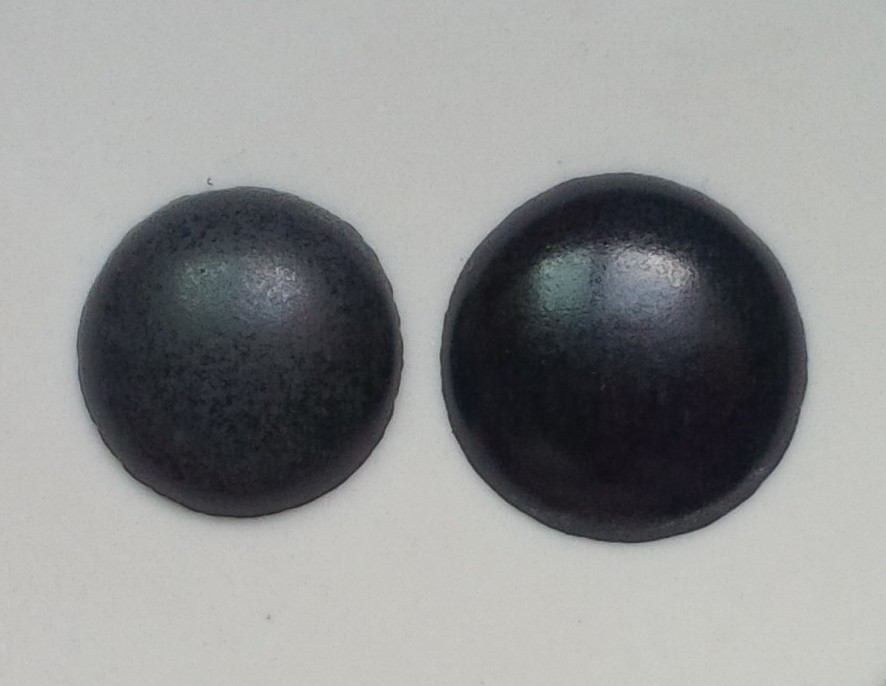
This is the G2934Y matte cone 6 recipe with a red stain (Mason 6021). The one on the left was fired using the C6DHSC slow-cool schedule. The one on the right was fired using the drop-and-soak PLC6DS schedule. The only difference in the two schedules is what happens after 2100F on the way down (the slow-cool drops at 150F/hr and the other free-falls). For this glaze, the fast cool is much better, producing a silky pleasant surface rather than a dry matte.

Related Pictures
The same glaze fires very differently depending on kiln cooling rate

This picture has its own page with more detail, click here to see it.
Both mugs use the same cone 6 oxidation high-iron (9%), high-boron, fluid melt glaze. Iron silicate crystals have completely invaded the surface of the one on the left, turning the gloss surface into a yellowy matte. Why? Multiple factors. This glaze does not contain enough iron to guarantee crystallization on cooling. When cooled quickly it fires the ultragloss near-black on the right. As cooling is slowed at some point the iron will begin to precipitate as small scattered golden crystals (sometimes called Teadust or Sparkles). As cooling slows further the number and size of these increases. Their maximum saturation is achieved on the discovery, usually by accident, of the likely narrow temperature range they form at (normally hundreds of degrees below the firing cone). Potters seek this type of glaze but industry avoids it because of difficulties with consistency.
Tuning the degree of gloss on a matte black glaze:
It's about more than just surface character
This picture has its own page with more detail, click here to see it.
These 10-gram balls were fired and melted down onto a tile. The one on the left is the original G2934 Plainsman Cone 6 magnesia matte with 6% Mason 6600 black stain. It has been a little too matte (and thus cutlery marking). On the right, the adjustment has a 20% glossy G2926B glaze addition to make it less matte. Notice the increased flow (the ball has flattened more). In addition, while the percentage of stain in the one on the right is actually less, the color appears darker because the more homogeneous glass allows more light penetration and less scattering.
My goal in making it glossier was to make it less prone to cutlery marking. The marking does not happen because the glaze is soft, but because the metal is abraded by microscopic surface roughness. Interestingly, I recovered the degree of matteness by slowing the cooling cycle, letting the kiln create a truer surface texture instead of forcing it through chemistry alone.
Videos
Links
| Glossary |
Matte Glaze
Random material mixes that melt well overwhelmingly want to be glossy, creating a matte glaze that is also functional is not an easy task. |
| Recipes |
G2934Y - Cone 6 Magnesia Matte Low LOI Version
The same chemistry as the widely used G2934 but the MgO is sourced from a frit and talc instead of dolomite. It has a finer surface, less cutlery marking and staining. |
| Firing Schedules |
Plainsman Cone 6 Drop-and-hold, Slow Cool
350F/hr to 2100F, 108/hr to 2200, hold 10 minutes, fastdrop to 2100, hold 30 minutes, 150/hr to 1400 |
 PayPal | No tracking, No ads, No paywall, No transient content! Just organized, concise information constantly updated and improved. Was this helpful? Consider supporting me. |
Got a Question?
Buy me a coffee and we can talk 

https://digitalfire.com, All Rights Reserved
Privacy Policy