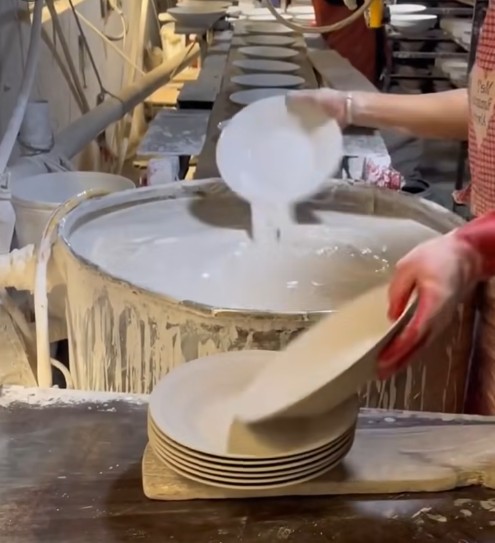
URL: A factory worker dip-glazes translucent porcelain plates with her bare hands. Very fast!
Click the link below to go to this page
https://www.facebook.com/reel/1555758769633769
She works at incredible speed, glazing one every two seconds. Without using dipping tongs. She applies a very thin layer of transparent glaze. While it appears very watery (low viscosity), it is likely high-solids and deflocculated to achieve extreme thixotropic behavior (fluid when moving, gelled when still). The speed of the dip, and fluid sweep while below the surface, ensure that all parts of the plate spend the same fraction of a second submerged, ensuring a uniform layer. Notice also that the plates on the split foam belt dry enough to stack within 10-15 seconds. What about the spot on the rim where she is holding it? Upon pulling the plate out, the glaze is still fluid enough to pool over it as a product of the way she releases it. Notice also that she picks them up with a glove, which means they may be hot (to speed drying). Finally, additions of surfactants and defoamers break the surface tension, enabling air bubbles to pop and smooth over quickly before the glaze dries. One final detail deserves repeating: This is translucent porcelain, maybe even bone china. That means the ware has been bisqued to zero porosity. Wow!
Related Information
This factory "flash dipper" is at another level!
This picture has its own page with more detail, click here to see it.
It only takes her two seconds. But those two seconds are packed with details. To a typical potter, it might seem that this factory worker is doing the impossible. Although she is just dipping plates, there is so much going on here we need to stop and itemize it. There is more than one thing a potter can learn from this. Click/tap the URL below to see the video and learn more.
Links
| Glossary |
Once-Fire
The practice of once-firing ceramics (no bisque) to produce fully glazed products. Considerable technical expertise and good testing are required to make it work. This is not a shortcut to skipping bisque firing. |
| Glossary |
Dipping Glaze
In traditional ceramics and pottery dipping glazes can be of two main types: For single layer and for application of other layers overtop. Understanding the difference is important. |
| Typecodes |
Videos of factory workers making holloware
They use the same basic techniques as potters. But they work at astonishing speed, use novel tools and hybrid workflows. |
| Projects | Videos of factory workers making holloware |
| URLs |
https://www.instagram.com/reel/Dd7wgQmiEQm
A factory worker uses his hand as a suction cup to hold a plate while dip glazing it The glaze is very watery so he is applying a very thin layer. As the final motion, he dips the draining rim into water. |
 PayPal | No tracking, No ads, No paywall, No transient content! Just organized, concise information constantly updated and improved. Was this helpful? Consider supporting me. |
Got a Question?
Buy me a coffee and we can talk 

https://digitalfire.com, All Rights Reserved
Privacy Policy