URL: Low fire engobes by Colorobbia
Click the link below to go to this page
They claim: "High pigment concentration, ensuring excellent coverage on large surfaces and ease of use. They can be applied on both greenware and bisque, and are perfect for the sgraffito technique". Glaze are applied over them. 56 colors. Sold at many dealers.
Related Information
Why your supplier does not sell dipping engobes:
#1 Getting the thixotropy just right is hard.
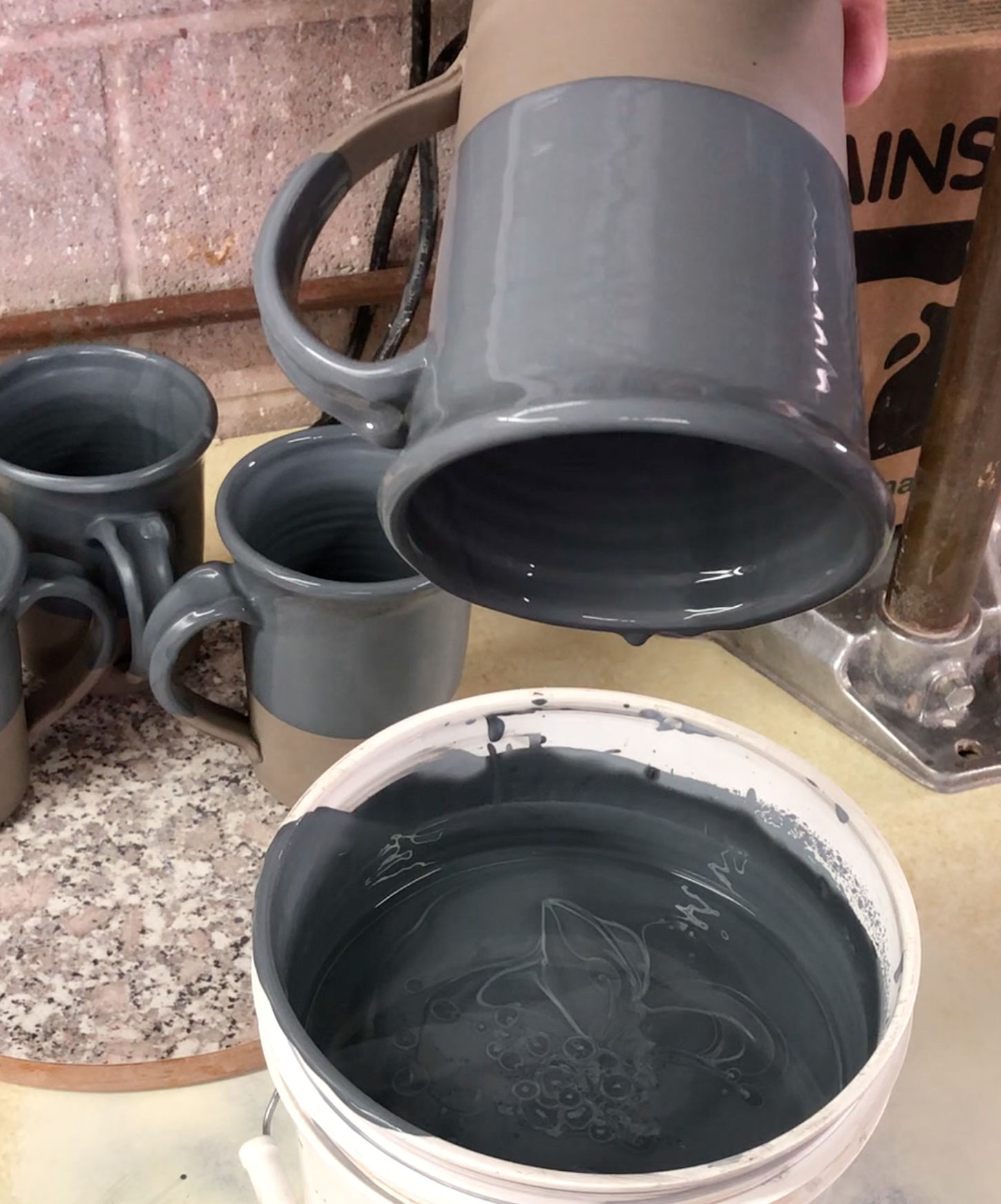
This picture has its own page with more detail, click here to see it.
Two things are happening simultaneously: The engobe is gelling and last few drips are falling away. I am rolling the mug just enough to encourage them (but so so much as to disrupt the gelling). Engobes are best applied to leather-hard ware and thus need to be thixotropic. The dipping process for each is to stir, pour-fill the mug, pour it out and push it upside down into the engobe. If I finish before the 10 second gel-time is up I get a perfectly even layer that does not move. Achieving this behaviour requires careful additions of Epsom salts. As the slip approaches the 10-second threshold even a slight bit more salts will turn it into a bucket of jelly (if that happens I add a drop or two of Darvan). This process works across a range of specific gravities (about 1.45-1.6), the higher the SG the trickier it is (but the faster it dries). I work at the low end, it’s easier..
Are dipping engobes useful? Incredibly. But the technical support that would be required to help customers learn the careful tuning of rheology is not something that any commercial glaze supplier would be prepared to do. No problem. DIY is the answer. This engobe is L3954B.
 PayPal | No tracking, No ads, No paywall, No transient content! Just organized, concise information constantly updated and improved. Was this helpful? Consider supporting me. |
Got a Question?
Buy me a coffee and we can talk 

https://digitalfire.com, All Rights Reserved
Privacy Policy