Crystalline glazes
A type of ceramic glaze made by potters. Giant multicolored crystals are grown on a super gloss low alumina high zinc glaze by controlling multiple holds and soaks during cooling in the kiln.
Key phrases linking here: crystalline glazes - Learn more
Details
Crystals can form during cooling and solidification in many kinds of glazes. They may be microscopic or very large, sparsely distributed or sufficiently numerous to cover the entire surface. Many matte glazes, especially calcium and zinc mattes, owe their surfaces partly or largely to networks of microscopic crystals. Unwanted crystallization in a glaze intended to remain glassy is commonly called devitrification.
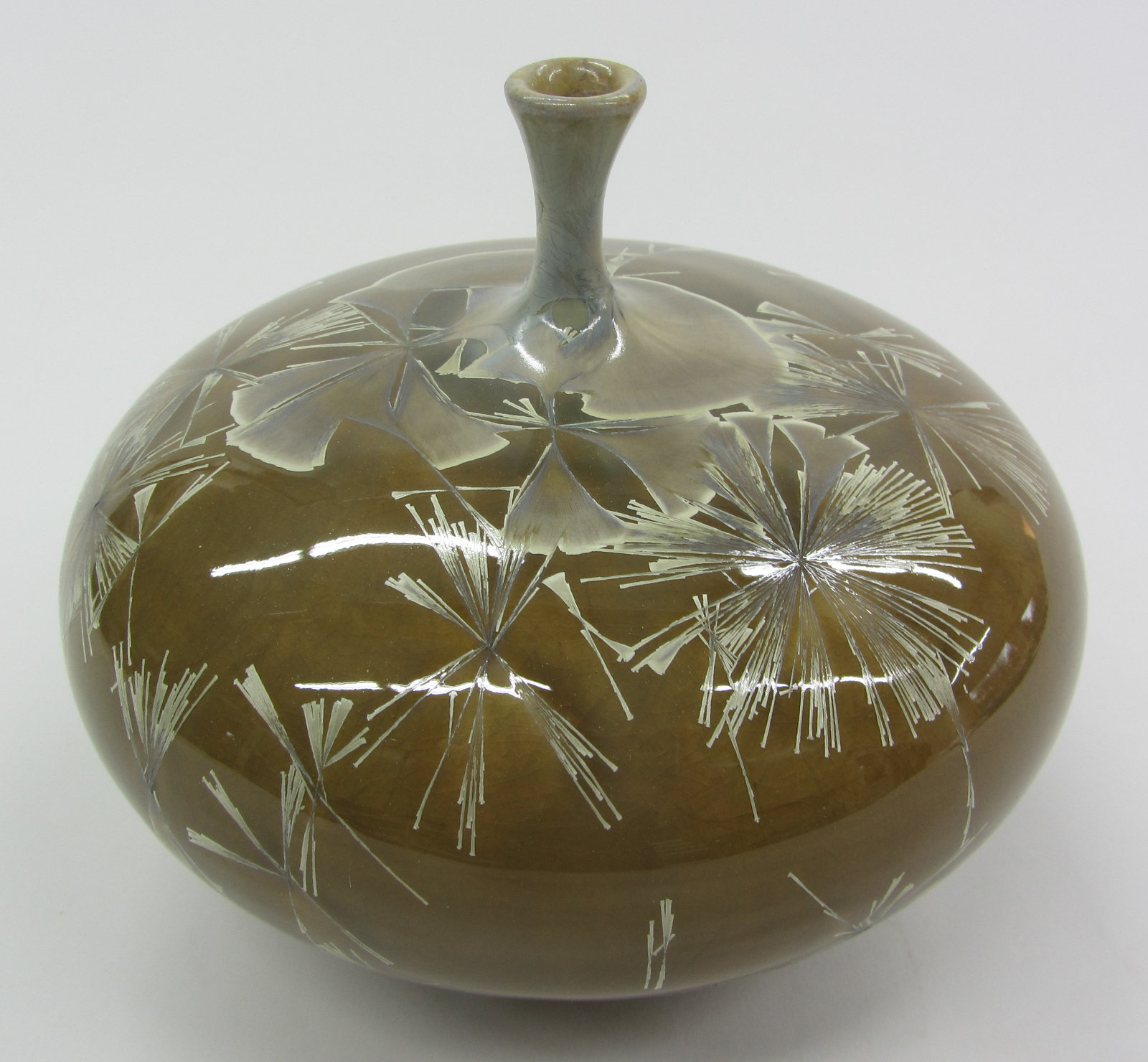
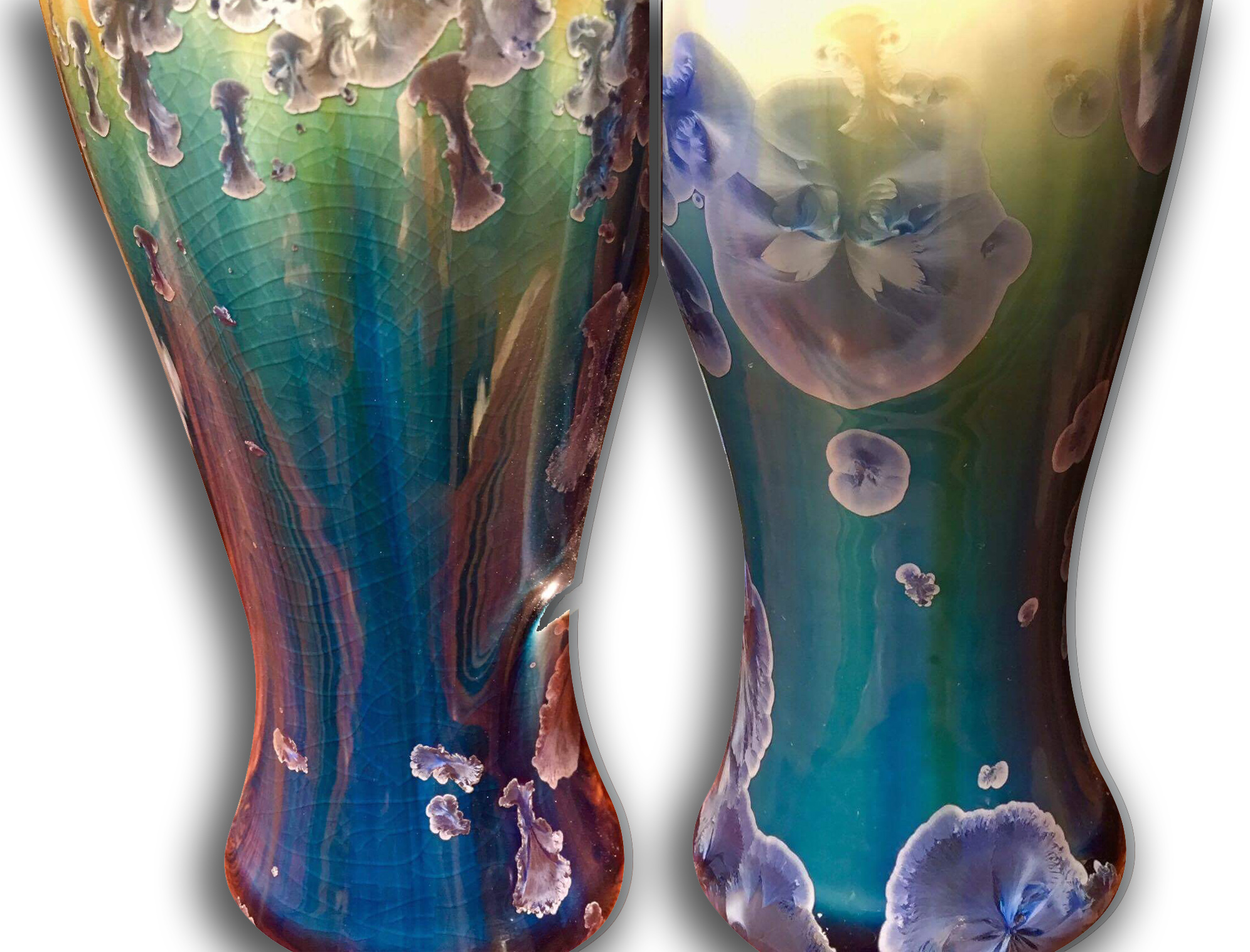
Crystalline glazed vase by Rod and Denyse Simair
This award-winning couple are-all in on crystal glazes. They have learned that success is about data. A lot of data. Thousands of pictures, hundreds of firing schedules, hundreds of recipes, endless notes all come together in the growth of crystals like these! Notice the clear background, no micro-crystals fogging it up. Notice that two fundamentally different types of crystals are being grown. Not to be ignored is the throwing skill it takes to make a porcelain piece like this, these are not small pieces.
The Chemistry: Macrocrystalline glazes normally contain very little Al2O3. Alumina stiffens a glaze melt and helps produce a stable glass network, whereas large crystals require sufficient melt mobility for crystal-forming ions to diffuse through the liquid and arrange themselves at a growing crystal surface. That being said, if melt mobility can be achieved with some Al2O3 present, crystal growth is also possible. These glazes normally contain a high concentration of ZnO together with sufficient SiO2 to form willemite. ZnO is not simply a catalyst or a material that creates nucleation points: zinc and silica are incorporated into the crystal itself. High ZnO also influences melting behavior and melt viscosity. Other oxides and mineral additions can affect nucleation, crystal morphology, color and the temperature range in which growth occurs. Titanium-bearing additions, for example, can promote nucleation under suitable conditions.
Melt Fluidity: The glaze must be fluid enough for diffusion and crystal growth, but not so fluid that all of it runs from the ware. This balance is difficult because compositions capable of growing spectacular crystals are commonly very mobile at peak temperature.
The Firing: It normally has three broad stages: melting, nucleation and crystal growth and rapid cooling. Melting is thorough because the glazes are fired high enough to make them very fluid, producing a relatively homogeneous liquid. The high melt fluidity enables firing rapidly to the peak temperature. Glazes prone to crystallization have a distinct "zone of crystallization" where willemite can nucleate and grow (e.g. 1900-2000F, although some sources quote the range as wider). Individual craftsmen distinguish their work by studying how specific glaze formulations, colorants and nucleating agents form crystals according to dwell times within this range. The best practitioners in this field do hundreds, even thousands of firings, carefully recording the schedules, recipes, procedures and pictures (an account at insight-live.com is excellent for this). After the desired growth period, the kiln is cooled more rapidly to reduce further crystallization and preserve the developed pattern.
Crystals and the Surrounding Glass: Most crystals are a different color than the surrounding glaze area (which is reduced in crystal-forming oxides and is thus a glass 'depletion zone'). Larger crystals grow at the expense of smaller ones in a 'survival of the largest' situation. The phenomenon can be considered a glass-ceramic composed of willemite crystals in a residual glass phase. Coloring materials tend to preferentially and selectively gather at one of these (one coloring oxide coloring the crystals, another the glassy areas).
The advent of hobby electronic kiln controllers and online communities has brought these glazes within the reach of thousands of potters worldwide. They are accurate enough to make results quite repeatable. That being said, electric kiln elements must be kept in good condition to ensure the kiln can follow the programmed schedule.
International exhibitions, books, online communities and generous information sharing have greatly increased the popularity and technical sophistication of this field.
Crystalline glazes need to be used on low-LOI bodies (ideally containing little or no ball clay), avoiding gas bubble production or body bloating.
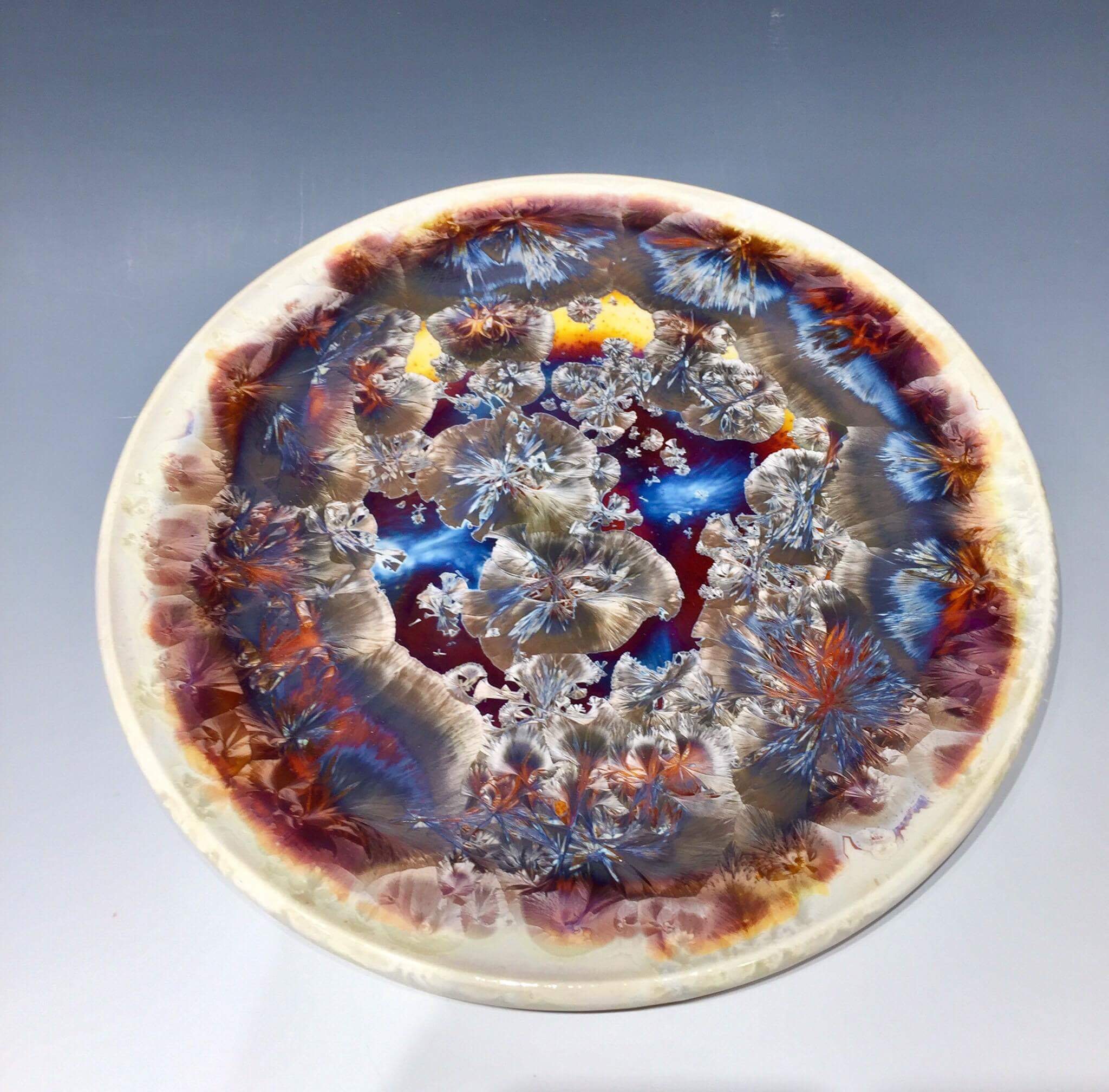
Crystalline plate made by Holly McKeen.
Notice the glaze is not crazing. That is because this is a high-silica porcelain.
The leachability of crystalline glazes used on food surfaces should be tested. They are flux-saturated, and the Al2O3, the very thing most needed to make a stable, durable glaze, is normally very low. Thus, by their very nature, they should leach and lack fired hardness. The tendency to craze noted above also affects food safety.
Because these glazes have very low (or zero) percentages of clay, the slurries do not suspend well in the bucket or harden well during drying. It is common to use CMC gum to improve hardening, but this produces sticky slurries that drip a lot during application and dry slowly. Bentonite additions of around 1-3% can suspend, harden and slow down drying. VeeGum has also been found to work well, but typically less than 1%. VeeGum has an added benefit, according to Holly McKeen. She observes: "Not only does it suspend better but than with CMC, the crystals got smaller and blander over time. A few times I applied from an old vs new batch - same formula, side by side, and the new was always best. Now, with VeeGum, no difference".
The firing schedules needed for this type of glaze put extra demands on the relays of electric kilns (especially hobby kilns). This is because schedules that hold or slowly decrease temperature need to switch relays much more often than with typical fast rises or drops. Special kilns, having heavier-duty relays, are available for crystalline glaze firing.
Even with catch plates, you will have accidents, where glazes run more than expected and get onto kiln shelves, so a good kiln wash is important. For smaller kilns, it may be practical to make your own shelves (we use calcined alumina, zircon or refractory kaolin/grog mixes for this). This can be a benefit since you can make them much thinner so there is less of a heat-dampening effect on the programmed firing schedule.
Related Information
Crystalline Glazes are a Triumph of DIY
And hard work, patience and good records
This picture has its own page with more detail, click here to see it.
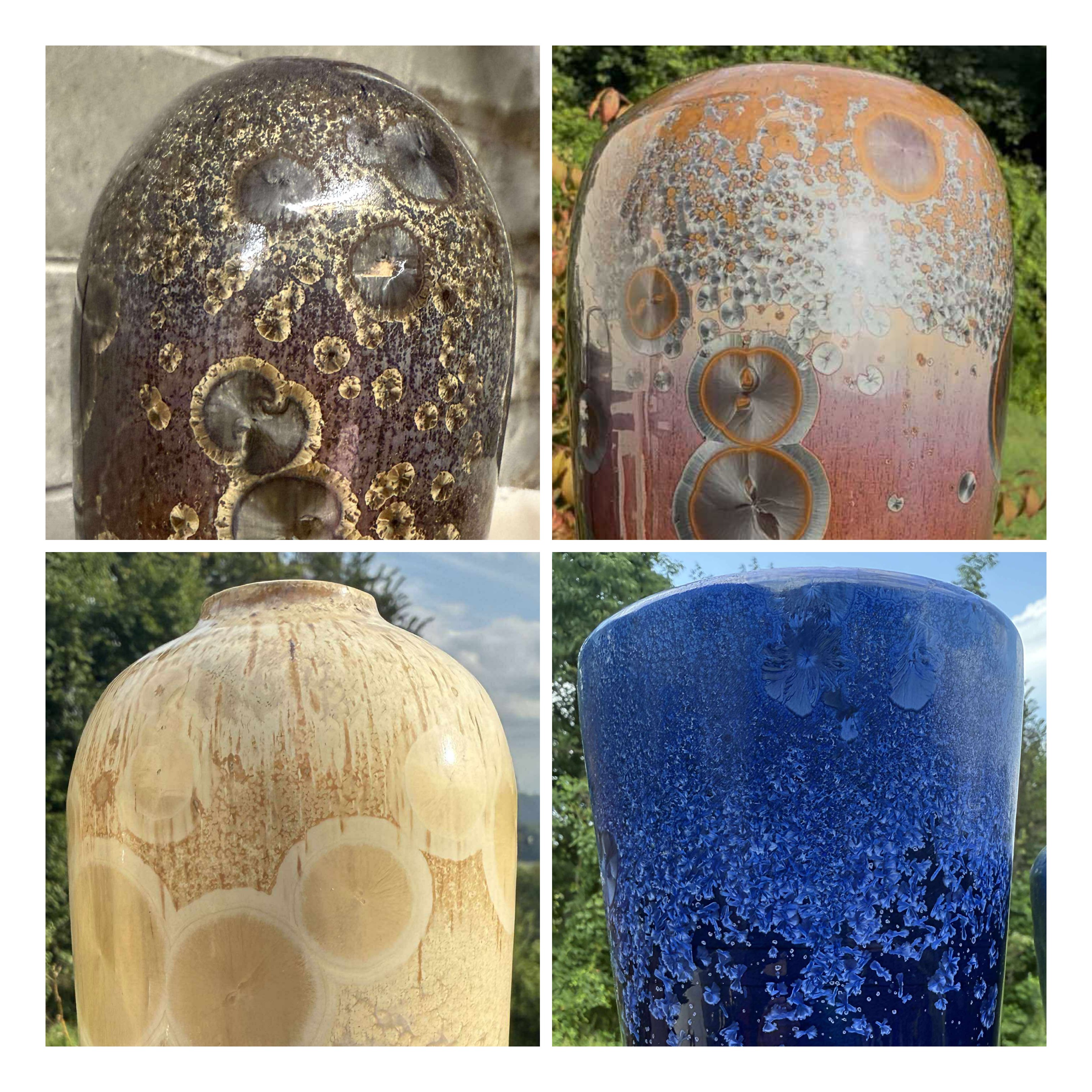
Michael Williams first applied his experience in tile-making to create crystal-glazed tile. After discovering little demand, he learned to throw and now makes these beautiful vases to showcase the magic. He explains the secret behind getting crystalline glazes something like this:
- Dozens and dozens of firings to figure out the ramps, temperatures and final temperature.
- Taking courses and absorbing as much as possible.
- Researching and frequenting places online, where people who know about this, are talking. This is where he finds the important things the courses leave out.
- Careful record-keeping that links details of crystal appearance with the glaze recipes, their chemistry and each ramp in the firing (other Insight-live users developing crystalline glazes are keeping track of hundreds of firing schedules and thousands of pictures that go with them!).
Michael sent the last picture (bottom right) as an example of one that is missing the final ramp in its firing (thus the fringes on the crystals). He even has a technique of etching the crystals using a powerful base (not an acid).
Crystalline glazed vase by Rod and Denyse Simair

This picture has its own page with more detail, click here to see it.
Internationally acclaimed ceramic artists Rod & Denyse Simair have represented Canada in major exhibitions in Europe and North America. They are the recipients of the highest international honour that has been awarded exclusively for Crystalline, Le Grand Prix du Jury, at Crystallines 2005 in France. The Simairs combine their talents with Rod's elegant and masterfully thrown original porcelain designs harmoniously brought to fruition through Denyse's personally researched, formulated and fired macro-crystalline glazes. They describe their pieces as "heirloom keepsakes of aesthetically inspiring ceramic art to cherish now and for generations to come".
Secret #1 of crystalline glazes:
The firing schedule

This picture has its own page with more detail, click here to see it.
The blue line is a crystal glaze firing schedule. While it reaches the same temperature as a typical glaze firing (purple line) it is different in how it does so. Notice key differences (while cone 10 is most common for this type of glaze, we will discuss theoretical differences in a cone 6 version):
-The steep climb: Crystallization needs a clean bubble-free melt, no lingering in temperature zones where they might start prematurely.
-The steep drop to 2000F: Crystals typically grow during a long soak in the 1900–2000°F nucleation zone.
-If the temperature is simply held steady at 1950°F only one type and size of crystal would form, likely smaller and crowding out others. The ups and downs are about manipulating the thermodynamics and kinetics of crystal formation — nudging new crystals to form or existing ones to grow differently.
-Cooling and then raising the temperature in the nucleation zone can re-dissolve smaller crystals or unstable nuclei. Then, cooling again encourages new crystal nucleation, rejuvenates existing ones or even changes the pattern of their growth.
-In the upper range of the nucleation zone, faster diffusion produces larger, more spread-out crystals. In the lower range, slower diffusion produces smaller, tighter crystals or detail-rich growth.
-Crash-cool to finish: Drop melt viscosity quickly to halt all crystal formation - this preserves a clean background and prevents blurring of crystal edges.
Crystalline firings are about precision and timing: Get in fast, melt everything, play within the range where crystals want to grow to get the type, distribution and size you want - and then get out. It is not difficult to see why crystal glazers may do thousands of test firings to discover the curve that produces what they want. The nucleation zone depends on firing temperature and glaze chemistry, testing is likewise required to discover it. Meticulous record keeping is critical to success; not surprisingly, many crystal glazes do it in an account at insight-live.com.
Secret #2 of crystalline glazes:
The chemistry

This picture has its own page with more detail, click here to see it.
Close-up of a crystalline glaze. These crystals grow because both the glaze chemistry and the firing schedule have been tuned specifically to make that happen. The melt must be very fluid, so they contain lots of flux and very little Al2O3 (since alumina stiffens the melt and inhibits crystal growth). They also contain lots of ZnO and enough SiO2 to form zinc-silicate crystals. Since clays and feldspars contribute alumina, crystalline recipes use very little of either, relying on frits and other low-alumina materials.
This is very much DIY territory. You test, adjust, document and repeat. The best crystalline glaze people often do hundreds of firings to dial in a recipe and firing schedule.
Secret #3 of crystalline glazes:
They run. A glaze catcher is needed.
This picture has its own page with more detail, click here to see it.
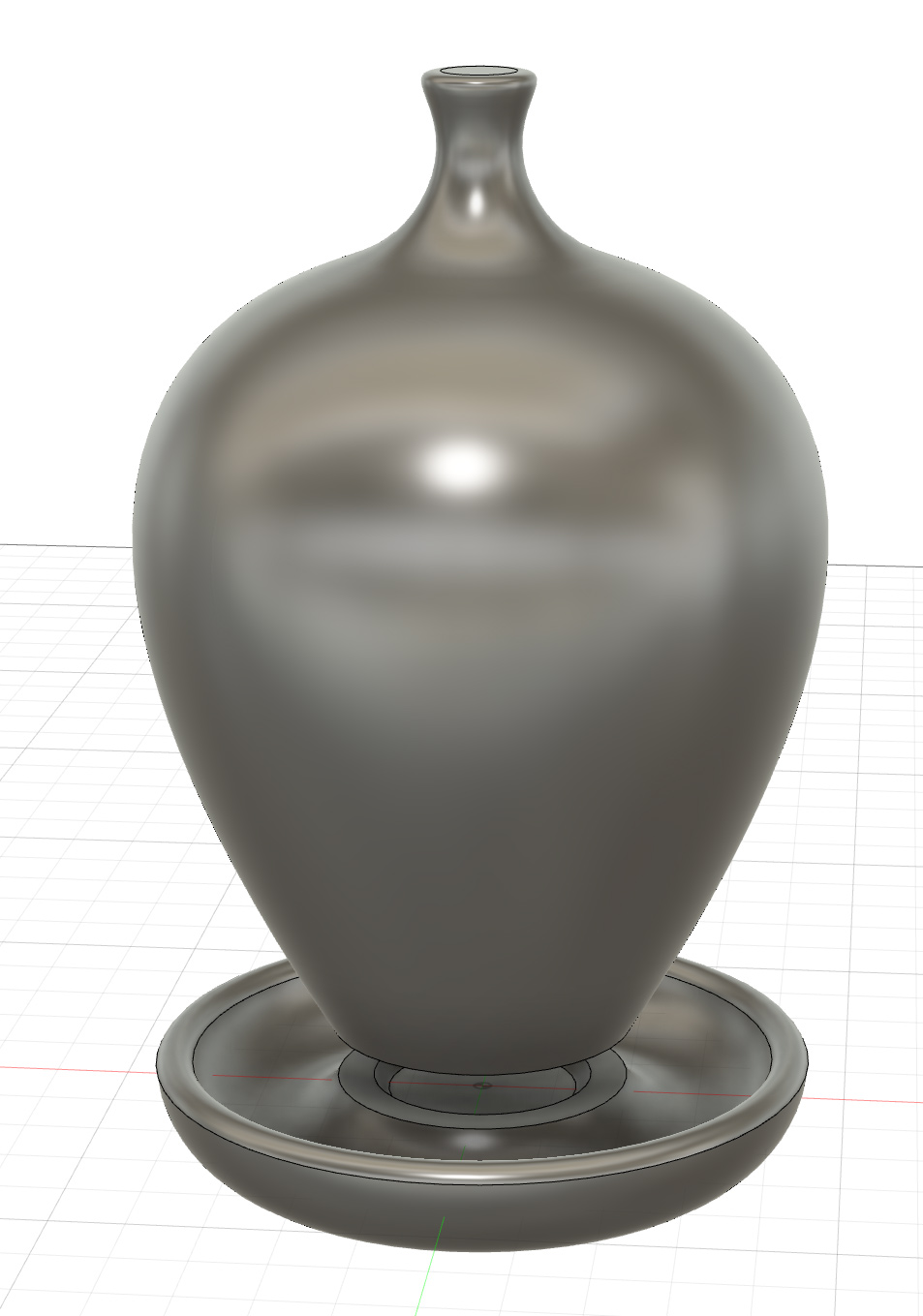
Crystalline glazes are highly melt-fluid by necessity. On first seeing this, typical potters are horrified at how runny they really are. How is it possible to even use them? By making glaze catchers, custom-sized to match the base of each piece. A calcined alumina or kiln wash paste (made using CMC gum or other binder) is applied to the base of the piece so that it does not stick to the catcher. After firing the catcher is broken off and the remaining sharp glaze edges are ground off.
Secret #4 of crystalline glazes:
They contain little clay. So without help, they don't suspend or harden on drying.

This picture has its own page with more detail, click here to see it.
Potters used to working with dipping glazes that contain plenty of clay are shocked when they see what crystal glazers have to work with: Slurries that contain very little clay because the Al2O3 contributed impedes crystal growth. They end up with dipping glazes conditioned with gum and bentonite that are bummers to work with. But here is a way to mix as a gelled brushing glaze that works surprisingly well. This requires two gums. Let's mix 500ml.
Step 1: Blender-mix 340g of the glaze recipe powder into 440g water. We now have a watery slurry that settles in seconds.
Step 2: Thoroughly blender-mix 5g of CMC powder into it. We now have a slow-drying but thin slurry.
Step 3: Blender-mix in, on high speed, 6g of VeeGum. Slowly add it. We now have a gelled slurry that will stay in suspension. And paint well with a fan brush.
Full gel might not kick in until aging it overnight. Of course, if it overgels for you, then use less VeeGum the next time. Why not add the gums together or the VeeGum first? Agglomerates will form, and even the blender can't remove them.
Secret #5 of crystalline glazes:
They craze. But there is a way to fix that
This picture has its own page with more detail, click here to see it.
The mug on the left, made by Holly McKeen, is a typical cone 10 Grolleg kaolin mullite porcelain (highly vitrified, low in residual quartz). Its glaze is crazed. Crystalline glazes are high in Na2O, making crazing virtually certain. Since most pieces are decorative, crystal glazers just accept this as part of the process. But these are functional mugs, the glaze needs to fit (if only for ware strength).
But what if the thermal expansion of the body could be significantly raised? The body on the right is Crystal Ice, it contains 40% silica (vs 20-25% in a typical porcelain). The percentage of Nepheline has been reduced, lowering vitrification to about 1.5% porosity. As a result, more quartz survives undissolved and less mullite develops, raising the body’s thermal expansion. The result is a body with a much higher thermal expansion, so it can not only relieve the glaze tension but actually put a squeeze on it. There is a downside: These are less resistant to dunting and thermal shock failure during use.
Could the glaze be adjusted instead? Yes. Some of the Na2O could be substituted for Li2O, the latter is also a strong melter but has a much lower thermal expansion. Glaze chemistry could be used to source it from Spodumene (to avoid solubility issues with lithium carbonate). However, zinc-silicate crystalline glazes are very sensitive systems, so the more lithia is introduced the more likely the effect on the firing window, crystal size/density and background clarity.
Trap a crystalline using a catcher glaze.
Stop the crazing using a custom body.

This picture has its own page with more detail, click here to see it.
This small vase was quick-cooled so crystals did not grow. But it was fired to the full temperature and held to give the glaze opportunity to run as much as possible. But no "glaze catcher" was needed because I used a "catcher glaze" instead. The upper has a typical high-zinc and high-sodium fritted crystalline glaze. The lower half is just a functional melt-stable cone 6 transparent, G2926B, (having the same amount of cobalt). Notice how it arrests the flow of the runny one.
There is more to this vase than meets the eye. It was slip cast from my L3802F DIY casting porcelain. That body has much more silica than is typical, which raises the thermal expansion of the body enough to stop the crazing (crystalline glazes have high Na2O so they are guaranteed to craze on normal porcelains).
Raw and calcined zinc oxides in a crystalline glaze

This picture has its own page with more detail, click here to see it.
Zinc oxide calcined (left) and raw (right) in typical crystalline glaze base (G2902B has 25% zinc) on typical cone 6 white stoneware body. This has been normally cooled to prevent crystal development. The melting pattern is identical. Note how badly these are crazed, this is common since crystalline glazes are normally high in sodium.
Inbound Photo Links
 Serious cracking in a crystalline-glazed P700 Grolleg porcelain. Why? |
Links
| Glossary |
Glass vs. Crystalline
In ceramics, understanding the difference between what a glass and crystal are provides the basis for understanding the physical presence of glazes and clay bodies. |
| Glossary |
Phase Separation
Phase separation in glaze melts creates microscopic discontinuities that affect transparency, color variegation, matte surfaces, and reactive glaze effects. |
| Glossary |
Crystallization
Ceramic glazes form crystals on cooling if the chemistry is right and the rate of cool is slow enough to permit molecular movement to the preferred orientation. |
| Glossary |
Metallic Glazes
Non-functional ceramic glazes having very high percentages of metallic oxides/carbonates (manganese, copper, cobalt, chrome). |
| Glossary |
Firing Schedule
Designing a good kiln firing schedule for your ware is a very important, and often overlooked factor for obtained successful firings. |
| Glossary |
Ceramic Glaze
Ceramic glazes are glasses that have been adjusted to work on and with the clay body they are applied to. |
| Oxides | ZnO - Zinc Oxide |
| Oxides | Al2O3 - Aluminum Oxide, Alumina |
| Properties | Glaze Variegation |
| Properties | Glaze Crystallization |
| URLs |
http://www.tiltonpottery.com
The Awesome Crystalline Glaze Gallery of Tilton Pottery |
| URLs |
http://www.puttgarden.com/crystal/Page-crystal.htm
Comprehensive crystal glaze links page: Phil Hamlin |
| URLs |
http://www.puttgarden.com/crystal/tech/page.html
Crystal glazes technical information links from Phil Hamlin |
| URLs |
https://www.amazon.ca/Crystalline-Glazes-Understanding-Process-Materials/dp/1490396357
Crystalline Glazes: Understanding the Process and Materials Get this 2013 book on Amazon.com, all aspects of developing, mixing, coloring, applying and firing to maximize the beauty of these glazes are covered in detail. |
| URLs |
https://www.facebook.com/reel/1716320922906216
Incredible crystal glazed vase in sunlight - by Richard Bideau |
| Firing Schedules |
Cone 6 Crystal Glaze Plainsman
Five-Step firing with no holds |
| Materials |
Zinc Oxide
A pure source of ZnO for ceramic glazes, it is 100% pure with no LOI. |
| Typecodes |
Crystalline Glaze Recipes Fara Shimbo
These are from Fara's Crystal Glazes books 1 and 2. Most are the frit 3110, zinc, silica base recipe (50:25:25) with small material additions at the expense of silica. |
 PayPal | No tracking, No ads, No paywall, No transient content! Just organized, concise information constantly updated and improved. Was this helpful? Consider supporting me. |
| By Tony Hansen Follow me on        |  |
Got a Question?
Buy me a coffee and we can talk 

https://digitalfire.com, All Rights Reserved
Privacy Policy